
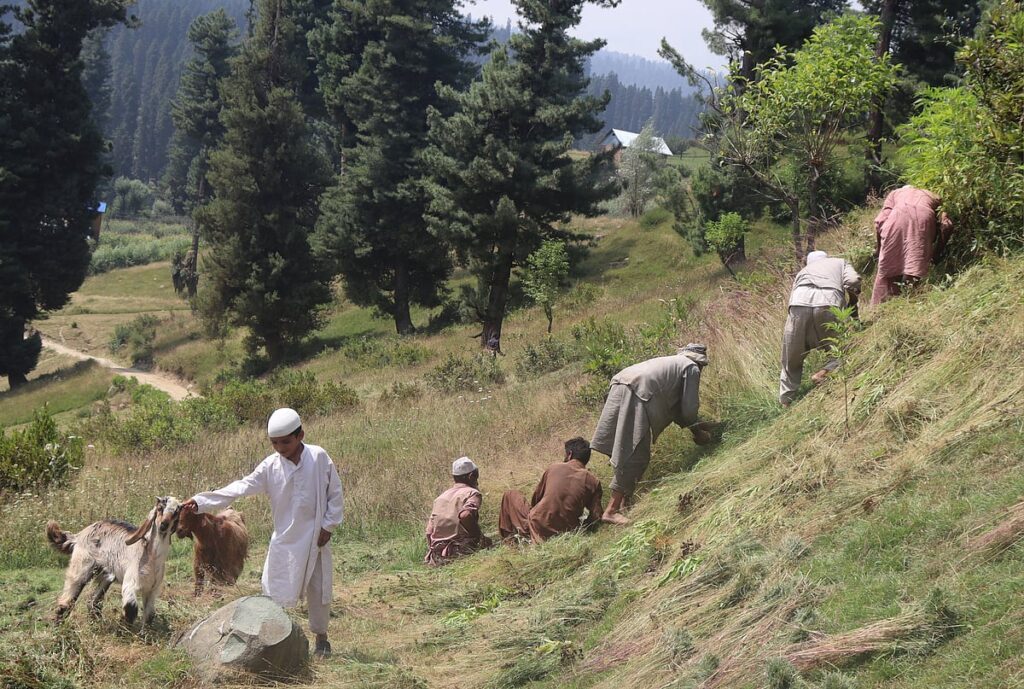
On the Karewas — elevated plateaus near Newa and Parigam in Kashmir — Papa Khan, 70, and his wife Kokla Begum, 60, have been living with around 19 families for the past two years.
“Less snowfall has allowed us to live here,” Kokla Begum said. “I love Kashmir. There is enough grazing land for our livestock.”
Her son-in-law, Mukhtar Ahmad, described an arrangement that has quietly become common: Bakarwal families pitching their tents within apple orchards through the winter months, keeping watch over the trees and protecting fruit stores against theft or damage, in exchange for shelter and permission to graze their animals.
According to veteran tribal researcher Javaid Rahi, this is a form of improvised adaptation — nomadic communities inserting themselves into the valley’s agricultural economy to survive a season they once avoided. Similar informal winter settlements can be found in Dhara Harwan in Srinagar, and in Imam Sahib, Shopian, Chotipora, Shirmal, Hawl and Tral in Pulwama and Shopian districts.
Naseeb Ali, a 40-year-old shepherd, sets out the economic reality. The annual migration — hiring trucks to transport families, livestock and belongings across the mountains, along with food and fodder costs — can cost around Rs 40,000.
“That money, we can use here to buy feed for our livestock and food for ourselves and just stay. Why take the risk of the road?” he said.
The risks of staying, however, remain. In January this year, around eight Bakarwal families in Pulwama’s Abhama area were trapped by sudden overnight snowfall and had to be rescued by locals and Jammu and Kashmir Police.
Fazal Hussain, 35, one of those rescued, said his family had stayed through winter for two years. “The snow was less than usual, but suddenly one night heavy snowfall hit and we were trapped,” he said. Their young livestock also perished.
These decisions are shaped by lived experience — the observation that winters have grown milder and grasslands remain accessible for longer. But such experience cannot always account for sudden extreme weather events, which climate change is making more frequent.
The IPCC AR6 Synthesis Report (2023) notes that every 0.5°C increase in global warming leads to measurable rises in the frequency and intensity of extreme weather events.