
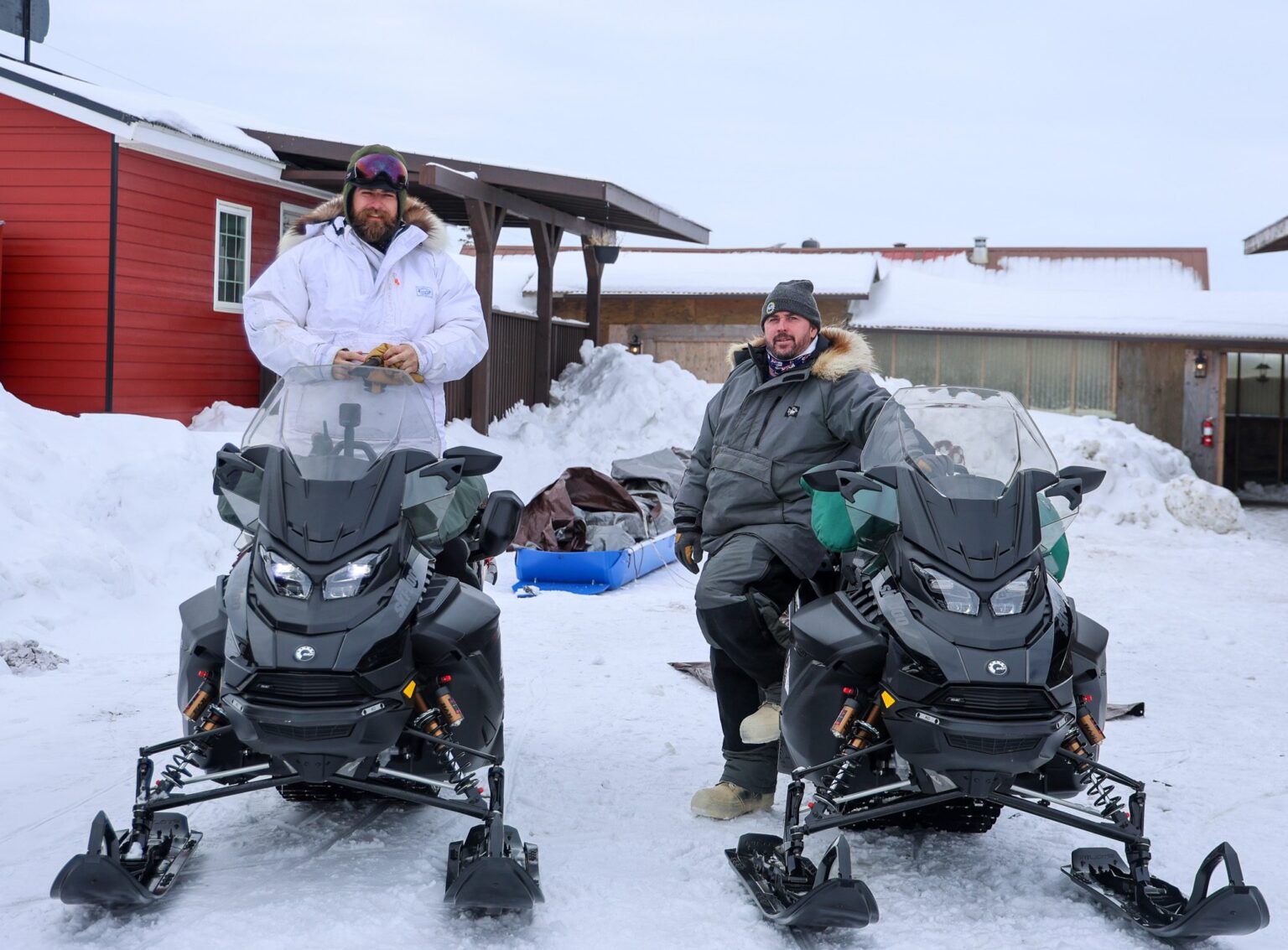
Two University of Alaska Fairbanks researchers completed a 1,986-mile journey along Alaska’s western coastline by snowmachine on Thursday. The expedition studied how the Arctic is changing and how those changes are reshaping life in coastal communities.
Inside a warm cabin in Nome, about halfway through their journey from Bethel to Utqiaġvik, Benjamin Jones was preparing for the next leg of a research expedition called COAST-X 2026. Outside, two snowmachine sleds were packed with about a week’s worth of food and gallons of fuel.
The pair said they finalized plans for this expedition about a year ago. It is a collaboration with UAF’s ACTION Project, which aims to address the science of a changing Arctic environment.
The Arctic is warming about four times faster than the rest of the world. There are commonalities in the coastal hazards communities in Alaska are experiencing due to climate change, such as erosion, storm flooding and permafrost thaw.
“They are right on the coast, so it’s flooded there a lot,” Wilson said. “So if they have a flood, there’s nowhere to go, and that’s not the same as other places. So similar issues and similar overall things, but different solutions and different things they are interested in in each spot.”
The expedition came just months after ex-typhoon Halong hit the Yukon-Kuskokwim Delta this fall, washing away infrastructure and devastating many communities with high water and severe wind. Typhoon Merbok also hit the Bering Sea region a little over two years ago.
Jones said remnants of those storms are still visible in the driftwood lines marking high water and in coastal bluff and riverbank erosion, and the stories are fresh on people’s minds.
“It makes the conversations, unfortunately, really easy,” Jones said. “Because it’s a bad situation, these big fall storms that are happening more recently.”
Climate change impacts have led several villages in western Alaska, including Shishmaref on the Seward Peninsula, to seek full relocation. Jones said his team would not advise communities on whether or not to move.
“But, what we can do is collect data,” Jones said. “To help figure out how much effort it might be to stay and shelter in place. Or if you do want to move to a new location, we can start studying that area, and then look at the permafrost properties, and reconstruct the erosion and the flooding history.”
The pair arrived in Utqiaġvik after 19 days on the trail. From there, they will head back to Fairbanks to process their data and people’s stories. Jones said he hopes they will be back next year to repeat the route and continue the conversations they started.