
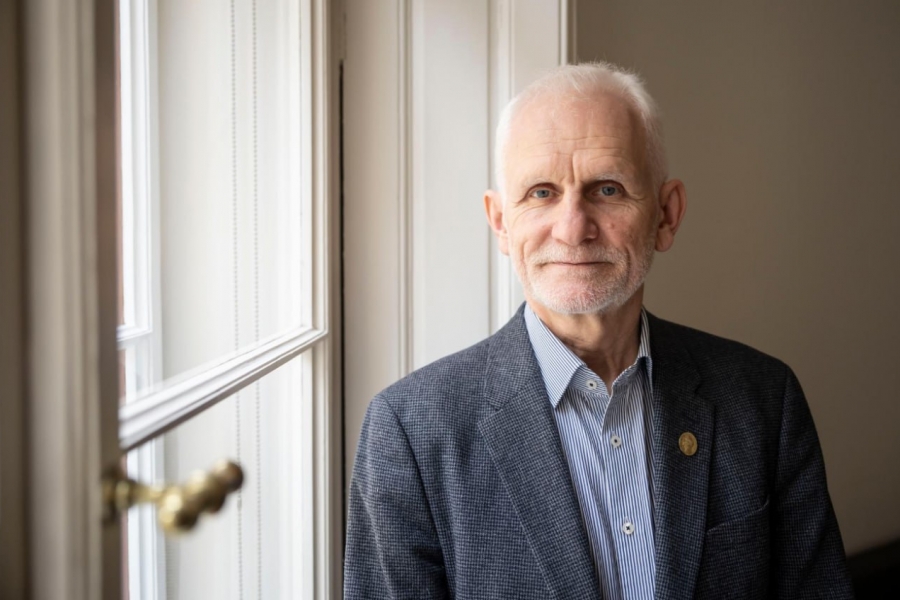
— In Belarus, chats for relatives of prisoners have been designated “extremist formations.” Can it be said that the authorities are deliberately expanding repressions, targeting not only activists but also ordinary people? Is this a calculated move by the authorities or a manifestation of a peculiar sadism?
Ales Bialiatski noted that the repressive mechanisms launched after 2020 are gradually expanding and covering ever new groups of people.
“These are the repressive mechanisms that were primarily aimed at activists. But gradually, this circle of repression is spreading,” he said.
According to him, now even those who have nothing to do with politics are falling under pressure – including people who simply exchange information.
“They have already started to involve seemingly apolitical things – associations of people, information platforms where people exchange information. For example, chats for relatives of prisoners, where they discuss the most elementary things: what to pass on, how to get to the colony. And suddenly they were made extremist,” Bialiatski noted.
The human rights activist added that similar logic could extend to other ordinary communities.
“What could be next there – one can only guess. These could be school chats, or apartment building chats,” he remarked.
He also drew attention to the fact that the very concept of “extremism” is significantly diluted in Belarus and is becoming increasingly broad, as a result of which an increasing number of people are effectively falling into the category of potential “extremists.”
“The authorities are trying to isolate people, to make them interact with each other as little as possible, creating a situation of complete control over society,” Bialiatski believes.
“Controlled Chaos and the Spread of Fear”
Can it be said that such actions by the authorities deliberately foster an atmosphere of fear and complete uncertainty in society, where people don’t know what exactly might lead to repression? And is there a chance that society will eventually realize that this threat concerns everyone, even those who believe they “did nothing”?
According to Bialiatski, this is precisely what the authoritarian system seeks to achieve.
“Such seemingly irrational attacks on a broad community of people create a sense of fear in society, tension, uncertainty – what will happen, what can be done, what cannot be done. This is what any authoritarian system aims for, when a person does not know what might happen to them tomorrow. In our situation, one can only recall Stalinist times, when such a state was also created, when it was unclear who would fall under repression and how it would all happen,” he said.
At the same time, Bialiatski emphasized that direct comparisons with Stalinist times are not entirely correct. He noted that history usually does not repeat itself: although sometimes events may look similar, they still happen differently. Therefore, according to him, it is not entirely correct to compare the repressions of the 1930s, when people died by the thousands, and modern repressions.
“Nevertheless, for today’s level of civilizational development in Europe – and Belarus is part of Europe – this is nonsense. It causes great indignation, because there is nothing like it anywhere on the European continent,” Bialiatski observed.
He once again noted that the situation in Belarus does not repeat the past and that today there are significantly more opportunities to influence society – including through independent media and social networks, which continue to operate in the country. The human rights activist added that this is also facilitated by the state of Belarusian society itself, which has become more educated and more pro-European than in previous periods.
“The authorities are trying to curb this element, which is clearly hostile to them and does not perceive them as a legitimate government. And these repressions are the only means of preserving power today. Otherwise, this government would have long ceased to exist, because any more or less fair elections would have led to its change,” Bialiatski emphasized.
Павялічыць
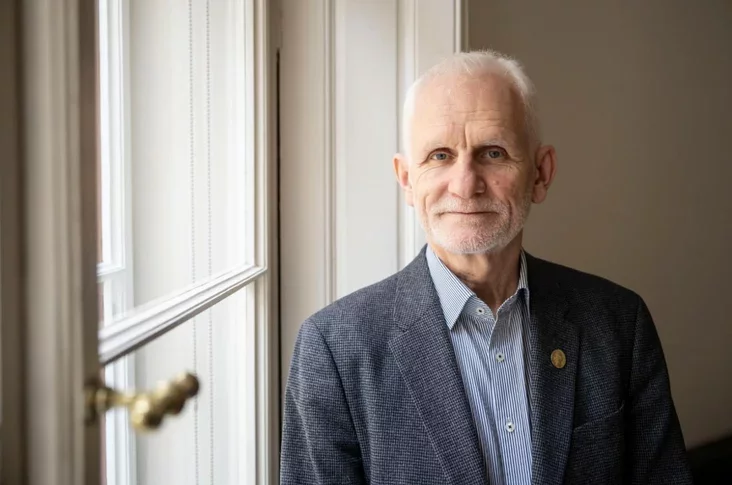
Photo: “Viasna” Telegram channel
He also noted that the demand for independent information does not disappear, but rather increases – especially in crisis moments.
“And this is unequivocally true. Even from my speeches and interviews that I give abroad, I receive a wave of feedback – it is clear that it all works. Therefore, we are not working in vain. We are not working for ourselves, the opposition is not working for the opposition – this must be clearly understood,” said the human rights activist.
“All Belarus is a Large Prison”
Are European countries formulating their policy correctly regarding Alexander Lukashenka’s regime — particularly through sanctions and pressure? Should this approach be strengthened, or, conversely, should avenues for negotiations be sought?
Bialiatski noted that the European Union’s position regarding Belarus currently remains consistent – all sanction pressure, introduced partly for the regime’s participation in the war and mass human rights violations, is maintained. At the same time, according to him, the situation in the world is changing, and the Belarusian agenda is gradually fading into the background.
“Certainly, one must consider that history moves forward, one event gives way to another. We have seen war near us for the fifth year already, we see new conflicts unfolding in the world. And these events push our problems into the background,” Bialiatski noted.
He emphasized that in this situation, it is important to constantly remind about the situation in Belarus and draw attention to the fact that it has not changed. According to him, human rights activists continue to record new human rights violations daily, and the scale of repressions remains significant.
“Despite what seem like good news, that I have been released, my friends have been released, we must not forget that according to ‘Viasna’s’ lists alone, 913 people remain political prisoners. And other violations are taking place that restrict freedom and prevent people from breathing freely,” he noted.
Павялічыць
In this regard, according to Bialiatski, it is necessary to continue speaking about Belarus at the international level so that it remains on the agenda of European politicians and international organizations. He emphasized that for this, it is important to voice facts and do so openly, noting that, unfortunately, there is sufficient evidence of violations in Belarus.
“Nevertheless, some good news still emerged, and I very much hope that this process of releasing political prisoners will continue – as American diplomats plan. That subsequent groups will be released and, perhaps, in the coming months, all political prisoners will be released, at least those who are currently imprisoned. Because now the process looks like this: some are released, others are imprisoned. Therefore, of course, we must strive for an end to repressions, an end to this repressive mechanism,” he said.
At the same time, Bialiatski noted with irony that the process of releasing political prisoners often looks like a peculiar trade: according to him, some were allegedly “exchanged” for potash fertilizers, and others for airplanes.
“On the other hand, if you trade with terrorists and negotiate with them, you also give them something in exchange for hostages. Our prisoners are essentially captives, hostages of this regime, and they must be freed. Even if it’s by such means, this process is ongoing, and thank God,” the human rights activist believes.
At the same time, Bialiatski noted that, despite individual releases of political prisoners, the overall situation in the country has not fundamentally changed:
“Essentially, nothing has changed. The country remained suppressed as it was. I have heard many times from people: all Belarus is one big prison. We sit in a small prison, and the whole country is a large prison.”
He added that without external pressure, no changes can be expected, and that nothing but economic and political pressure can force the authorities to release people.
“We are essentially a colonial country”
— Can it be said that Western economic sanctions, on the one hand, strengthen Belarus’s dependence on Russia, and on the other hand, worsen the human rights situation? And in such circumstances, what is more important for the country’s future — pressure on the regime or maintaining greater independence?
Bialiatski believes that the issue of Belarus’s dependence on Russia has no simple solution: according to him, Lukashenka has his own line in relations with Moscow, which external players practically do not influence. He emphasized that agreements with Russia are being fulfilled, and this directly affects the state of Belarusian independence.
“We are essentially a colonial country today, having neither our own separate military policy nor our own economic policy. We are strongly ideologically dependent on Russia. We see what is happening now – this Russification is underway, and very actively recently. And Lukashenka approves these processes. For cheap oil, as they say, there’s no such thing as a free lunch – and for such a price, he is effectively selling the Belarusian soul. And this is a huge threat to our future, to the future of the entire Belarusian people,” said the Nobel laureate.
At the same time, he noted that he currently does not see an immediate threat of Belarus joining the war, although in 2022, in the first months of the full-scale aggression, the situation was much more dangerous and unpredictable. According to him, there were real risks then that Russia would be able to subjugate Ukraine and turn it into another colonial state, but these plans met with resolute resistance from Ukrainian society.
Павялічыць
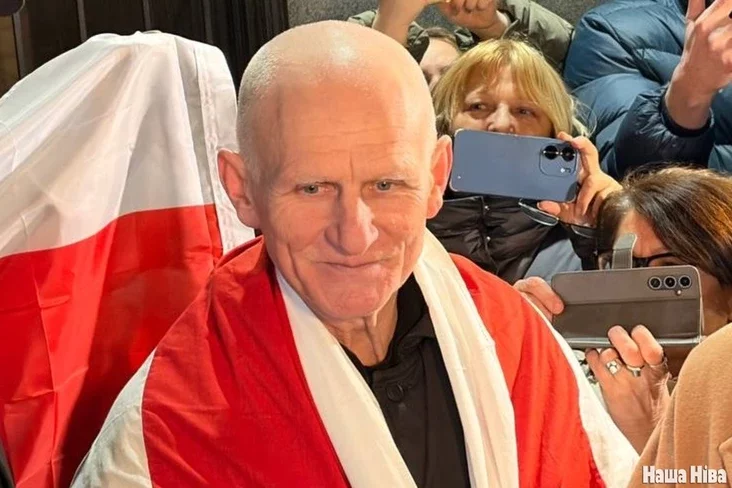
Ales Bialiatski on the porch of the US Embassy in Vilnius after his release from the colony. December 13, 2025
“It seems to me that now the Belarusian authorities understand a certain gamble, but they cannot simply back away from it. Because there are agreements, there are political promises, and there are also obligations that Lukashenka undertook in 2020 when he remained in power. We understand that if there had been no support from Putin, the history of Belarus would have gone in a completely different direction, and now he is forced to pay for it – including with the country’s independence. But, thank God, for now, he is not crossing this last line and not fully involving Belarus in the war. Therefore, I think the threat exists, but today it is smaller than in 2022,” Bialiatski believes.
Commenting on potential threats related to the deployment of nuclear weapons in Belarus, hybrid attacks, and the use of uncontrolled migration, Bialiatski noted that this is part of Russia’s general policy aimed at destabilizing the situation near the EU borders.
“All of this is Russia’s general policy: to destabilize the stable situation near the EU borders, including through the deployment of nuclear weapons. It generally covers all of Europe. The Belarusian issue becomes a problem for the entire European continent, and this truly strains all of Europe,” he emphasized.
Concluding the conversation, Bialiatski answered the question of how Belarusians can preserve themselves in the current situation.
“We wait, we gather strength. We await the next wave of activity and opportunities, because it will undoubtedly come – just as it did in 2020. It will repeat itself. We just need to take into account the negative experience, take with us all the best, and achieve qualitative changes in Belarus. How and when this will happen – no one knows. Therefore, we must gather strength and continue to work,” summarized the Nobel laureate.