
As winegrower pilot programs press for investments in artificial intelligence technology, wine experts say small businesses soon may not be able to keep up in a struggling industry facing the pressure to adopt rapid change.
Sonoma County Winegrowers has the Farm of the Future initiative to support countywide sustainable farming efforts. Several pilot projects already underway involve new technology to address water conservation practices as well as improvements to vine and soil health, the use of fertilizers or pest control. While some farmers and educators have reported early signs of success, they have expressed skepticism over the pressure to incorporate artificial intelligence into their industry. Concerns include accuracy and the expense, especially for small winegrowers.
Proponents of the tech point to examples such as John Deere’s Smart Apply tractor technology that uses sensors and algorithms to predict foliage on grape canopies, and help wine grape growers maximize their yield. Karissa Kruse, president and CEO of Sonoma Winegrowers, said these are exciting advancements to help improve prospects in an industry where some producers are removing vines.
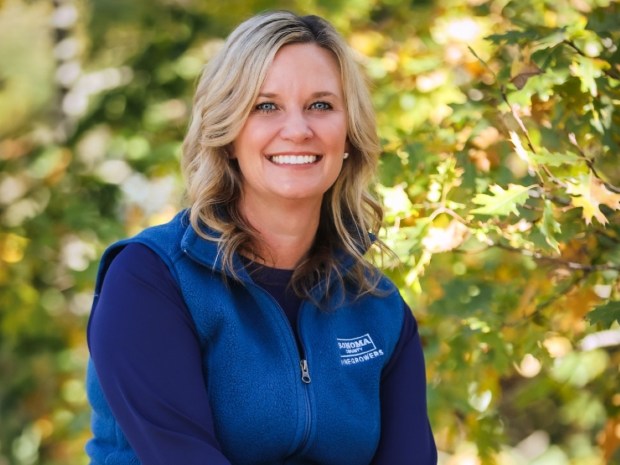 Karissa Kruse, CEO and president of the Sonoma County Winegrowers. (Provided photo)
Kruse noted the opening of a group of startups in April focused on farm robotics and different applications of AI. Reservoir Farms is set to open at the Winegrowers office off Guerneville Road near Santa Rosa, saying it intends to take lessons from Silicon Valley and apply them to winegrowing operations. It will feature fabrication facilities, an engineering workshop and 14 acres of managed vineyard test blocks where robotics startups and ag companies can work together to explore and develop technologies. Cropmind Inc. and Budbreak Innovations committed to the program in January.
Danny Bernstein, Reservoir Farms founder and CEO, said in an interview the idea for the company grew from his time in Silicon Valley, where, he said, “We found there were gaps in how startups were really reaching growers.” Bernstein previously held executive roles at Google and Microsoft and now runs Reservoir as three venture capital investments, saying he intends to spend the next few years exploring how AI can address winegrowers’ needs.
“We’re envisioning Sonoma as the epicenter for viticulture ag tech,” Bernstein said. “We’re in the process of entering a phase when AI will have an impact on farms. It’s an opportunity for cybernetic hardware to make an impact on sustainability.”
However, farmers and educators say while they are excited about some Farm of the Future initiatives, they’re not sold on centering AI in California’s famed Wine Country.
Angelo Camillo, a professor of wine business at Sonoma State University, said that small, family-owned operations account for about 80% of the wine business in America, and don’t usually have the money to invest in AI.
Camillo, who is also editor-in-chief of the Wine Business Journal and chair of the American Culinary Federation’s San Francisco chapter, said that’s a problem because the push for AI use has expanded so rapidly that “we’re at the point of no return. There is no going back.” Some local wineries have moved to AI for the majority or nearly 100% of all operations, such as Napa winery Palmaz, where vineyard conditions are controlled by satellites to determine harvesting, and where the grapes are being handled by robots.
Camillo said the use of “cobots” is rapidly advancing as another method of replacing manual labor and cutting costs. He said over time, such automation technologies will gradually replace laboratories and other longstanding processes that vineyards enlist as part of the winemaking process.
Camillo said the rapid expansion of automation is complex, in part because “the entire AI industry is so fragmented that no one owns anything.” There are legal questions to consider about using technology to replace workers, including over-regulation, he said. In the rush to adopt, small winegrowers will struggle to keep up or will lose their business, he added.
“These are investors with millions of dollars who came here and found a niche market,” Camillo said. “But it is very expensive. Those who cannot afford it will be left behind. So what’s going to happen to them?”
The industry will also fundamentally change as technology changes and as winegrowers already facing labor shortages are forced to find workers trained in using AI. Educators are not able to train industry newcomers quickly enough. “We just can’t catch up with that,” he said.
Camillo acknowledged AI data centers can be an environmental strain. Some farmers have rejected offers to buy their land for data centers, which can drain local water supplies, strain power grids and contaminate soil and affect wildlife habitats. Forbes reported in 2023, U.S. data centers consumed an estimated 17 billion gallons of water, according to the Energy Department and Lawrence Berkeley National Laboratory. A large data center can require roughly 300,000 gallons of water per day and hyperscale facilities may consume between 16 billion and 33 billion gallons annually by 2028.
-
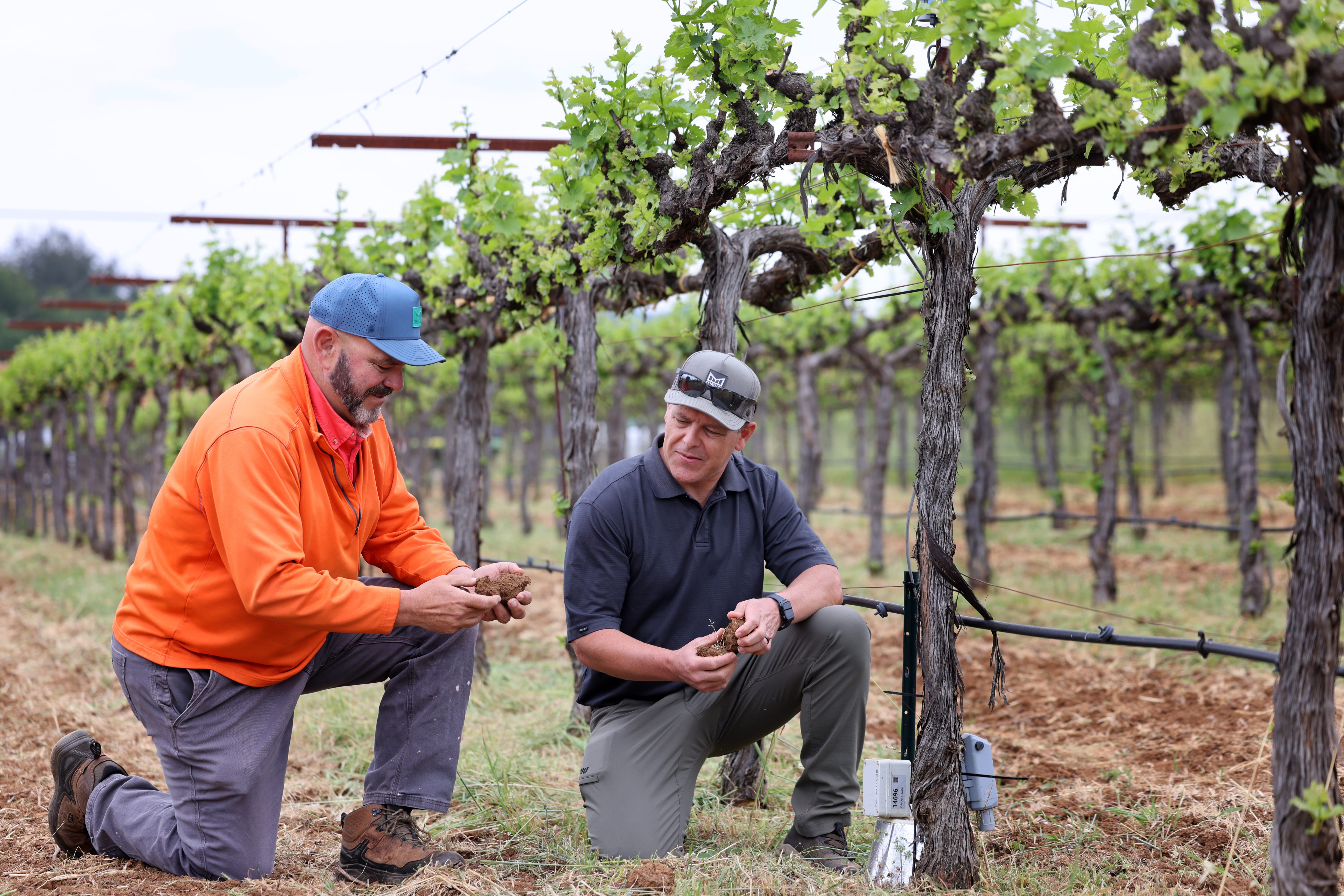
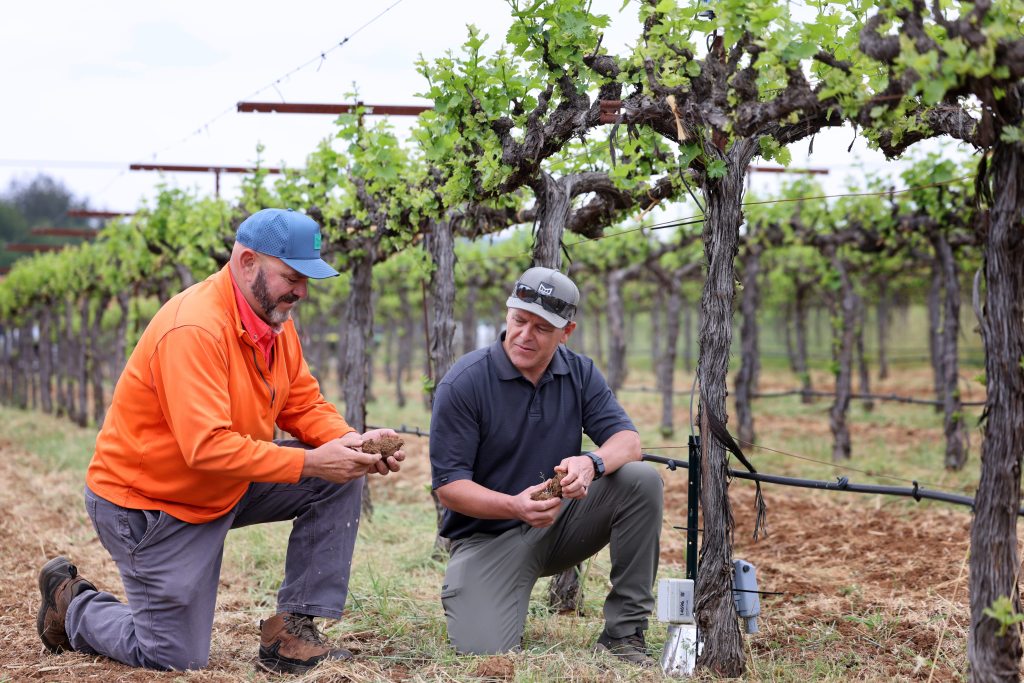
Armon Azevedo and Dan Ivaldi, crop advisors from Wilbur-Ellis, are using Agrology’s Arbiter Carbon Monitoring System to monitor real-time microbial respiration, soil health and canopy conditions in the vineyards at Shone Farm in Forestville Monday, March 30, 2026. (Beth Schlanker / The Press Democrat)

1 of 3
Armon Azevedo and Dan Ivaldi, crop advisors from Wilbur-Ellis, are using Agrology’s Arbiter Carbon Monitoring System to monitor real-time microbial respiration, soil health and canopy conditions in the vineyards at Shone Farm in Forestville Monday, March 30, 2026. (Beth Schlanker / The Press Democrat)
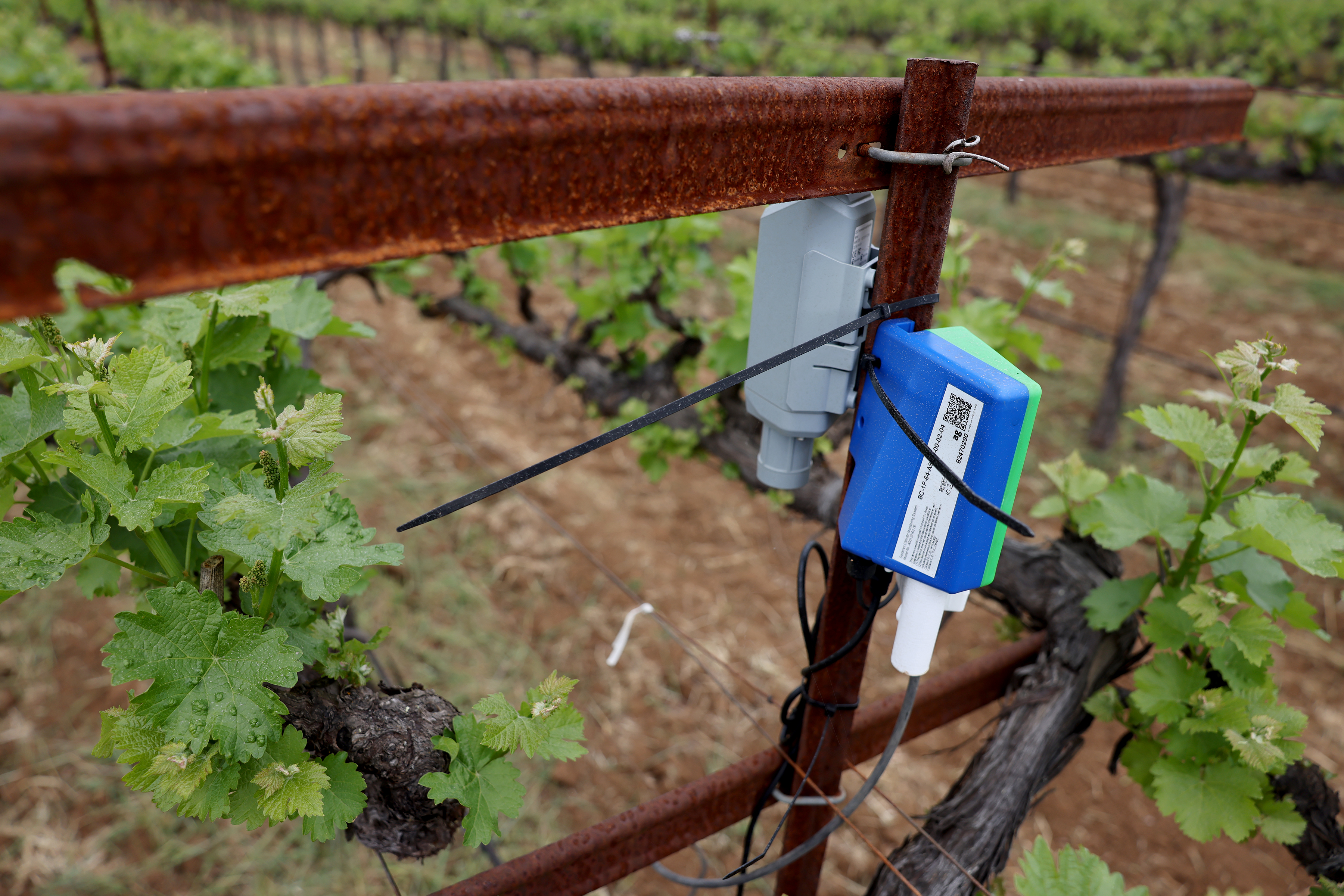
Ahead of AI’s advancement into the valley, some farmers who worked with Farm of the Future reported success using other programs. Several vineyards worked with Wilbur-Ellis and Agrology, using Agrology’s soil sensors designed to measure soil moisture and respiration — how much carbon dioxide is released from soil — and to monitor microbial biomass carbon levels analyzed in soil samples to assess soil productivity and health. They said these pilot programs are being conducted without AI features.
Agrology founder Adam Koeppel said the sensors can help farmers understand how to cut water use while optimizing photosynthesis in order to grow more fruit and maintain healthy vines.
They saw interesting results when using the sensors at various vineyards across Sonoma and Napa counties, including vineyards where no tilling is performed to retain over 50% more soil moisture. “One study found 16,000 gallons of water per acre saved per growing season,” said Dana Revallo, head of Agrology’s custom success department. However, those vineyards had smaller grape yields than tilled fields, he said.
That kind of data analysis will help in the face of climate change, particularly as heat waves hit the North Bay and affect growers. Revallo said Agrology can assist in a number of ways such as showing growers the rate of infiltration, or how quickly water moves through the soil between vines.
“We don’t want to tell anybody how to grow their wine,” Koeppel said. “All we want to do is give them more data so they can inform their decisions. It’s giving them a holistic picture of the health of the soil and of the vines in real time.”
Some farmers are entering a third year of using Agrology, such as Wilbur-Ellis viticulturists Armon Azevedo and Nick Claussen. Azevedo said Agrology’s sensors helped show how different soil types can respond to different management styles.
The team said they appreciated what the sensors offer for their vineyard management, and have mixed feelings about turning to AI tech. They said that growers are working hard to maintain a legacy of farming, including the Munselle family, which has been farming in the valley for nearly 150 years.
Claussen said he believes in “boots on the ground” farming, saying those who have farmed for decades know that AI cannot replace human expertise.
“No level of technology will ever replace the need for boots on the ground,” he said. “I think we have a need for limiting errors, and technology can reduce errors made in a field. We just don’t know how to use it to the best of our ability.”
Azevedo said it’s possible that some day AI can make decisions that combined experience currently can, but that hasn’t happened yet. Reservoir’s strategy presents a chance to test and “fact check” tech on the ground, which he said is helpful for now.
“I use it as an aggregator of information and to summarize so I can make a decision,” Azevedo said.
“We’ve seen it all the time, where you go all in on a piece of technology … and there’s a lot of money being thrown at things and sometimes it’s not ready for primetime,” he added. “You have to weigh that with experience. Some of the most intelligent people we’ve worked with … know just from looking at the vines and soil when to do certain practices. Saying, ‘we’re going to farm based only on this piece of technology and data,’ it typically doesn’t end well. You have to include that human element.”
Tyler Klick, partner and viticulturist at Redwood Empire Vineyard Management, agreed with Agrology’s assessment of the data gathered at his vineyards. He said it has been the first time his team has been able to gather data on soil respiration relating to soil health and farm production practices.
Klick said he appreciates Agrology since the sensors’ data can be accessed and read on his phone, while he walks the vineyards on foot to assess vine and soil conditions. He said that while he has been researching whether technology using AI can work for his site, he is skeptical about the current options and their varying levels of accuracy.
“Currently, AI is too expensive to implement,” he said. “It’s an added cost to our farm budget, without improving yield (or) reducing my farming costs. It’s very difficult to find the return on investment to justify it.”
However, he said “If there’s some way where AI and automation could reduce costs in some areas, I think most of us would agree we’re open to that. It’s about, how can we integrate it in a useful way? If we fast forward 10 years from now, I think we will see integration at some level.”