
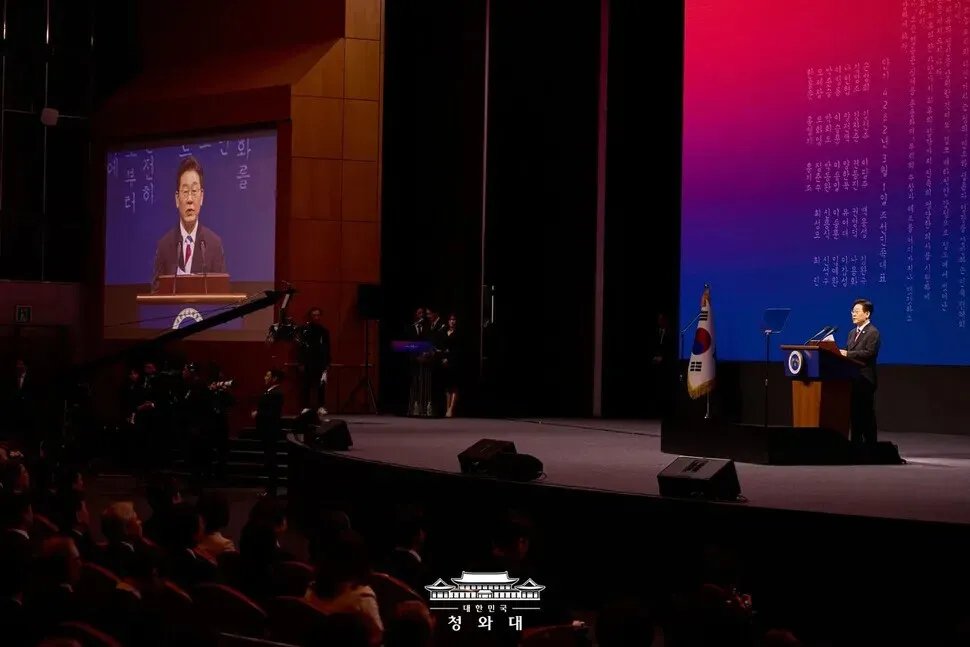
President Lee Jae Myung of South Korea delivers a commemorative address for the 107th anniversary of the March 1 Independence Movement on March 1, 2026. (courtesy Blue House)
Inter-Korean relations remain at a frustrating impasse. Amid the Middle East crisis set off by the US and Israel’s bombing of Iran, instability is growing on the Korean Peninsula as well.
What can Korean President Lee Jae Myung do to achieve a breakthrough?
What I propose is for Lee to make a “special declaration” communicating a major change in thinking.
The only Korean president who has unveiled a vision for inter-Korean relations in the form of a special declaration is Roh Tae-woo, with his Special Presidential Declaration for National Self-esteem, Unification and Prosperity on July 7, 1988.
This declaration sought to end the history of conflict between South and North Korea and push the two sides down the road toward reconciliation, exchange, cooperation, peaceful coexistence and unification.
It’s no exaggeration to say that Roh’s special declaration was the model for the South-North Basic Agreement reached three years later.
However, the death knell has sounded for the “special interim relationship stemming from the process towards unification” outlined in Roh’s declaration and in the 1991 accord reached by the two sides.
Thus, we find ourselves at a crossroads. Should we cleave to the old system, or should we seek a new approach?
At the moment, Pyongyang is determined to cut off all ties with the ROK, which Seoul maintains is impossible.
What this tells us is that a change-oriented approach is essential. Without that, no proposal we offer the DPRK is likely to be effective.
That’s why I’m hoping for a special presidential declaration — the first in 38 years, and only the second in Korean history.
The need for such a declaration can be found in the structural shift surrounding the Korean Peninsula, the most marked of which concerns the changes within the DPRK itself.
While we’ve been focused on its nuclear program and missiles, its insistence on labeling us south of the DMZ a “hostile state,” and the possibility of Kim Ju-ae’s succession, the DPRK has already beaten us to the chase by acknowledging the ROK as an independent state.
Starting in July 2023, it swapped out its conventional nomenclature of “south Korea” (“nam Choson”) for “Republic of Korea,” South Korea’s official name. Since June 2025, the country has abstained from using derogatory phrases like “puppets” or “things” when describing South Korea.
In recent years, clauses related to plans for reunification through prompting a socialist revolution in the South have been removed from the rules of the Workers’ Party of Korea, the supreme law of the land in the DPRK.
We will have to wait and see if the DPRK cements the inter-Korean relationship as one between two hostile states in its Constitution, but any way you slice it, it is becoming clear that two distinct and recognized states currently coexist on the Korean Peninsula.
Another factor we should consider is that, regarding peninsular issues, inter-Korean relations now carry nearly as much power to shape outcomes as that of US-DPRK relations. Not only that, but we’re actually seeing a decoupling of US-DPRK relations from inter-Korean relations.
This is evident in how the push for preemptive strikes against the DPRK has disappeared in the US, how Washington and Pyongyang can engage in direct communication without using South Korea as a mediator, and how the DPRK is exploring the possibility of peaceful coexistence with the US while regarding the ROK — rather than the US — as its “principal enemy.”
This shift presents both challenges and opportunities for us. How we respond to the DPRK’s two-state policy is a core part of the challenge, along with knowing that improvements in US-DPRK relations will not automatically ease tensions between the two Koreas.
On the other hand, the opportunity lies in the fact that the DPRK’s recognition of the ROK as a sovereign state carries the potential to address the root causes of the threat of war that has loomed over the peninsula for the past 70 years and pave the way for peaceful coexistence.
Instead of taking DPRK’s policy of abandoning unification as something regretful, we must focus on the potential for peace inherent in its position that it will not attempt a “communist reunification” or “unification by force.”
Because inter-Korean relations now carry greater weight, the potential benefits of our policy choices have increased. This means that we hold in our own hands the power to resolve a significant share of the challenges before us.
What issues, then, should the president’s special declaration address? At its core, the message must be one of pursuing two peaceable states. Given that countless experts, the media, and even the Unification Ministry have all said as much, one could be forgiven for thinking there is nothing remotely new here.
But that would be misguided, as the pursuit of two peaceful states on the Korean Peninsula has not yet been adopted officially by the ROK government, and there are a number of elements that remain at odds with this principle.
While the DPRK revised its party rules in 2021, discussions in the ROK regarding the revision or abolition of the National Security Act have been absent from political discourse since at least 2004.
The plans for a wartime armed reunification scenario involving occupying the DPRK, waiting for stabilization, and achieving unification, which were incorporated in the ROK/US Combined Forces Command’s operations plans and in joint drills in the 1990s, remain in place to this day.
The existence of the “Chungmu Plan,” which states that sudden changes in North Korea would prompt unification through absorption, and the Committee for the Five North Korean Provinces, which denies the DPRK’s statehood, also prove this point.
Seoul also continues to call the country “North Korea” (bukhan), which implies that it is part of the ROK. Article 3 of the ROK Constitution, which states that the “territory of the Republic of Korea shall consist of the Korean Peninsula and its adjacent islands,” has not been changed for nearly 80 years, and has been left out of countless discussions on constitutional amendments
We have been so fixated on the idea that we won the ideological war and must remake “North Korea” through contact, engagement, and aid that we have largely overlooked the need for us ourselves to make changes.
As such, if Lee does issue a special declaration, I can only hope that it acknowledges the reality we find ourselves in while also reflecting the courage and foresight needed to open a new chapter in inter-Korean relations and peace on the Korean Peninsula.
First, I suggest that he states our respect for the DPRK’s “sovereignty,” instead of merely expressing our respect for its “system.” I make this proposal as respect for a country’s sovereignty is the fundamental spirit of the UN Charter and the ideal of peaceful coexistence. By doing so, I would like to see the abolition of the National Security Act and the overhaul of the Committee for the Five North Korean Provinces into a support office for those who have been displaced due to the division of Korea.
The president should also show his unequivocal commitment to the principle of not pursuing unification through absorption. The key to this is to scrap the Chungmu Plan and do away with the section in Part 2 of the ROK-US Combined Forces Command’s operations plan and joint exercises for a wartime reunification of Korea scenario.
While this may be a difficult topic to tackle right away, I also suggest opening the floor to debate on the use of the DPRK’s official name and the revision of the territorial clause in the Constitution. I also propose initiating talks for peace negotiations between the ROK, the DPRK, the US, and China, with the goal of finalizing a peace treaty within Lee’s term.
You may ask, what about denuclearization? But we’d do well to avoid raising that point. It would be better in many respects to replace any statements on that issue with the sentiment that we will strive to achieve a Korean Peninsula, and indeed a world, which is free of nuclear threats and nuclear weapons.
You’ll notice that I also haven’t mentioned “unification,” but I believe it will be more than enough to state that our only goal is to achieve peaceful unification in the long term and commit to steadily laying the groundwork for achieving that.
Thus, the pursuit of two peaceful states must be built on three pillars: substantive measures to recognize the DPRK as a state, complete disavowal of unification through absorption, and the pursuit of a peace treaty that will transform the armistice into a state of peace within Lee Jae Myung’s term.
Of course, robust national security must undergird this pursuit. For this to happen, we will need to redefine the scope of South Korea’s national defense to only include the area south of the Military Demarcation Line and establish the principle of being exclusively defense-oriented, meaning that force is only used to counter an attack — not to launch one.
This is how we can aim for peaceful coexistence on the Korean Peninsula while also pursuing self-reliant national defense.
All these issues could spark intense controversy. However, as the number of Koreans who recognize the DPRK as a sovereign state continues to increase and unification through peace is enshrined in the Constitution, it should be possible to build a national consensus on effectively ruling out the possibility of unification through absorption.
Controversy over the abolition of the National Security Act could subside if we emphasize the principle of reciprocity. As the US is reportedly also eager to revise operational plans and retool joint military exercises, this is an issue that can be discussed between Seoul and Washington. Also noteworthy is US President Donald Trump’s interest in the Korean War.
Amending the territorial clause of the Constitution is an act that will require sufficient public debate. Furthermore, rather than including all the aforementioned points in the special presidential declaration, it would be wise to proceed with feasible steps, one at a time, and make the declaration after June’s local elections.
Of course, one may ask whether the DPRK will actually reciprocate if we shift courts. One thing we need to remember is that Pyongyang believes that Seoul cannot change and is therefore set on ensuring that inter-Korea relations remain hostile. Conversely, this means that change within the ROK is the best method to elicit a response from the DPRK.
After several other colleagues and I shouted “Go DPRK!” as we cheered on the DPRK’s women’s soccer team at a match against China in Australia on March 9, the DPRK players waved and greeted us after the match. While this may strike many as trivial, I believe that this shows how changing our own ways can help pave the way for engaging with others.
By Cheong Wook-Sik, director of the Hankyoreh Peace Institute and director of the Peace Network
Please direct questions or comments to [english@hani.co.kr]