
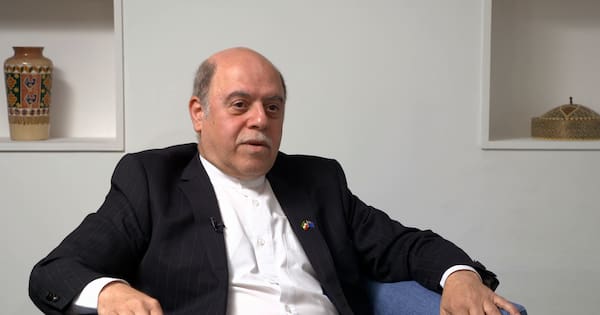
Iran’s ambassador in Wellington says New Zealand’s failure to condemn the US and Israeli strikes on Iran will be interpreted as tacit support for the attacks, warning the relationship between the two nations has shifted.
In an interview with Q+A, Iranian ambassador Reza Nazar Ahari said New Zealand’s diplomatic “quietness” had damaged the relationship between the two nations.
Ahari said the world had shifted from a “rule of law” to a “rule of the jungle”, where nations had given themselves the right to attack others without authorisation.
“A country like United States have made a military attack on Iran, and it is very clear that it is contrary to all international regulations, but New Zealand has not condemned that.
“Then that kind of quietness means that support. In Iranian culture, in many cases, quiet means positive reply,” he said.
Peace talks today between the US and Iran in Pakistan resulted in no new agreement, after weeks of strikes on Iran and the Islamic Republic’s retaliatory attacks. A recently agreed upon two-week ceasefire in the war appears fragile.
“We learned the whole world is experiencing a very profound change at the international level. Somehow the world is transferring from a world of rule of law to the rule of the jungle,” the ambassador told Q+A.
Netanyahu vows to finish operations against Hezbollah, through war if need be. (Source: 1News)
Ahari suggested New Zealand had once been seen as a pioneering country for peace, but over the past five years, Iran’s view on that had changed.
“In the last maybe five years, I don’t know, it is not categorised at that country,” he said. “New Zealand is more supportive — is considered as more supportive to the unilateral approach.”
A Foreign Affairs and Trade Ministry (MFAT) spokesperson rejected the assertion, saying New Zealand regularly stood up for international law as a core part of its foreign policy.
Strait of Hormuz
Asked why New Zealand’s economy should be punished through restricted oil supplies when it had no warning of the US-led strikes, Ahari said Iran had the right to control the Strait of Hormuz as its territorial waters were being used to threaten its security.
“It is a wartime situation,” he said. “When your security are being threatened from that point, you have right to make control over that.”
Foreign Minister Wiston Peters says announcements from the US and Iran are encouraging. (Source: 1News)
He said US attacks had created a new awareness that the strait should be a focus for Iran, signalling future security arrangements with Oman and other Gulf states.
“Otherwise, if a country who has attacked you, and formally and officially has stated that, ‘we want to destroy you … we want to topple your government’ — it cannot be tolerated to be at the same situation until now. From now on — no,” Ahari said.
Asked if there was any future in which Iran would allow freedom of navigation without tolls, he said: “Let these negotiations happen, and they are going to decide on that.”
Human rights record
Interviewer Jack Tame challenged the ambassador on Iran’s human rights record, citing a UN report that documented a crackdown on journalists, human rights workers, and ethnic and religious minorities including Kurds, Arabs, and Bahá’í communities.
The report also recorded a concerning increase in state executions.
Ahari questioned the credibility of the report, but acknowledged he had previously said there had been some “shortcomings” from the Iranian government.
Tehran’s retaliations have struck throughout the Gulf and closed the Strait of Hormuz. (Source: 1News)
Activists claim as many as 30,000 people were killed by a government crackdown on protests in Iran in January. The Iranian government’s only statement on the issue was a claim issued on January 21 that said 3117 people were killed.
NZ ‘stands up for international law’ – MFAT
When asked about calls from some Iranian New Zealanders for his expulsion, Ahari said it was “up to New Zealand”.
US President Donald Trump said NATO nations had “gone out of their way not to help” in the Iran conflict. (Source: Reuters)
“If New Zealand wants to deprive itself from the link with that important area, important, also, countries for New Zealand like Afghanistan, Türkiye, Central Asia, Caucasus, Arab countries, Persian Gulf, it’s up to New Zealand,” he said.
“Iran in the Middle East is an important player, as you have seen, and even from now on, maybe much more important than before.”
Speaking to Q+A before the talks with the US started, Ahari also used the interview to call on the New Zealand Government to explicitly back the inclusion of Lebanon in the ceasefire negotiations.
Ahari said he remained pessimistic the talks would proceed smoothly given the pattern of previous rounds, but said endorsing a Lebanese ceasefire “will be a good move for succeeding [in] this round of process”.
An MFAT spokesperson told Q+A on Friday: “Just today, New Zealand has signed onto a joint leaders’ statement with Australia, the UK and other world leaders which calls on all sides to implement the ceasefire, including in Lebanon.
Associated Press correspondent Isabel Debre explains what could happen if Iran agree to a deal to open the crucial strait or make peace. (Source: Breakfast)
“This reflects our alarm about the ongoing conflict in Lebanon and the need to stop the fighting.”
They added: “We strongly reject the assertion that New Zealand does not stand up assertively for international law.
“Our record shows that we regularly stand up for international law as a core part of New Zealand’s foreign policy, which is reflected in our approach on conflicts.”
Additional reporting by the Associated Press
Q+A with Jack Tame is made with the support of New Zealand On Air