
My brother Robin has a superpower he never asked for.
He almost never blinks.
Parkinson’s disease does that. It steals the small, involuntary things first — the natural rhythm of eyelids, the easy swing of arms while walking, the face’s instinct to move when the heart does. Robin was diagnosed about 15 years ago. He spent more than 30 years as a Southern Baptist preacher before deciding to stop late last year.

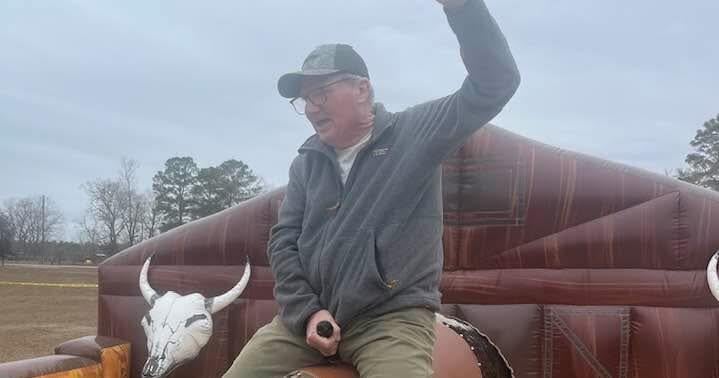
In March on his way to New Orleans, Robin Risher, aka Brother Blink, made a stop by Southern Boyz Outdoors in Hammond, Louisiana.
Provided photo
Though Parkinson’s has affected his cadence, about a year before he stopped preaching, he appeared on a podcast called Hayden Alabama — it’s focused on the outdoors, Christianity and Southern storytelling. They hit the trifecta with my brother.
As is the custom with Baptist preachers, the hosts call him Brother Robin.
He showed up the way he always has — direct and funny with exquisite timing as a storyteller. One of the first stories he told — “The Plowed Dirt” — has been watched millions of times.
I’ve watched it at least a dozen times myself, and there are still a couple of places in it that make me laugh every single time. Considering the distance between my brother’s perspective and my own, that’s saying something.
The podcast invited him back.
And back again.
Many stories later, my brother has an audience.
Those viewers, before anyone explained that Robin was ill, noticed something. The comments flooded in: “Blink, Brother, blink.” So many of them, so consistently, that it has become his de facto name.
He is now widely known as Brother Blink. He gets invited to speak at events and outdoor shows. People seek him out. They’ve even made well-designed T-shirts.
My brother — who once refuted evolution with the declarative sentence, “If you put a dog in a basket and leave it there, it’s still a dog” — now has merchandise.
Ain’t life grand?
Early on the morning of July 29, 1981, columnist Jan Risher convinced her younger brother, Robin Risher — now known as Brother Blink — to get up early and enjoy breakfast after watching the wedding of Prince Charles and Lady Diana. She got out the crystal for tea and crumpets.
Provided photo by Nelda Risher
By his own description, Robin is a gun-toting, Bible-carrying, camouflage-wearing, Walmart-shopping Southern Baptist preacher. The only time he lived outside Mississippi was in the mid-1990s when he attended the New Orleans Baptist Theological Seminary.
Meanwhile, he has described me as follows: “My sister married a Mexican, and they have a Chinese daughter. Plus, she left Mississippi and has lived all over the world and country.”
Through the years, our holidays around the table have been interesting.
Growing up, Robin and I were four years apart and largely living in different worlds, even under the same roof. Looking back, I remember a few moments when we weren’t.
There were others, harder to name, but the most vivid was centered around a Dan Fogelberg song. I loved Dan Fogelberg with my whole heart. Robin called him Dan Eat-a-booger. Nonetheless, when I was 14 and Robin was 10, one spring day, our parents were gone for the afternoon.
I had just gotten my stereo and Fogelberg’s “Home Free” album. There was one song on that album that sounded more country than the rest. It’s called, fittingly enough, “Long Way Home — Live in the Country.” It was the only Fogelberg song that Robin liked too.
Early on the morning of July 29, 1981, columnist Jan Risher convinced her younger brother, Robin Risher — now known as Brother Blink — to get up early and enjoy breakfast after watching the wedding of Prince Charles and Lady Diana. She got out the crystal for tea and crumpets. In a rare conciliatory moment, he obliged.
Provided photo by Nelda Risher
So, we did what you do when you are young and the house is yours for a few hours — we opened the front windows and turned the speakers outward toward the front yard full of loblolly pines and blared the song as loud as it would go.
And then, we went outside and sang and danced — loud, wild, joyful, ridiculous dancing. Together.
The song is about longing for open land and sky, for a life unplanned, for children laughing just because they’re living.
Robin, even at 10, already knew that was exactly the life he wanted. I was 14 and knew I was headed somewhere else entirely.
We danced anyway.
What strikes me now, watching him in his Brother Blink era, is how light he seems. For decades, Robin carried the full weight of fire and brimstone — the calling, the congregation, the responsibility of standing before people week after week.
Something has lifted.
The people who follow him online don’t know or care about any of the things that made us different. They just like him. They find him funny. He gets recognized at restaurants. People want to take their pictures with him and call out, “Blink, brother, blink!”
My brother has turned an involuntary symptom of a hard disease into an identity that brings joy, connection and purpose.
Phillip Bremmerman, co-host of Hayden Alabama podcast said that Robin makes people feel something.
Robin Risher stands behind Hayden Alabama Podcast co-hosts Shane Thomas and Phillip Bremmerman in their studio.
Provided photo
“He generates emotion within people — and by and large, that emotion is humor and joy,” Bremmerman said. “People want to feel the joy he brings through his stories and just his demeanor and quips.”
Shane Thomas, also co-host of the podcast, described my brother as “the master of metaphor.”
He said that Robin is able to paint pictures with words that surprises people.
“People are like, ‘Wait a second, that’s not where I thought this was going,” Thomas said. “This guy can use words in a way that allows people to go somewhere in their minds and be there with him in that moment.”
I think about those speakers turned outward to the front yard and two kids headed in opposite directions, dancing among the loblollies to the same song anyway.
I’m glad we had that afternoon. I’m glad he’s still making people laugh.
I’m glad the world found him, too.