
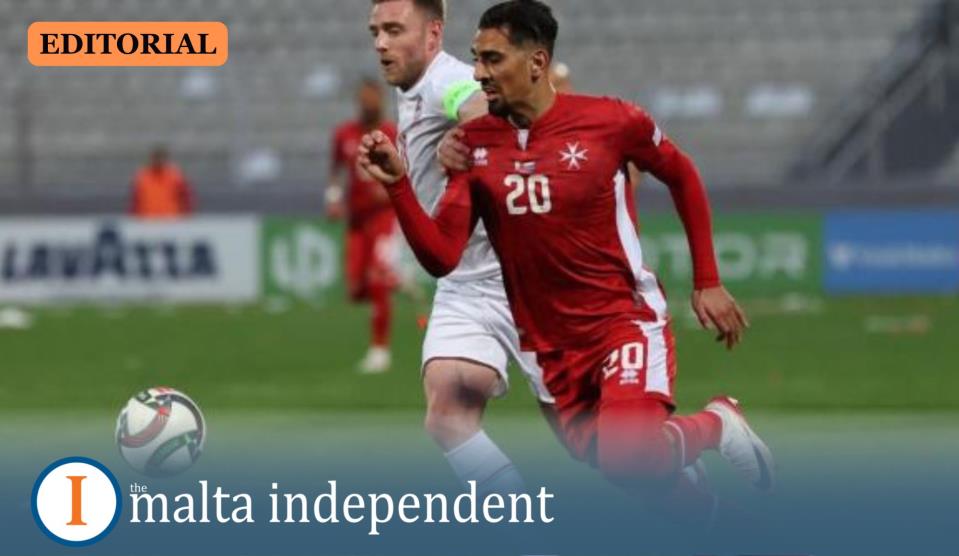

There was a lot of build-up around Malta’s national football team’s two play-off matches against Luxembourg which were scheduled for last month – and quite understandably so.
These play-off matches were important for the progress of Maltese football. Victory over the course of the two legs would have resulted in Malta being promoted to Division C of the UEFA Nations League – something that the national team has been targeting for a while now.
Much effort has been made to improve the standing of the national team over the past years, with investment in infrastructure and also with a clear focus on attracting players who are Maltese by descent or who may be naturalised.
Yet that effort has been largely futile. Malta barely put up a whimper of resistance as they fell to a 5-0 aggregate defeat to Luxembourg, hence putting paid to any hopes of that much-desired promotion.
It is a defeat which is particularly stinging: Luxembourg have historically been similar in stature to Malta as a micro-state, and Malta even beat them in a friendly in 2023, just three years ago. Yet the progress of the two countries couldn’t be more different.
20 years ago, Luxembourg was ranked 194th in the global FIFA rankings. Today, they are 98th, having counted themselves among the top 100 teams in world football for since 2017. Malta meanwhile remains languishing in 161st place. At the end of 2006, 20 years ago, Malta was ranked in 119th place.
There is a similar parallel that can be drawn between Malta and fellow minnow Faroe Islands, who got promoted from the Nations League in Malta’s stead.
There is precious little to be optimistic about at youth level as well. Malta’s U21 national side has not won a competitive game since 2021, and Malta’s U19 national side’s Euro qualification round last month resulted in losses to Norway (1-0), Albania (7-1), and Luxembourg (4-0).
It is clear that there are systemic issues in Maltese football that start from the top but also permeate throughout the setup in the country.
Ramon Falzon – who has recently returned to Malta after spending more than a decade in Australia, where he earned multiple titles and accolades in the Australian National Premier League – told The Malta Independent on Sunday in an interview that the Maltese football system is not doing enough to empower and protect homegrown Maltese players.
The signs are there: many Maltese talents are constrained to having to play their football in Malta’s second tier – the Challenge League – in order to get consistent minutes, the number of Maltese players going to ply their trade abroad is minimal, and there are serious questions on the effectiveness and quality of coaching that players receive in their formative years.
But there is also a mentality issue. Falzon said “the biggest shift that needs to happen in Malta is mental”. He said that while Australia abides by a culture of no excuses, “in Malta, we love excuses”.
This is even seen in the way some sports media outlets cover the national team. One sports outlet termed Malta’s 2-0 first leg loss to Luxembourg as being a valiant effort by the Maltese. There is a culture of mediocrity – a problem of mentality. For too long have we been content with a minimal loss but an apparently ‘valiant’ performance.
Football is Malta’s most funded, and most popular sport – while other sports consistently excel to far higher degrees. It’s time that the sport in Malta is held to a higher account than it is now, as for all the millions of euros that have been invested, there has been precious little to show for it.