

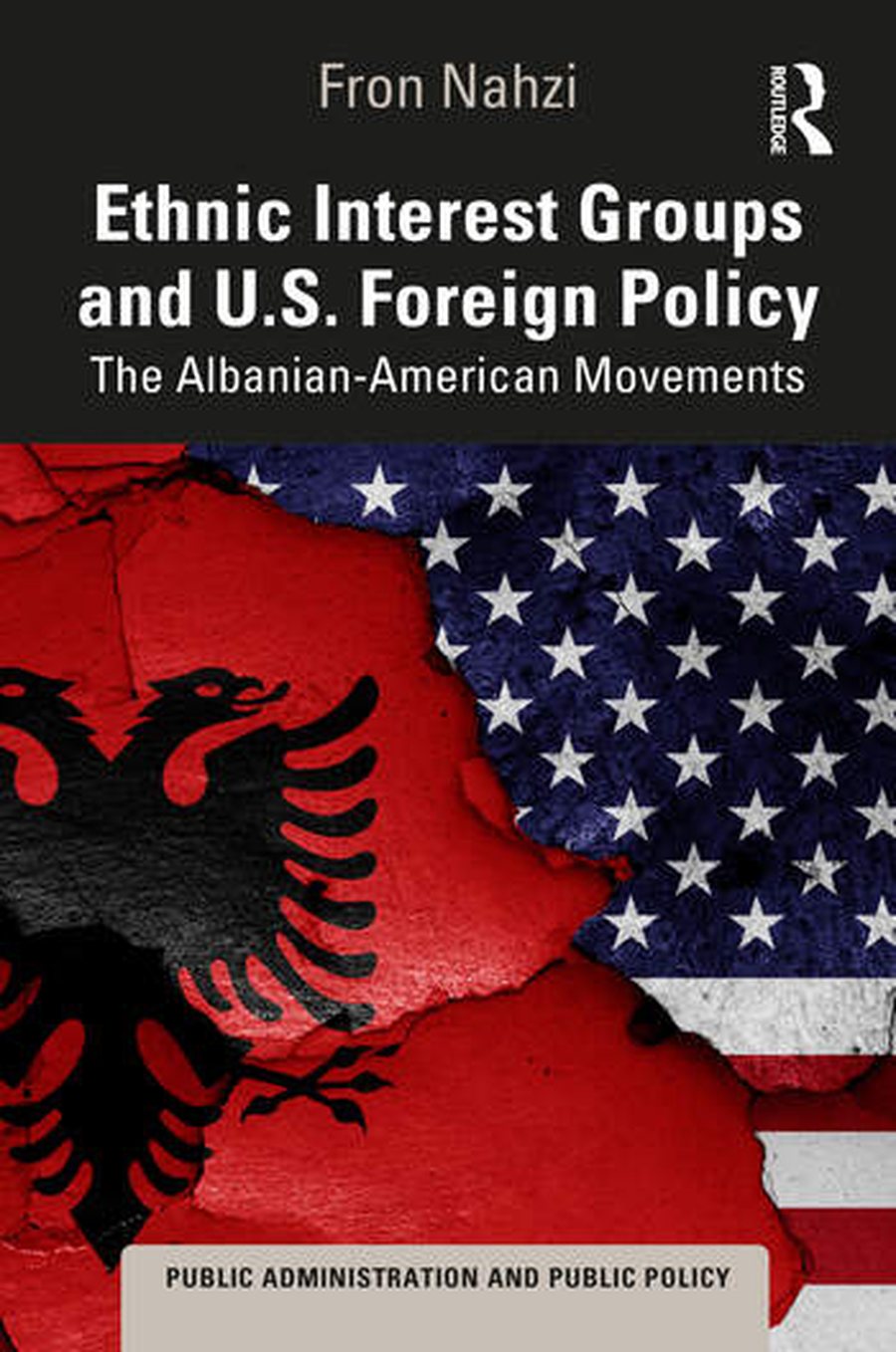
There is a myth embedded in Albanian historical memory: that American President Woodrow Wilson, moved by the justice of Albania’s cause, used his moral authority to protect the country’s borders at the Paris Peace Conference of 1919 – and that America was Albania’s friend. Fron Nahzi’s meticulously researched new book does not exactly shatter this myth, but it reframes it in ways that are both more honest and, ultimately, more instructive.
U.S. experts assigned to draft the Balkans report for Wilson in 1917 recommended partitioning Albania among its neighbors, concluding that “an independent Albania is almost certainly an undesirable political entity.” A 1919 intelligence report advised that Albania was not worth U.S. time and should simply be divided between Yugoslavia and Greece. Wilson’s own State Secretary Robert Lansing opposed the self-determination principle his president was promoting, warning it was “loaded with dynamite” and would “breed discontent, disorder, and rebellion” across the globe. These were the people working for the president whose Fourteen Points speech Albanians had taken as a promise.
What changed was not American values. It was Albanian organizing. A small community of emigrants, mostly unskilled workers from Korça who had settled in Boston, built a pan-Albanian federation of 80 chapters stretching from New Hampshire to Missouri. They published Kombi, the first Albanian-language newspaper in America. They flooded the American Commission to Negotiate Peace with coordinated telegrams. They published English-language books and journals distributed directly to conference delegates. Fan Noli met Wilson personally at a July 4th ceremony at Mount Vernon and made the case for Albania face to face.
And then there was the oil. When it was discovered off the Albanian coast in the early 1920s, the Sinclair Oil Company lobbied Washington to recognize Albania before the contract went to Britain or Italy. Official U.S. recognition came in July 1922, driven by a combination of diaspora pressure and straightforward commercial interest.
Albania was not saved by a generous superpower, or a highly moral man. It was inserted onto the agenda of a distracted one by people who understood how Washington worked and used every tool available to them. The oil contract, however, went to the Anglo-Persian Oil Company, known today as BP, not to Sinclair. Some U.S. and Albanian officials at the time suspected that London had threatened to back Greece’s territorial ambitions in southern Albania unless Tirana played along, and that Albanian leaders had been financially persuaded to cooperate. The diaspora had done its job. The superpowers settled the rest among themselves.
Nahzi is well placed to tell this story. His parents fled communist Albania to Kosovo in 1952. In 1968, his father contacted the Free Albania Committee in New York, one of the U.S. government-funded exile organizations that feature centrally in this book, which helped process the family’s immigration application. They were relocated to a small town in Italy while their paperwork was completed and arrived in the United States in 1969 on a $700 Catholic Relief Services travel loan. The loan was repaid in full by 1974.
Nahzi is writing about the Albanian diaspora from inside a story his own family lived. That personal grounding gives the book an authority that purely academic treatments of diaspora politics rarely achieve. Drawing on declassified CIA files, State Department cables, congressional records, and personal interviews with key participants, Nahzi traces more than a century of Albanian American efforts to shape U.S. policy toward Albania and Kosovo, from the first wave of mostly illiterate laborers who arrived in Boston around the turn of the 20th century to the activists and lobbyists who helped push NATO into Kosovo in 1999.
Achieving two independent states in less than a century, with a tiny diaspora, is a considerably harder ask than anything comparable in American political history. Irish Americans shaped U.S. policy on Northern Ireland, Cuban Americans on Castro’s Cuba, Jewish Americans on Israel’s security. These are among the most studied and influential lobbying operations on record. Nahzi’s key argument is that Albanian Americans belong in that company. The difference is that unlike those other communities, which lobbied for homelands that already existed as recognized states, Albanian Americans were lobbying for the creation of states; first Albania itself, then Kosovo.
That record deserves more attention than it has received.
The Cold War chapter is the book’s most richly documented section. The story of Operation FIEND, the covert U.S.-British attempt between 1949 and 1954 to overthrow Hoxha’s regime, compromised by British double agent Kim Philby and ending with more than 200 Albanian agents killed or imprisoned, will be familiar to many Albanian readers. What is less familiar, and more interesting, is Nahzi’s argument about what the failure produced. The exile coalition assembled to lead the operation was riven by republican versus monarchist factions, regional loyalties, and endless leadership struggles. It was, in many ways, diaspora politics at its most self-defeating. Yet out of that failure grew something durable: a community infrastructure of newspapers, cultural organizations, and immigration networks that kept Albanian identity alive through the Hoxha years and, crucially, laid the organizational groundwork for the generation that would fight and win the Kosovo battle forty years later.
The Kosovo chapter is where the book is most personally candid. Nahzi himself was there: establishing the Soros Foundation in Albania in 1992, watching Berisha’s democratic promise curdle into authoritarianism, working as a senior editor during the Rambouillet negotiations, relaying messages between KLA commanders and U.S. contacts on the night the agreement was finally signed. His account of how the Albanian American community initially rallied around Berisha because of his northern Albanian origins and anti-communist credentials, then watched as he dismantled press freedom and judicial independence while the U.S. looked away, is one of the frankest assessments of diaspora political judgment in the literature.
Nahzi is equally candid about the role of U.S. officials: the contrast he draws between Richard Holbrooke and Chris Hill, who consistently framed the Kosovo conflict in religious terms and sought a deal preserving Serbian sovereignty, and Secretary of State Madeleine Albright, who understood that Milošević only responded to force, is drawn with forensic precision and supported by declassified documents.
The book ends on a note of pointed concern. The pattern that runs through the book’s entire length is by now familiar: U.S. engagement with Albania is driven by interest, not sentiment, and Albanian American organizing is what converts that interest into policy. Nahzi’s concern is that this organizing has stopped. He argues that the Albanian American community has largely retreated from Washington, replaced by professional lobbying firms hired directly by Tirana and Prishtina. The December 2024 award of the island of Sazan to Jared Kushner without a tender is cited as the latest chapter in a transactional dynamic that stretches back to Sinclair Oil in 1922. The difference is that in 1922, Albanians used American commercial interest to their advantage. The question Nahzi leaves hanging is whether today’s arrangements serve Albania’s interests at all.
Ledio Cakaj is a former U.S. diplomat and the author of When the Walking Defeats You, an account of the Lord’s Resistance Army in Central Africa (Zed, 2016).