
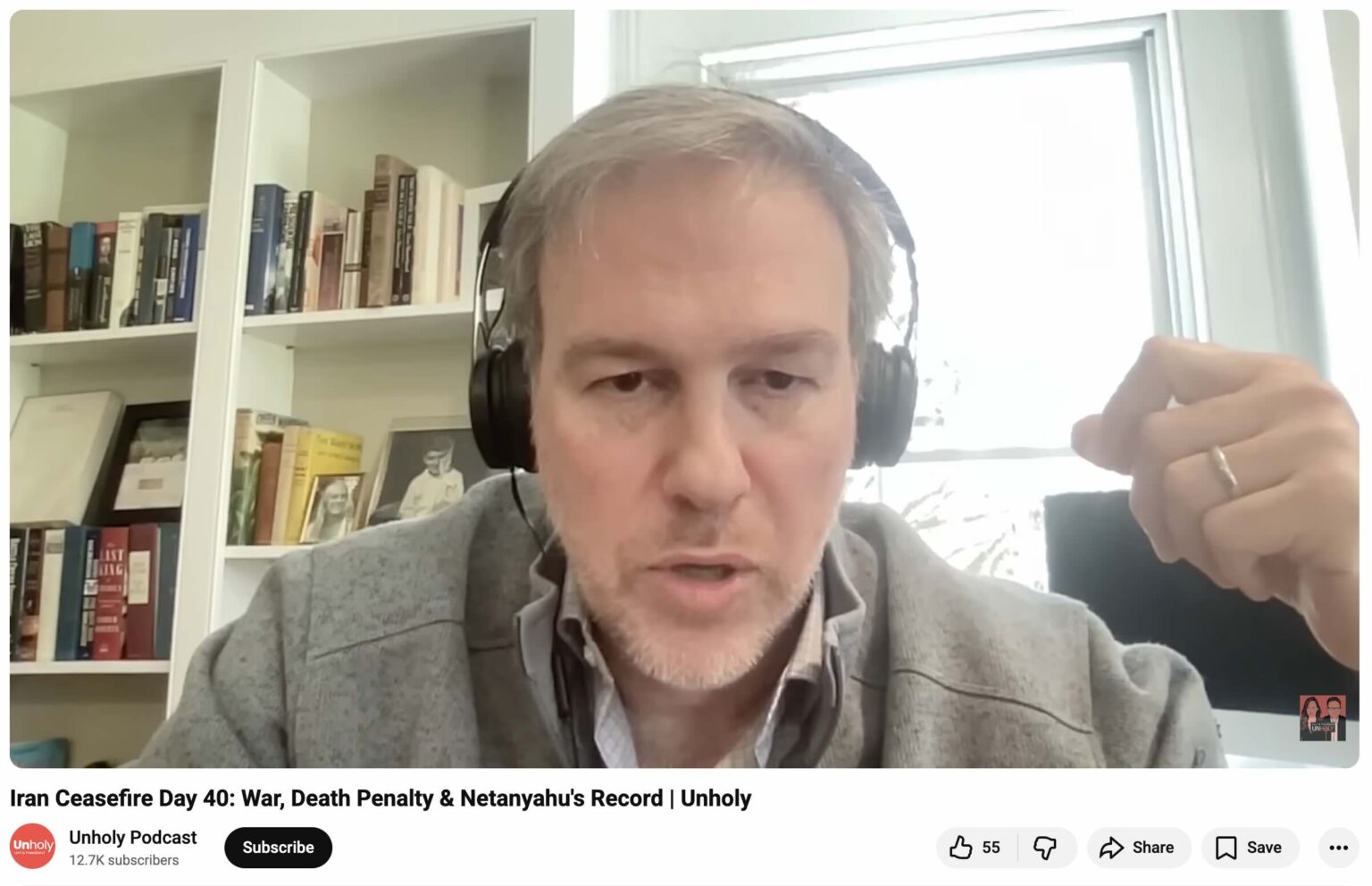
On April 10, 2026, during the 40th day of the early 2026 Iran War, Bret Stephens – New York Times columnist, Editor-in-Chief of Sapir – was interviewed on the popular podcast Unholy and made the following statement: “If you look at the history, Israel’s security history from 1948 onward, with the notable exception of the peace with Egypt and I guess with Jordan too, the history of Israel’s wars is a history of kicking cans down the road.” And that the story of Israel’s wars comes down to a single fact: Israel has “enough power to postpone reckonings but not to end them.”
Because Bret is a smart guy, and because his opinions influence Americans and Israelis, I feel obligated to correct him: Israel’s strategy, until the rise of Benjamin Netanyahu, was to achieve geopolitical breakthroughs through the judicious use of force. It was only with the rise of Netanyahu that Israel switched to maintenance mode – and it was that switch that brought upon us today’s troubles. Understanding this shift is critical to understanding Israel and its geopolitical position. Distinguishing between the narrative put forward by Netanyahu’s administrations and the story of Israel’s earlier decades is essential if we are to secure Israel’s future in the region.
It’s important to start at the beginning: even before the State was founded, the Yishuv – the alliance of Jewish towns and villages in Ottoman Southern Syria and then the British Mandate of Palestine – agreed on a security doctrine: the Iron Wall. The name came from Vladimir Zeev Jabotinsky, but the concept began with Hashomer in 1909: Jews understood they would only be safe if they could defend themselves so thoroughly that their neighbors would give up their attempts to kill them and expel them.
Both Jabotinsky’s Revisionist conception of the Iron Wall and Labor’s concept, later adopted by Israel’s founding Prime Minister David Ben Gurion, shared the same goal: not to survive to fight another day, as Bret said, but to establish conditions for Jewish acceptance in our ancestral land which had, over time, become inhabited by others who would forever be part of our national lives. The thinking, best elucidated by Jabotinsky, was as follows:
“As long as the Arabs feel that there is the least hope of getting rid of us, they will refuse to give up this hope in return for either kind words or for bread and butter, because they are not a rabble, but a living people. And when a living people yields in matters of such a vital character it is only when there is no longer any hope of getting rid of us, because they can make no breach in the iron wall. Not till then will they drop their extremist leaders whose watchword is “Never!” And the leadership will pass to the moderate groups, who will approach us with a proposal that we should both agree to mutual concessions. Then we may expect them to discuss honestly practical questions, such as a guarantee against Arab displacement, or equal rights for Arab citizens, or Arab national integrity. And when that happens, I am convinced that we Jews will be found ready to give them satisfactory guarantees, so that both peoples can live together in peace, like good neighbours.”
Thus did Israel fight its wars: 1948 to ensure Jews weren’t pushed into the sea by five invading Arab armies; 1956 to curry favor with the British and French in order to overcome the American arms embargo and gain military equipment required to repel future attacks; 1967 to preempt the war Arab leaders declared they were ready to launch after completing a massive troop build-up in the South and North – and separate Jordan and secure the East; 1971, to support the Hashemite Kingdom in Jordan to cement peaceful relations; 1973, after being attacked, to convince the Arab world it can’t win militarily. Each war served political purposes, exemplified by the historic Begin-Sadat Agreement or the Peace Agreement with Jordan.
Even the 1982 Lebanon War had a diplomatic objective: to aid Christian Lebanese forces to rid themselves of militant groups attacking Israel from Lebanon, and clear a path for peace between Lebanon and Israel. The war’s failure doesn’t change the fact that Israel historically fought wars to clear the path for peace with its neighbors.
By the 1990s, Israel felt sufficiently confident in its Iron Wall’s ability to protect it from regional threats, enabling it to turn inwards, deploying the same strategy: the same Yitzhak Rabin known for the Oslo Peace Process had previously ordered extreme force to crack down on the Palestinian uprising known as the First Intifada, to establish an Iron Wall to enable negotiations leading to separation. The same Ariel Sharon who led a brutal crackdown during what would be known as the Second Intifada did so to lay the groundwork for the peace process his successor, Ehud Olmert, would attempt to complete at Annapolis. And, for a while, Benjamin Netanyahu – as a young Prime Minister – continued this story, seeking to settle the Palestinian issue once and for all in direct talks with Mahmoud Abbas in 2010.
And then things changed. Netanyahu came to adopt the concept that the philosopher of Israel’s center-right, Micah Goodman, called “shrinking the conflict,” which, practically, can be translated to “kicking the can down the road.” In Gaza, in Lebanon, with Yemen, and with Iran, Netanyahu – a master tactician – switched Israel’s security doctrine from “Iron Wall” to “mowing the grass.” Instead of saying “what yes,” Netanyahu focused only on “what no.” Instead of using military power to change geopolitical reality, Netanyahu decided to use military might to keep it at a status quo. To postpone reckonings, as Bret puts it, but not to end them.
Thus, Netanyahu said “Hamas is an asset,” because it enabled him to delay the reckoning with the Palestinians. Thus, Netanyahu enabled Hizbullah to rearm time and again, without pushing for peace with Lebanon between wars, and rejected calls by the defense establishment to take the fight to them. Thus, Netanyahu kept the fight with Iran on a low flame for decades, using the threat of a nuclear Iran to create the conditions for the Abraham Accords in the hope of rapprochement with Saudi Arabia without compromising on the Palestinian issue. And for a while, it worked for him. Until it didn’t.
The war that began on October 7th is a direct result of Netanyahu’s selling the story of “delayed reckonings” to Israel and the world. It proved that the founders of the Zionist movement’s story were right, and Netanyahu and Goodman and their peers were wrong: there is no way to shrink the conflict, only the long, hard slog towards solving it. Unless we want to keep “mowing the grass” in Gaza, in Iran, it is time we return to the story that worked for Israel’s great leaders and visionaries: that of the Iron Wall laying the ground for peace. And that means accepting a pathway to Palestinian self-determination to unlock Saudi recognition of Israel, enabling the Sunni world to join us in ending the Muslim Brotherhood and the Islamic Revolution in Iran. Only then, as Jabotinsky predicted, will “both peoples…live together in peace, like good neighbours.”
Ariel Beery is the founding Editor and Publisher of Prophecy: A Journal for Tomorrow, and an active investor and advisor to initiatives dedicated to building a better future for Israel, the Jewish People, and humanity. His geopolitical writings can also be found on his Substack, A Lighthouse.