
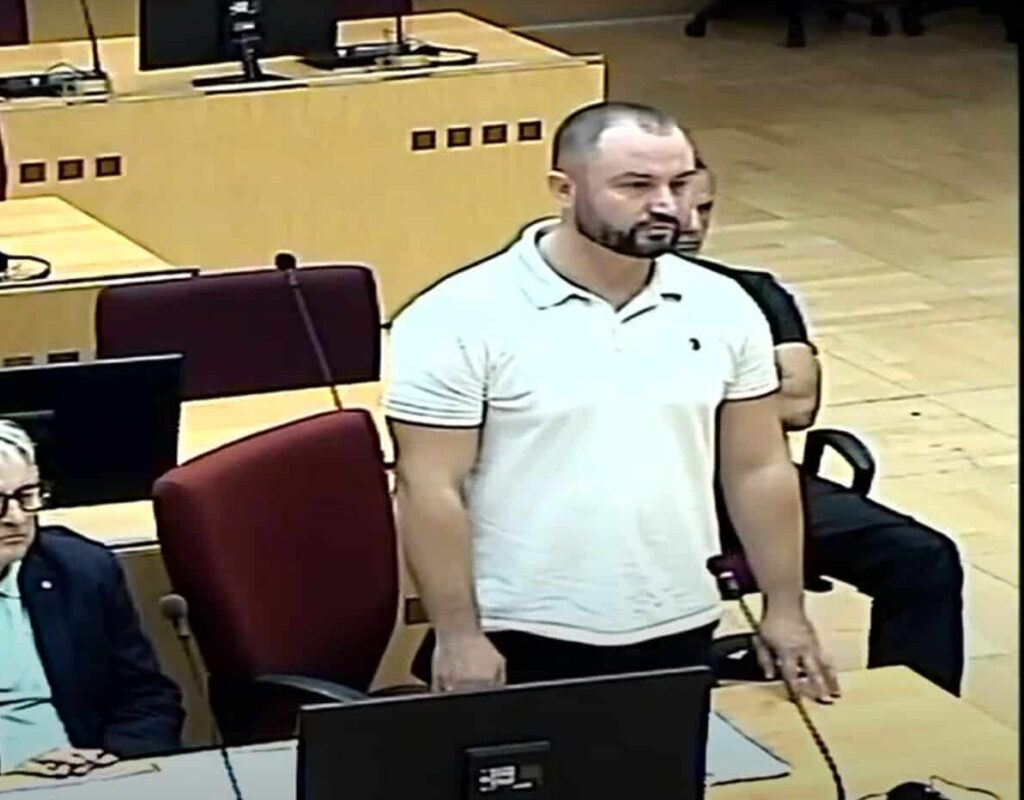
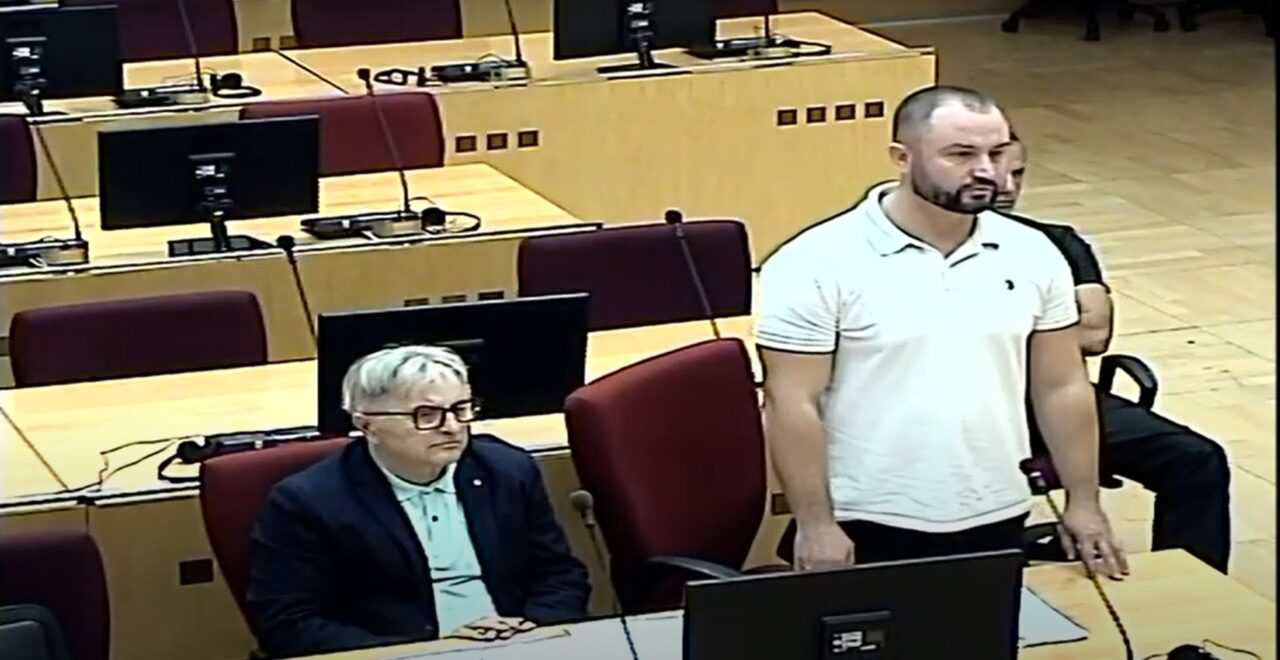
Dario Ristic (R) and his lawyer Rade Culibrk at the Bosnian state court. Photo: Court of Bosnia and Herzegovina.
The case of Dario Ristic has raised concerns about shortcomings in legislation on dual citizenship after the Bosnian state court rejected an indictment against him for fighting for Russia in Ukraine. Ristic has both Bosnian and Russian citizenship.
Less than a year after his return to Bosnia and the initiation of an investigation, the court concluded that there was no reasonable suspicion that Ristic had committed a criminal offence.
The ruling stated that he joined the regular army of the Russian Federation as its citizen, which does not constitute a criminal offence under domestic law.
“The suspect Dario Ristic joined the regular army of the Russian Federation, as a citizen of the Russian Federation, and therefore did not fulfill the essential elements of the criminal offense of unlawfully forming or joining foreign paramilitary or parapolice formations,” the ruling stated.
The Bosnian state prosecution filed an appeal against this decision, but it was rejected. The court clarified that the legal provisions apply to informal and illegal armed groups, not to the official armed forces of an internationally recognised state.
Ristic surrendered to the judiciary in September 2025 after an Interpol red notice was issued for him. He was arrested at Sarajevo Airport and charged with participating in the war in Ukraine. According to the court ruling, he left Bosnia in November 2023 and went to Russia, where he obtained citizenship in February 2024. Citizenship was a condition for joining the Russian Army, with which he then signed a one-year contract.
The Criminal Code of Bosnia and Herzegovina penalises Bosnians who join foreign military formations. But it does not apply to individuals who have citizenship of the country in whose army they serve, as long as the country is internationally recognised.
Despite this, security experts warn of the possible consequences of such a legal framework. People who went to fight for the Islamic State can be prosecuted in court, but those who went to fight for Russia can evade prosecution if they take citizenship.
Sead Turcalo, dean of Sarajevo University’s Faculty of Political Sciences, said that this opens up space for various forms of crime to slip through the cracks. “In fact, a safe haven is being created for all types of criminals and terrorists,” said Turcalo.
Ukraine’s ambassador to Bosnia, Volodymyr Bachynski, also expressed concern, saying that “every crime must be punished, regardless of whose citizen the perpetrator is.”
Ristic became known for promoting participation in the war in Ukraine by showing live drone footage of Russian attacks on TikTok.
It is estimated that more than 200 people from the former Yugoslav region are fighting on the Russian side in Ukraine.