
Estonia is not alone in its security despite U.S. President Donald Trump’s recent statements after NATO allies refused to back the blockade of the Iranian Strait of Hormuz, Prime Minister Kristen Michal (Reform) said.
NATO military command and allied cooperation work better in practice than it seems on the surface, Michal said in an interview given to Vikerraadio Tuesday.
As to whether Trump’s comments about the U.S. future in NATO leave Estonia relatively isolated and relying only on itself and its nearest neighbors for its security, the prime minister said: “Practice does not confirm such an approach.”
“I understand where these opinions come from, and I understand that there are very influential commentators who are saying so,” he added.
In a recent interview in LP with former president of Estonia Toomas Hendrik Ilves, the latter said Trump might not give his consent if Article 5 on collective defense needed to be invoked in the event of an attack.
Michal said he does not see it that way, noting the tense security situation which has prevailed since he took office nearly two years ago. “No, I do not [agree with Ilves], but I also stand with the practitioners in security matters. During the time I have had to serve as prime minister, there have been a disproportionately high number of security incidents which we have had to deal with and crises we have had to get through. A great deal of energy, money, and people’s effort has gone into that,” Michal said.
“I’ll go back a few moments so people understand that we do have something to rely on. When we desynchronized [from the Russian electricity grid], when we were supposedly meant to be plunged into darkness and Russia was cursing and predicting that the Baltic states would no longer manage, at that moment cables in the Baltic Sea had to be protected — and NATO ships began doing so after I spoke with NATO Secretary General Mark Rutte. And the President of Finland spoke with him too. Similarly, we have had Russian military aircraft in the skies, and I recall that at that moment the Italian F-35s stationed here went to escort the Russians out of our airspace. And there have been many such incidents,” he went on.
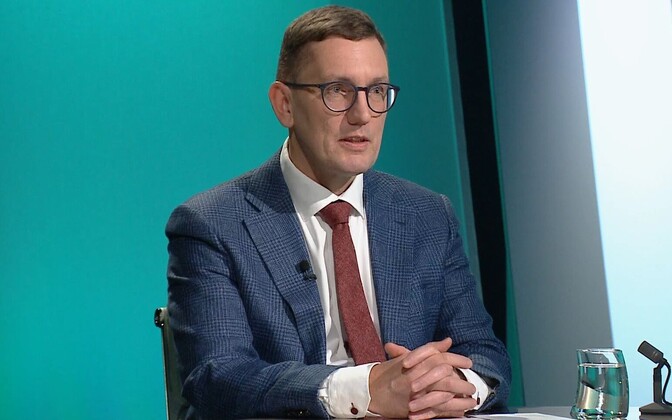 Prime Minister Kristen Michal on a previous edition of “Esimene stuudio.” Source: “Esimene stuudio”
“On the practical side, I could simply say that within NATO, the chain of command, cooperation between countries, and the military side function much more smoothly than the political messages allies often send one another,” Michal added.
NATO’s Supreme Allied Commander Europe (SACEUR) Alexus G. Grynkewich has, Michal said, a very wide authority when taking any defense-related steps. “That means that if he says something should happen, then it will happen. Consequently, I say that, from the practical side, NATO’s response capability and readiness are very good.”
Cooperation with U.S. Ambassador to Estonia Roman Pipko remains healthy too, the prime minister added. As to whether the U.S. has, via Pipko, made any proposals to Estonia to provide mineral resources such as rare earth metals in exchange for security guarantees, Michal said that that had not happened.
“I have met with Pipko. No such proposals were made to me. On the contrary, we both noted that the partnership between Estonia and the U.S. on security issues is very good. As he himself has said publicly when in America, compared with other countries, we are an exemplary state, which takes its own defense seriously,” Michal responded.
Michal recalled that Trump himself has repeatedly said that he would defend both the Baltic states and Poland where needed. “I was with him at the NATO summit in The Hague, where his message was exactly the same: If you are investing in your own defense, then everything is fine. His wish is for Europe to shoulder a greater share of the burden of defense. We are prepared to contribute more, though we acknowledge that everyone is feeling the challenge of finding the funds for that,” Michal said.
Some NATO allies, including the U.K. and France, have declined to join Trump’s blockade of the Strait of Hormuz which began Monday and followed Iran’s own closure of the strait, permitting vessels through which paid a toll. Trump had threatened a U.S. reconsideration of its membership of NATO if other member states did not fall behind the blockade.
—
Source:
‘Stuudios on peaminister,’ hosts Mirko Ojakivi and Arp Müller.