
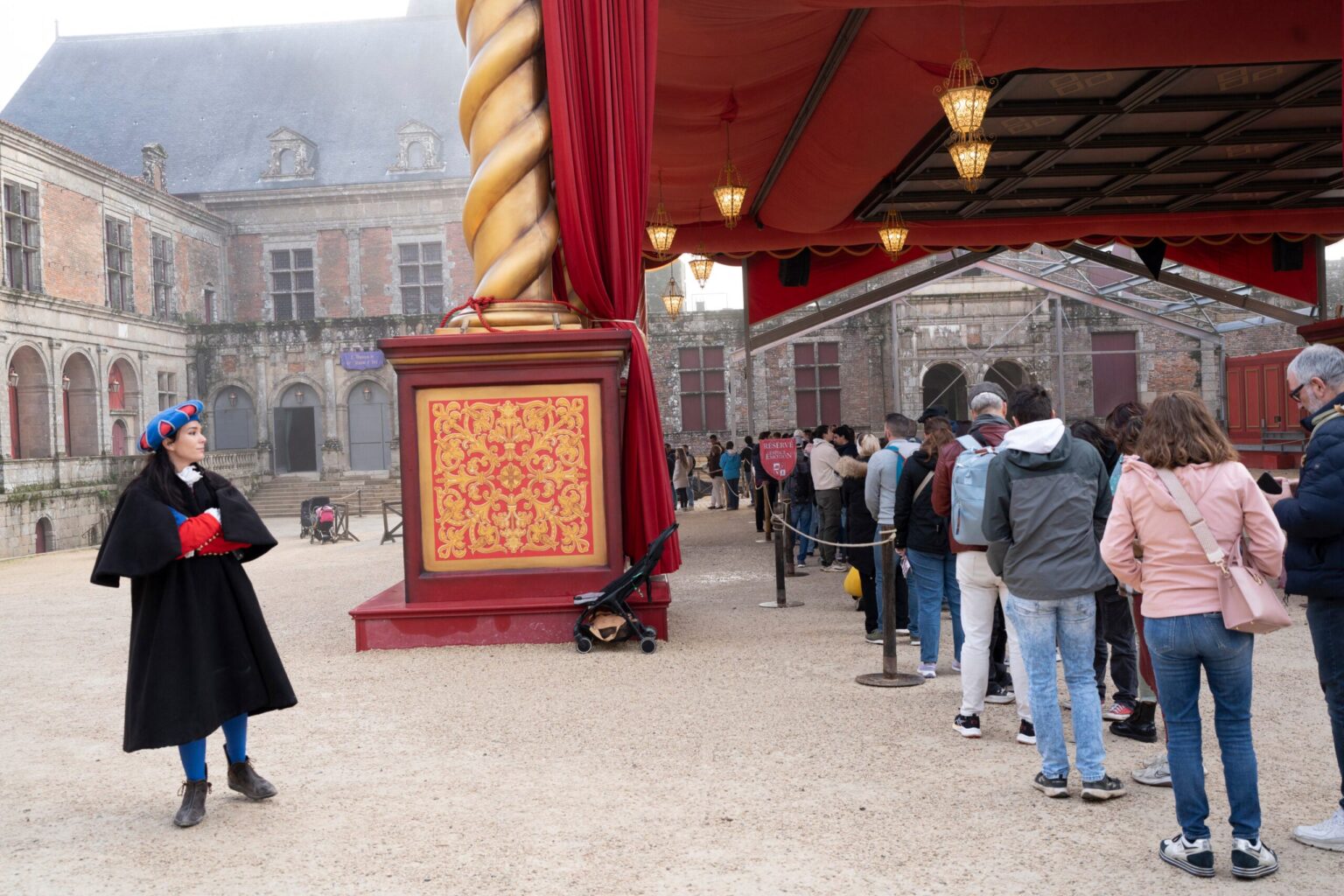
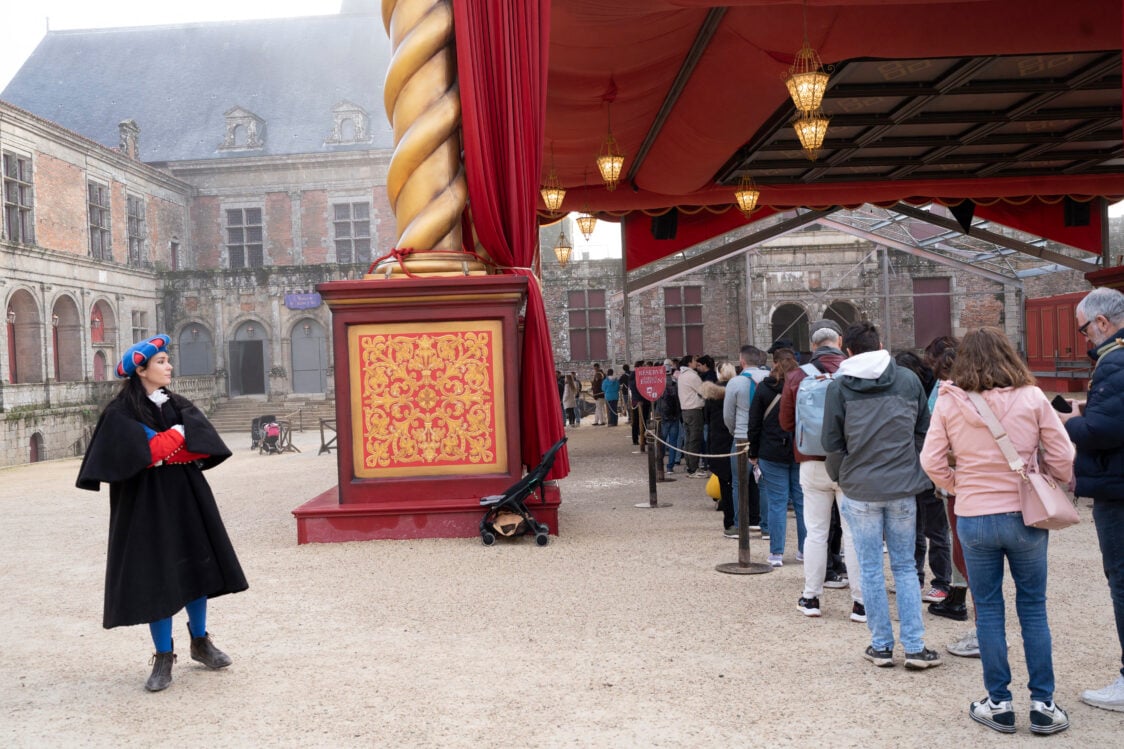
The entrance to the immersive show “La Renaissance du Château.” All photographs of
Puy du Fou, November 2025, by France Keyser for Harper’s Magazine © France Keyser/MYOP
It’s when the branches of the animatronic tree sprout swords and start swinging at Tristan that I think, Hang on. Puy du Fou is a theme park devoted to French history. Isn’t King Arthur British? We’re outdoors on a damp November morning, and although the mist has lifted a little, the actual, nonanimatronic fringe of leafless beeches above the cluster of turrets and half-timbered gable ends is still only semivisible through the ashen haze. Arthur’s scheming half sister, the enchantress Morgan le Fay, has buried the Round Table at an undisclosed location. It is Tristan’s quest—nowhere to be found in the Arthurian canon, but then neither are heavily armed trees—to find it. The Lady of the Lake appears like a fairy godmother on the ramparts. “Frappe la souche du mal,” she says, sonorously. “Et tu vaincras.” Strike at the root of evil and you will prevail.
I recall, dimly, that the Arthurian cycle might be Anglo-French in origin, something I’m able to confirm later, when, over a plastic cup of lager on the outskirts of a faux eleventh-century hamlet, I look it all up on my iPhone. The twelfth-century Welsh cleric Geoffrey of Monmouth was the first to shape the jumble of older myth and pseudohistorical material into unified form, later developed by the French poet Chrétien de Troyes and the anonymous French authors of the Lancelot-Grail Cycle. What began as a miscellany of Welsh, Cornish, and other folktales about a questionably historical Romano-British leader cohered into legend largely as a function of cultural exchange. Arthur is myth: he belongs to all of us.
Still, these Frenchies. After an acrobatic display of swordsmanship, including ducks, cartwheels, and the odd MMA-style roundhouse kick, Tristan thrusts his sword deep into the evil tree trunk. The tree has been guarding Excalibur, lodged nearby in a plasticky rock. “Montre-nous la table ronde!” he exclaims. Show us the Round Table! At which point almost the entire set—a grassy, boulder-strewn hillside, twenty yards wide and ten deep—is lifted on massive hydraulic pistons. Underneath is a lake, with what appears to be a vast sinkholelike well a few inches below the water’s surface. With violent spurts, the well drains, exposing its mortared stone walls and, eventually, the missing Round Table. It’s a bit slimy-looking, like unscrubbed decking in the rain.
There’s no sign of the big guy. “We’re too late,” laments one of Tristan’s companions. “King Arthur is no more.” Then, magically, from some hidden dugout at the bottom of the well, the once and future king rides up from below the table astride a white horse. Tristan kneels and restores Excalibur to its rightful owner. “You have vanquished the evil that haunted this place,” says Arthur, with the sort of aggressively enunciated portentousness I will discover is common to all the park’s shows and that might usefully be referred to as “history voice.” By way of a thank you, Arthur grants Tristan the hill and commands him to build a dwelling place upon it. “And you will name it Puy du Fou.”
“L’Épée du Roi Arthur”
It is the kind of half-solemn, half-mischievous meta moment that will come to seem characteristic of my weekend at France’s second most popular theme park, after Disneyland Paris. A moment ago, the show—“L’Épée du Roi Arthur”—was breezily appropriating King Arthur for France. Now it’s appropriating him for the park itself: Camelot is right here, if only we would let it be, under the bleachers and the friendly young ushers selling plastic swords and branded beanies.
Puy du Fou occupies a wooded site in the largely rural commune of Les Epesses, thirty-five miles southeast of Nantes in the western department of the Vendée. You’d be forgiven for assuming that “fou” was a mildly self-congratulatory reference to its own wackiness, but in fact it derives from a local dialect term for beech tree. Puy du Fou means “Hill of Beeches.” It differs from other popular French theme parks like Disneyland or Parc Astérix in that it has no rides. The attractions on offer consist, for the most part, of spectacular live shows reenacting an event or period in French history or myth, each lasting between fifteen and thirty-five minutes. I say reenacting when what I really mean is mounting a weird, camp, outlandishly high-budget, quasi-historical fantasia, standing in roughly the same relation to the actual event as the Boston Pops Fireworks Spectacular does to the Declaration of Independence.
People go nuts for it. Visitor numbers hit three million last year. In 2021, an affiliated park, Puy du Fou España, opened near Toledo, applying the same sensibility to episodes in Spanish history. If planning permission is granted, a British park, in Oxfordshire, will open in 2029. The original Puy du Fou has twice won the Outstanding Achievement award at the Thea Awards, the Oscars of themed entertainment. It is regularly voted one of the world’s favorite amusement parks in Tripadvisor’s Travelers’ Choice Awards. In 2024, Le Figaro pronounced it the best theme park in the world.
It is also one of the most controversial. The strain of pious bombast typified by “L’Épée du Roi Arthur” has aroused the outrage of many scholars and commentators, who allege that the park smuggles in reactionary propaganda under the cover of family entertainment. Co-opting Camelot for France is one thing, but after a weekend of shows like “Les Vikings,” in which a fiery miracle converts marauding Norsemen to the Catholic Church, or “Mousquetaire de Richelieu,” in which Louis XIII appears as a kind of salvific superking, it’s hard to shake the feeling that a fantasy version of French history, drenched in missionary zeal and longing for a lost monarchy, is being advanced at the expense of a secular, republican modernity construed as ruinous. As the anti-immigrationist far right continues to surge in French polls ahead of next year’s presidential election, it seems reasonable to ask whether an authoritarian, ethnonationalist, fanatically Catholic conception of the past is reshaping the way the French think about the present or merely responding to a need. Can a theme park flirt with fascism and still be the best in the world?
Philippe Marie Jean Joseph Le Jolis de Villiers de Saintignon, the founder of Puy de Fou, is a highly visible member of a social class that purports not to exist: the French nobility. The Le Jolis de Villiers family, originally from Cotentin, in Normandy, was ennobled in 1595 and has seen no shortage of its sons rise to prominent positions in public life. Philippe was born in Boulogne in 1949. After earning a law degree in 1971, he followed a path worn smooth by generations of France’s political elite, studying at Sciences Po before moving on to one of the grandest grandes écoles of them all: the now defunct École Nationale d’Administration. In 1977, aged twenty-eight, de Villiers came across the ruins of the Château du Puy du Fou, built in the sixteenth century on the remnants of a medieval castle. To raise funds for its restoration, de Villiers, with the help of hundreds of local volunteers, staged “La Cinéscénie,” a son et lumière dramatizing the history of the region.
To this day, “La Cinéscénie” is a highlight of the Puy du Fou experience, featuring 2,550 actors on a fifty-seven-acre stage, along with horses, cattle, fireworks displays, the latest in 3D-projection techniques, and voice-overs by Gérard Depardieu and the late Alain Delon. It’s a grandiose crowd-pleaser fueled by a residual sense of injustice. One of its focal points is the War in the Vendée, the counterrevolutionary uprising that took place from 1793 to 1796. Many historians believe that the insurrection was prompted by the reactionary manipulations of the royalist aristocracy; others hold up the war as a glorious, peasant-led revolt against Republican oppression.
“La Cinéscénie” is firmly in the latter camp. Its championing of the Vendean cause set the tone for all the other shows de Villiers would go on to create: devoutly Catholic, monarchist, resistant to centralized power and to the Republic in particular. By 1989, the show had become so popular that the decision was taken to open the “Grand Parc” on a neighboring site. Over the years, the park continued to grow, as de Villiers devised new daytime material to flesh out the schedule before the after-dark spectacular of “La Cinéscénie.” In 2004, he passed the day-to-day responsibilities of running the park to his son Nicolas, who was appointed its president eight years later. Today, Nicolas de Villiers presides over twenty “experiences” distributed across 140 acres of woodland and interspersed with themed hotels, fast-food restaurants, and “period villages,” such as Font-Rognou, a medieval settlement complete with a Romanesque chapel, a street of historical shops selling trinkets and replica weapons, and a tavern offering “Vendée garlic bread” and something called “Arthur’s platter.” The shows span 1,400 years of French history, from the reign of the sixth-century Frankish king Clovis I to the Nazi occupation.
The set of “Les Amoureux de Verdun,” an immersive dramatization of the First World War
Some shows are immersive, like “Le Mystère de La Pérouse,” which takes you belowdecks on an eighteenth-century ship caught in a storm en route to the tropics, actors in naval uniform studiously ignoring you as the deck heaves and water pours through the overheads. Others rely on a more traditional fourth-wall dynamic. “Le Dernier Panache,” the Vendée War show, is staged in a huge hangarlike auditorium with a 360-degree rotating grandstand that seats 2,400 and weighs 530 tons. At outdoor shows like “L’Épée du Roi Arthur,” “Les Vikings,” and “Le Bal des Oiseaux Fantômes,” you sit facing the elaborately landscaped sets on steeply raked wooden bleachers—memorably so at the climax of “Le Bal des Oiseaux,” when 330 birds, including eagles, vultures, and spoonbills, are lured by a team of falconers to swoop directly over your head, clipping the occasional bald spot or fumbling the scraps of raw chicken tossed up as tidbits and dropping them onto the audience.
It would take an effort of cynicism not to be won over. The shows are knockouts: ingeniously staged, technically virtuosic, pop-surreal in the most engaging, inclusive, forgivably cheesy way. It is a measure of the park’s popularity, and the political clout that comes with it, that during the pandemic, Puy du Fou was twice granted an exemption to a ban on gatherings of more than 5,000 people, prompting accusations of presidential favoritism that were all the more striking for the ideological gulf between Philippe de Villiers and the centrist administration of Emmanuel Macron.
The more persistent objections, however, relate to the park’s ideological sleight of hand, what questionable goods are being sold in such attractive packaging. In 2022, a group of historians, including Guillaume Lancereau, then a fellow at the European University Institute, published Le Puy du Faux—“Peak of Falsehoods,” or conceivably, “Bullshit Hill”—a book-length takedown of the park. For the authors, the version of the past presented in the shows is “pure fiction, a fantasy that one may or may not subscribe to, but that has nothing to do with history.” It is simplistic, clichéd, reliant on “images inherited from films, novels, and comic books,” ignorant or contemptuous of the historical method, and riddled with inaccuracies, lazy caricatures, and in some cases outright falsehoods.
More than that, Lancereau and his co-authors contend, these errors are intentionally and consistently made in the service of a political ideology that conceives of France as an “ancient and immutable entity.” Its values—the sanctity of village life and the Catholic Church, pride in a nation founded and sustained by heroic warriors and “the necessary opposition to dangerous enemies from without,” and wistfulness for a lost monarchy coupled somewhat paradoxically with a hostility to unaccountable power—are threatened not only by the external forces of globalization, secularism, and Islam, but by domestic voices that would question the scale of that threat in the first place.
A case in point is a relic on display at the Château du Puy du Fou. In 2016, Philippe and Nicolas made the winning bid of slightly more than 375,000 euros for a ring that allegedly belonged to Joan of Arc. Visitors to the château are met by an actor in chain mail writing what he refers to as “the extraordinary tale of Joan of Arc’s ring.” But as Lancereau et al. point out, no such historical document exists. Experts including Olivier Bouzy, a former director of the Maison Jeanne d’Arc in Orléans, believe the ring to be a forgery. Nonetheless, there the ring sits, on its royal-blue cushion, dramatically lit and dwarfed by its gilded display cabinet, with no mention of its dubious provenance. Its display is an act of pure assertion, of willed significance, and strikes you, in retrospect, as it struck the authors of Le Puy du Faux, as sneaky verging on manipulative, an experience whose immersiveness is shrewdly designed to keep you below the waterline of fact.
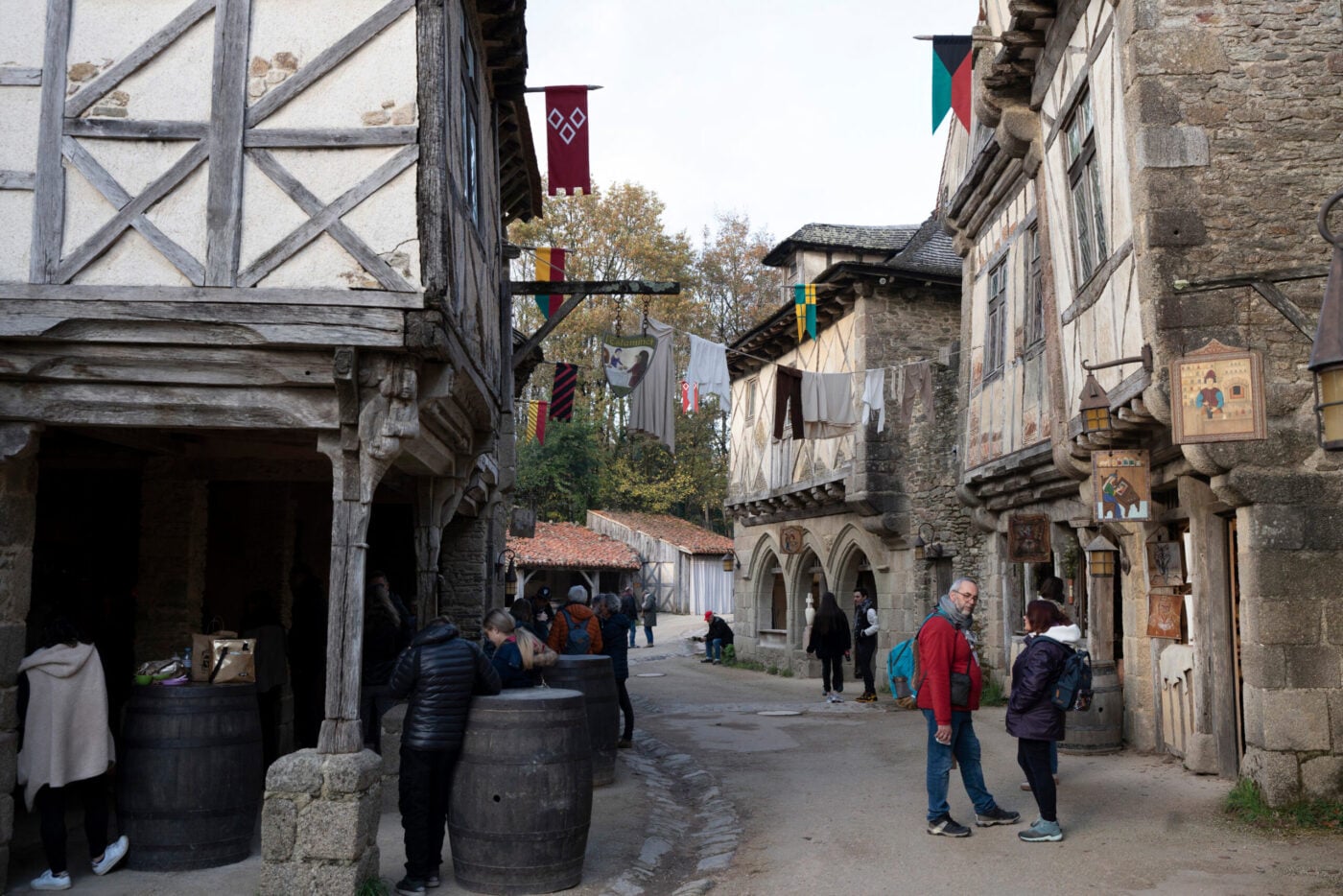
A street in Font-Rognou, a faux medieval village
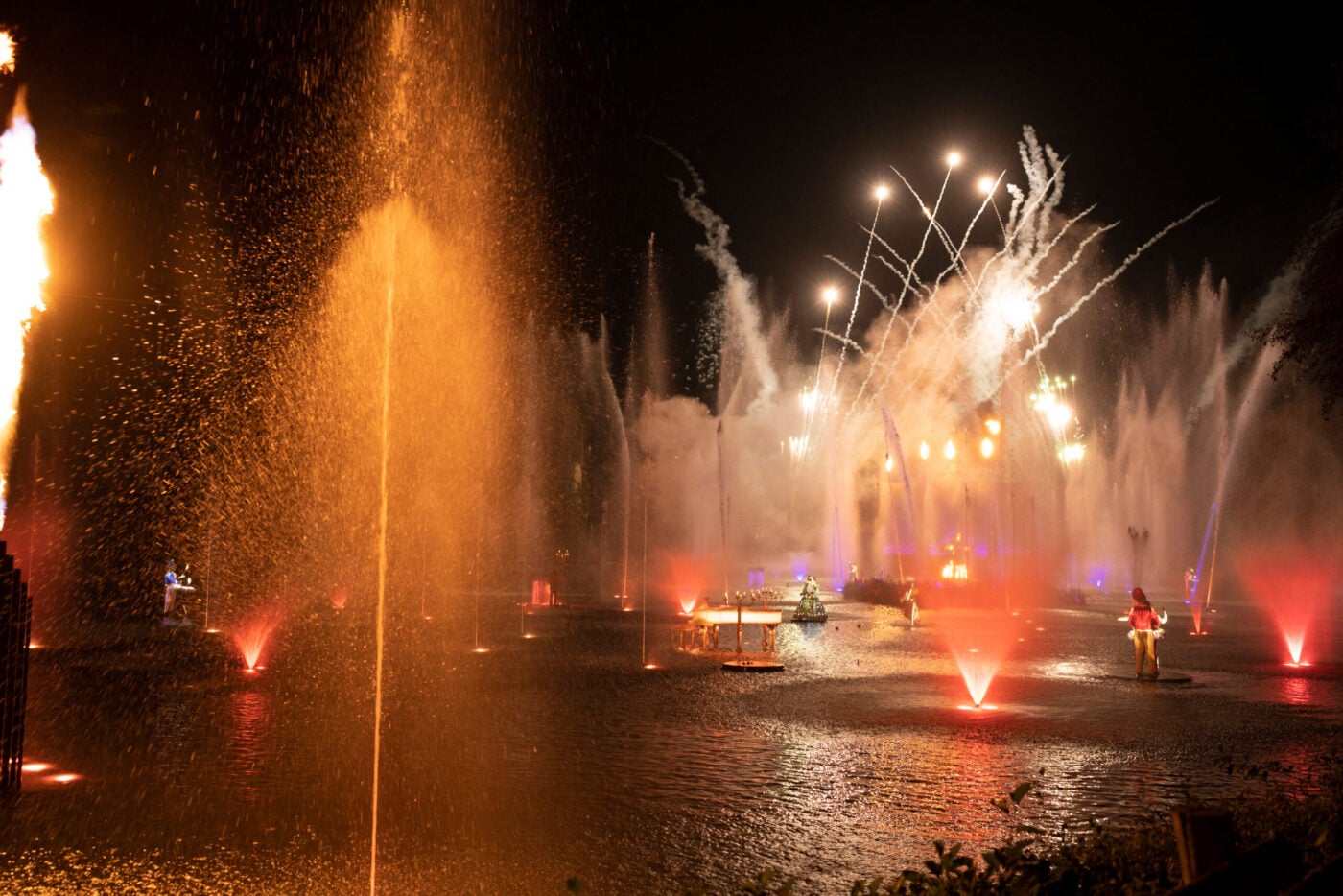
A musical performance of “Les Noces de Feu”
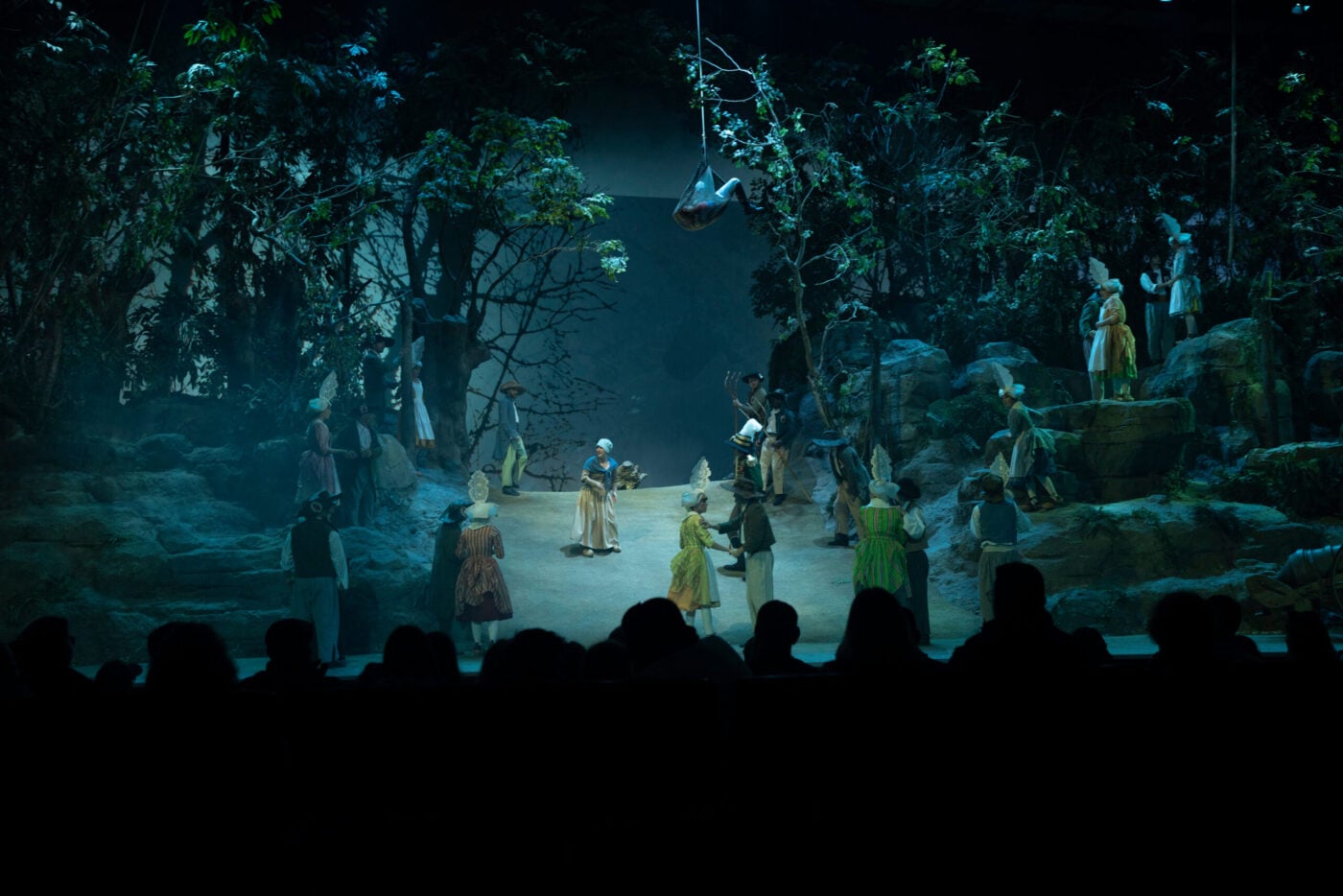
“Le Dernier Panache”
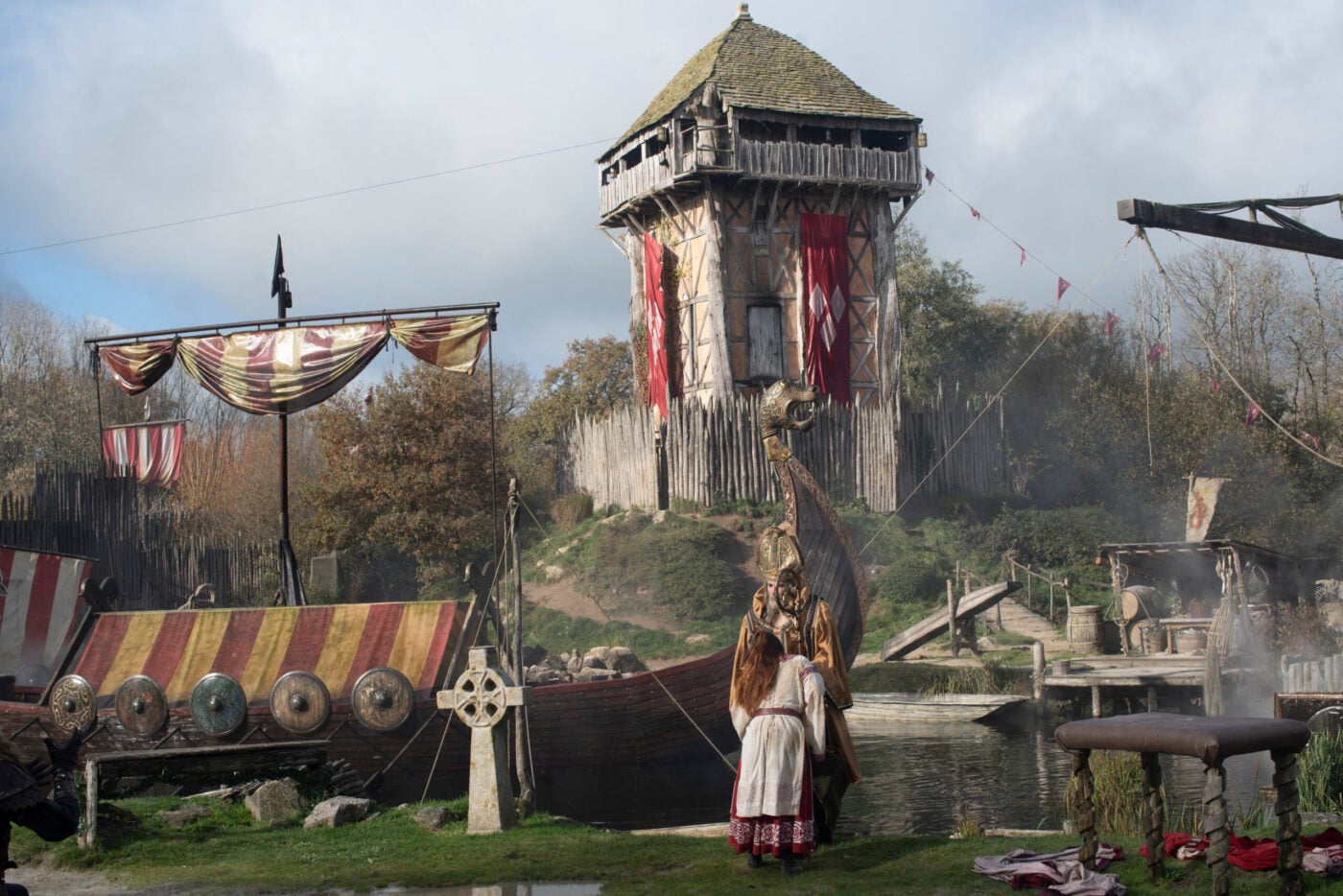
“Les Vikings”
The response you generally get from Puy du Fou apologists to accusations that the park is falsifying the historical record to serve a sinister right-wing agenda is: lighten up. This is pretty much the position taken by Nicolas de Villiers when I speak to him shortly after my visit to the park. How does he respond to his critics? “I laugh,” he tells me. “They see ideology everywhere.” Nicolas is trim and youthful for his forty-six years, with light-brown, neatly cropped hair and the credible manner of precisely the kind of technocrat that the French, for all their inclination to extremity, still seem sorely tempted to elect. He is the Emmanuel Macron of attractions management. If the shows sometimes err on the fanciful side, Nicolas explains, that is only to be expected. It’s a theme park; it’s supposed to be fun. “We are not trying to change your mind,” he tells me. “We just give you beautiful shows. And then you like it, or you don’t like it.” This could be the park’s motto. When I ask Pierre-Augustin Totaro, a software engineer I meet outside the immersive First World War experience, what he thinks of the park’s approach to French history, he gives it to me straight. “Si vous n’aimez pas, ne venez pas,” he says. If you don’t like it, don’t come.
Everything is peachy in the eleventh-century Frankish village until the Vikings show up and ruin it for everyone. Nearby Noirmoutier is on fire. Earlier, some monks in brown habits passed by, warning of “drunken, bloodthirsty monsters seizing the wafer boxes, burning the holy books, cutting the throats of all who resisted with axes.” And now the monsters are here, in idyllic St. Philbert le Vieil, in their wolf pelts and curly-horned helmets, striding about in hypermasculine fashion with their arms not quite by their sides, driving a herd of cattle before them and, as if further proof were needed of their heathenry, contemptuously tossing the holy reliquary of St. Philbert into the river.
A forty-foot longship plunges down the hill to the left of the bleachers and launches with a splash into the water. Advance forces in black leatherwear somersault off the dragon-shaped prow and set fire to the Frankish watchtower. There is a lot of pretty convincing combat with axes and broadswords. It’s momentarily distracting, from an immersiveness point of view, when a villager escapes the burning watchtower on a zip line, but there’s too much going on to get pedantic about it. A man on fire rides past on horseback. To a discordant blare of horns, a second, much larger longship rises from beneath the river’s surface. (There is a recurring preoccupation at Puy du Fou with the submerged, the inundated.) The ship is manned by what appear to be life-size model Vikings—until, having evidently been holding their breath or relying on concealed scuba equipment, they spring to life and crack on with the pillaging.
Soon the Vikings have set fire to a thatched hut and tipped a fifty-foot tower on its side. It’s all over for the native Franks—or would be, were it not for the sudden appearance of a huge blazing cross, sending a pulse of kerosene-scented heat across the bleachers and heralding the emergence of St. Philbert himself from the waters. The Norsemen, instantly converted, lay down their arms. Their bearded chieftain goes weak at the knees with Marian piety. “We no longer have a taste for the profession of arms, queen of great peace and disarmament,” he exclaims. “We will be an army of signs and crusaders. We will be founders, witnesses of the other world.”
Quite a few other shows at Puy du Fou tell a similar story. In “Le Secret de la Lance,” set during the Hundred Years’ War, Marguerite, a young shepherdess, defends the Château du Puy du Fou from the English and Burgundians with a magic lance entrusted to her by Joan of Arc, who herself received it from the archangel Michael, warrior saint and defender of the church. As Sudhir Hazareesingh, an Oxford historian of modern France, tells me, Puy du Fou “seems to be about the monarchy, the nation, and Catholicism. Of these three, I think the Catholic element is perhaps the strongest, because that’s what de Villiers passionately feels. It’s intégriste [traditionalist] Catholicism as well. It’s not the lighthearted version.”
Holy mysteries, Marian veneration, last-ditch conversions, burning crosses, and fiery spears: the park sacralizes the past with an ardency that is testament to its founder’s faith and politics. After a brief career as a civil servant, Philippe de Villiers joined the liberal-conservative, pro-European Republican Party. He then served as France’s secretary of state for culture for a short spell in the mid-Eighties, during one of the rare and uneasy periods of power-sharing known as “cohabitations,” when the Socialist president François Mitterrand was forced to appoint the center-right Jacques Chirac as his prime minister.
An increasingly vocal Euroskeptic, de Villiers left the Republican Party and in 1994 formed Mouvement pour la France (MPF), a conservative sovereignist party opposed to further European integration, the primacy of E.U. over French law, and, crucially, what it saw as the “Islamization” of France. In both the 1995 and 2007 presidential elections, de Villiers ran as the MPF candidate. He bombed both times, receiving just 2.23 percent of the vote the second time around.
After his defection from mainstream politics, de Villiers drifted ever further to the authoritarian, ethnonationalist right. In 2014, just months after Russia’s annexation of Crimea, he and Nicolas met with Vladimir Putin in Yalta to discuss plans to open a pair of Puy du Fou–style historical theme parks in Crimea and Moscow called Tsargrad. Their investment partner was to be the Russian oligarch Konstantin Malofeev, who had recently been sanctioned by the United States and the European Union for bankrolling pro-Russian separatists in Ukraine. Philippe emerged from the meeting “highly impressed” by his host. Tsargrad would play a crucial role, he said, in promoting “the history of Crimea as a part of the long history of Russia.” Reaching a deal would be “an act of peace,” Nicolas said, not least because, in his father’s words, “Europe’s future does not lie with the American continent. . . . There is no future for Europe without Russia.”
The Tsargrad parks were never built, but Philippe had made his affinities clear. “I would gladly swap Hollande and Sarkozy for Putin,” he told a German radio station after his meeting in Yalta. As for his own ambitions, the disappointing electoral fortunes of the MPF seem to have prompted his pivot from candidate to commentator. After losing all its seats in the National Assembly and the European Parliament, the MPF was dissolved in 2018. De Villiers has since become well known for his denunciation of Islam, supporting a ban on the construction of new mosques and decrying the “halal-ization of minds.” In the run-up to the 2022 presidential election, he endorsed Éric Zemmour, the leader of the far-right party Reconquête! (“Reconquest!”) and a leading proponent of the great replacement theory, which holds that a globalist liberal elite is conspiring to edge out the white populations of Western nations in favor of non-white immigrants. Zemmour is Jewish but, by his own admission, “steeped in Catholicism,” and insists that all non-Catholics assimilate into an “eternal, Catholic France.”
De Villiers’s latest book-length polemic, Populicide, was published this past October. It is laconically titled compared with his previous books, which include The Time Has Come to Say What I Have Seen (2015) and I Pulled on the Thread of the Lie and Everything Came Undone (2019). In Populicide, he accuses the French political class of pretending
not to see that we are in the process of moving from a homogeneous society—that of my youth—with its codes, its connective tissues, its affective networks and neighborhoods, its art of living, to a tribal, multifractured, multiconflictual society, a pre–civil war society.
Populicide has been a hit; within three months of publication, it had already sold 185,000 copies.
These days, every Friday at 7 pm, de Villiers appears on his television show, Face à Philippe de Villiers, on CNews, the French equivalent of Fox News, where, with his young conservative co-host Eliot Deval, he regularly rails against the arrogance and totalitarianism of the E.U. superstate. His project is the “defense of civilization” against the “eclipse of the national consciousness” by the “famous globalized elite” and the ignorance of a bien-pensant French bourgeoisie who believe in the fiction of an assimilable Islam. As with Zemmour, for Nicolas the only answer to the “fundamental antagonism” between the Muslim and Christian populations of France is either the full “Francization” of the former—that is, requiring all French Muslims to disengage with their religious culture, renounce the veil, and develop “a taste for pork”—or “remigration” for those unwilling to adapt.
“C’est comme ça,” he says. It is what it is. Si vous n’aimez pas, ne venez pas. “On est en France.” We’re in France.
After the conversion of the Vikings, I return to my hotel for a lie-down and a shower. The Villa Gallo-Romaine is a reimagined Roman settlement with distressed ocher walls and amphorae stacked on the cobbled sidewalks. At the reception desk, you are greeted by staff in togas. The website promised my room would be “decorated with Roman javelins and furniture, combining authenticity, comfort, and modernity.” My favorite combination of authenticity and modernity is the TV, which, although I can’t turn it on, as the batteries in the remote have died, is housed in its own wall-mounted wooden temple, complete with pediment and Tuscan pilasters.
Lying on the bed, I get the fleeting sense that I am a very confused, moderately successful Roman grain merchant coming round from a two-thousand-year nap. The appeal that Puy du Fou makes to the past—and here I must also note the eco-friendly towel-reuse reminder in the en suite bathroom, engraved above a laurel wreath in capitalis monumentalis—is essentially consolatory. Just before lunch on my second day, I meet Titem Amani, a production coordinator for a textile company, and her chauffeur husband, Ahmed Abdella, on the outskirts of St. Philbert le Vieil. This is their first visit to Puy du Fou. What brings you here, I ask?
“It’s my dream,” Titem says. She would have preferred to have been born in the Middle Ages. “Any period other than this one,” she laughs.
This is pretty close to a universal sentiment among the roughly forty visitors I speak to over the weekend. France is “une catastrophe.” “Simply put, our government is run by idiots.” “It’s sad.” “We feel a bit lost.” From a certain perspective, the pervasive sense that France is on its last legs is nothing new. Simon Kuper, a columnist for the Financial Times and the author of Impossible City: Paris in the Twenty-First Century, tells me that “hysterical declinism has been part of French culture for a very long time.” Hazareesingh, the Oxford historian, agrees. “De Gaulle himself kept repeating it: ‘On est foutu.’ ” (“We are screwed.”) “And de Gaulle never believed his own rhetoric. It was what he felt the French needed in order to pull themselves out of this existential anxiety. That’s why I think this is not a new story. It’s just the French going round and round in circles.”
The difference this time is that the intensity of declinist sentiment looks as though it could propel the far right into power for the first time since Vichy. Kuper puts the chances of Jordan Bardella, of the far-right National Rally, winning the next presidential election at fifty-fifty. On the path to the Gallo-Roman arena, I meet Christophe Mérel, a mechanic from the Aisne, who is visiting the park with his beautician wife, Mélinda, and their three children. Sometimes, Christophe tells me, they find their country unrecognizable. Who could take France back to the way it was, I ask?
“Bardella,” says Mélinda, without hesitation. “It can change with Bardella.”
Nicolas de Villiers takes a similar sounding of the national mood. For him, an irony of the present crisis in French identity is that the liberal establishment seeks to address it by disavowing the past. Puy du Fou does the opposite. “Every country has its heroes,” he tells me. “Why shouldn’t we be proud of them? Why should we hide them to erase the past? It’s stupid.” In Nicolas’s view, the pride that Puy du Fou expresses in the heroes of French history is a prerequisite for peaceful coexistence: “I believe in shining pride,” he says. “If you feel this shining pride, you feel at peace. . . . If a country doesn’t feel at peace with its past, it will go to war,” he continues. “At war against other countries or at war with itself. And this is exactly what has happened in our countries in Europe.” This is the function of a place like Puy du Fou, he says, to give its visitors a break, a vacation in partially restored patriotism, a measure of the pride that contemporary culture insists on denying them. His tone turns evangelical. “The reason people are coming more and more is to find not exactly the past—because we are not historians, we are just artists—but what could have been the past, what the past could say to us now.”
There is a contradiction in Nicolas’s argument, one that I didn’t initially grasp. On the one hand, Puy du Fou dispenses with all the woke, revisionist hand-wringing in favor of a view of the past that is inherently less divisive for being celebratory. On the other, it owes its success to an appetite for escapism stimulated by grim expectations. In this respect, France is no different from the rest of the liberal West. Having destroyed our faith in the future, our quarter century of catastrophe—September 11, COVID-19, the climate and financial crises—has delivered us whimpering into the arms of nostalgia, to the fireside crackle of, as Nicolas sees it, “Harry Potter, or Game of Thrones: all the movies and series that are based on a fantasy past.”
This is the core of Puy du Fou’s appeal. By Nicolas’s own admission, the setting of “Mousquetaire de Richelieu” and “Le Secret de la Lance” is “not exactly the past” but what it “could have been.” Like Harry Potter, the shows are comforting fantasies.
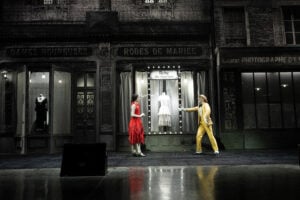
“Le Mime et L’Étoile”
So which is it? Pride in a past that has been falsified by revisionist historians, or pure escapism? You can’t have it both ways: pride in something that didn’t happen is tough to justify. At times, Nicolas’s evasiveness on the subject seems indistinguishable from his ideological indeterminacy. Does he share his father’s views, or is he merely a shrewd businessman, sitting on the overstuffed suitcase of his political inheritance? At several points during our talk, he betrays a certain fogyism—about “beautiful places” in Paris disfigured by modern sculpture, or the failure of the current generation of parents to teach their kids basic manners—that might hint at a disposition that he is too savvy to express openly. Is his nod to civil war not an unambiguous tell? After the meeting in 2014, Nicolas spoke of Putin’s “sweet eyes and sweet words” and defended Malofeev, the oligarch, as a man of “great moral power.”
And yet: the studied neutrality. Nicolas waves off any whiff of partisanship. “We don’t deal with current political issues, because we stay in a very past history.” Again, any difficulties are resolved by an appeal to commonsensical levity. Lighten up. It’s a theme park. We’re just here to make people happy.
“To the journalists or the few people from Paris, who say”—and here Nicolas puts on the wheedling voice of the pre-offended bobo—“ ‘Oh my God, you make bad shows because of blah blah blah,’ I say, ‘Come to see us.’ ” Nicolas laughs. “And when they see the shows, they say, ‘I’m sorry, I made a mistake. You are not reactionary, you are not dangerous, you are not, like, oh là là, you are not at war against anybody.’ No, we are not. We just want to heal the pain of people.”
Maybe he has a point. After “Le Secret de la Lance,” I go to see “Le Mime et L’Étoile,” an indoor show set in a silent-movie studio in 1914. The set, a Belle Époque street lined with cafés, boutiques, and butchers, fifty feet high and over a mile long, glides past us as the actors proceed on a hidden moving walkway in the opposite direction, so the impression is of an extended tracking shot. The storefronts are rendered with a mix of traditional set design and state-of-the-art, black-and-white projection mapping. It’s glorious—technically astonishing, gracefully choreographed, affectingly scored, and like the best of the silent romances that inspired it, sentimental without a hint of schmaltz.
“It’s a nice spectacle,” admits Hazareesingh. “And presumably if you’re not thinking about it in ideological terms, it’s entertaining.” Lancereau takes a similar view. “We enjoyed it very much when we went there,” he tells me—this from the guy whose co-author received a death threat after Puy du Faux was published. Even if the history is tendentious bullshit, so what? No one’s going to have their political bearings reset by a couple of days at a theme park. For Lancereau, the shows at Puy du Fou are far less likely to influence people’s political views than what they read and watch every day. A visit to Puy du Fou is a special occasion, and “exceptional moments are less important than repetition.” If anything, support for the far right is more cause than effect of the popularity of nostalgic historical reconstructions. As Lancereau puts it: “I vote for A, so I’m going to consume B.”
Even then, the notion of Puy du Fou as a bellwether depends, perhaps, on a level of ideological engagement not habitually applied to a family day out at an amusement park. Maybe Puy du Fou is just the air we breathe, a measure of what it is acceptable to say. When I ask Titem and Ahmed whether, as Parisians of Arab descent, they think the traditional values promoted at Puy du Fou are representative of modern France, I get a Gallic shrug. “I really like it,” says Ahmed. “I didn’t know it would be so good.”
On my last afternoon at Puy du Fou, I take my stone seat in the Gallo-Roman amphitheater, where it quickly becomes apparent that I have been allocated a side. I’m with the Gauls. The show is called “Le Signe du Triomphe.” It is the fourth century. The empire is crumbling. Undeterred by Diocletian’s persecutions, the plucky Christians of Gallia are in a defiant mood. A rebel chieftain in a gray tunic, oatmeal cloak, and fur mantle leads us in an oafish chant. “GAUL-OIS, GAUL-OIS, GAUL-OIS!” On the opposite side of the arena—oval like the one at Nîmes, and 125 yards from end to end, with room for 7,000 spectators—the Roman governor is having none of it. “Silence!” he thunders. “There is no more Gaul. There is only the empire.”
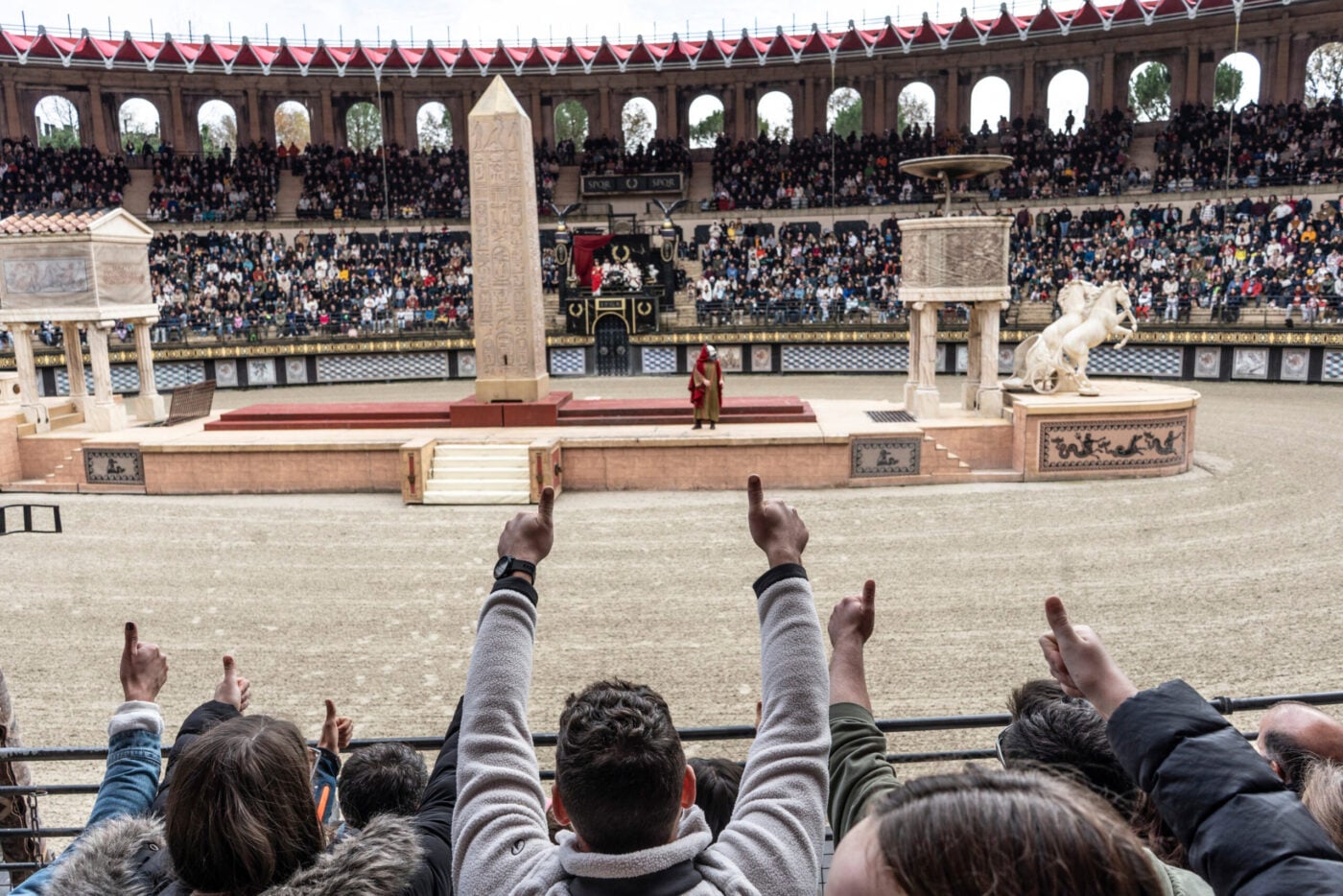
“Le Signe du Triomphe”
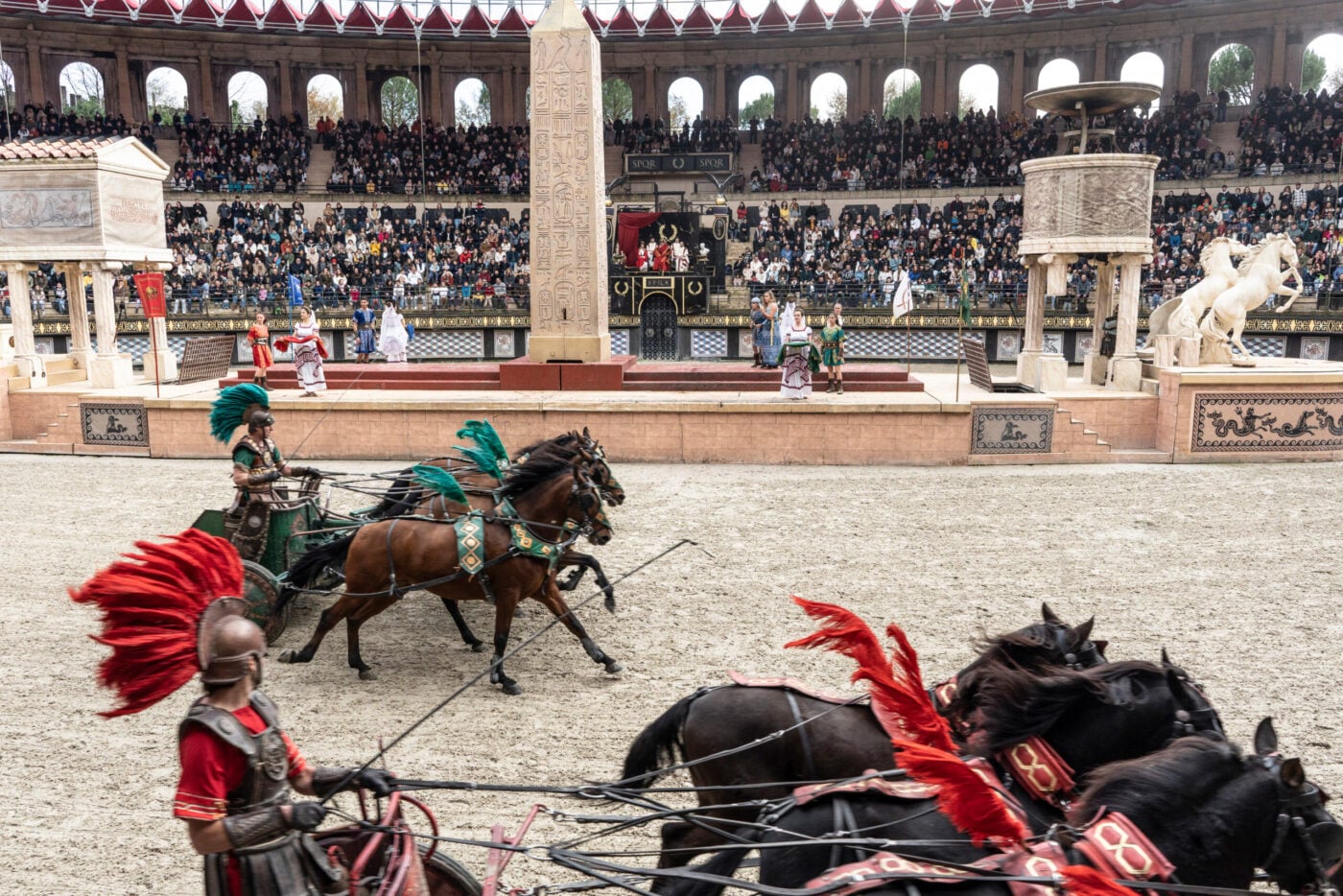
“Le Signe du Triomphe”
A parade is put on to keep the rabble happy. To a fanfare of horns, a centurion on horseback leads the six vestal virgins, a bronze Capitoline wolf carried on a litter, goats, camels, a carnival-float bacchanal drawn by oxen, and a flock of waddling geese in flying-wedge formation greeted by the audience with a gasp of biophilia. (“People need to gather and to feel something very real,” Nicolas tells me later. “Not only beautiful stories, but also real stories, with real horses onstage, real birds, all these things that you can’t touch anymore in the big cities.”)
It turns out that Damien, the Gallo-Roman centurion, must defeat the three greatest charioteers of the empire in a Ben-Hur–style race to save his Christian girlfriend, Soline. Our God-fearing hero is very much in white: white plume on his galea, white chariot pulled by four white horses in white harnesses. His opponents are decked out in blue, red, and green. After a few laps around the arena, the blue chariot loses a wheel. The red one collapses entirely, leaving its driver dragged by his horses on a fragment of side panel. The green chariot falls behind on the home stretch. White wins. But the despotic, elitist, out-of-touch governor tricks Damien: the Gauls must face yet another, even harder trial. The Gaulish stands erupt in boos.
Soline makes a rousing speech. “Don’t you see, representative of the last Caesar, that this world is sick, old, out of breath, that your empire is cracking everywhere, that an imminent crisis is brewing, that new and unknown things are going to happen? This world of which you speak—it is collapsing.” The governor announces the final trial: a naumachia, a mock naval battle. The large stage in the center of the arena unfolds to become a trireme spurting fire from its gunwales. A massive sword fight breaks out on deck, although, spoiled as I have become by the rotating grandstands and hoisted hillsides, I’m a little disappointed not to see the arena fill with water.
It’s a squeaker. The gunwales are ablaze. The plucky Gauls prevail, again, but the governor, refusing to admit defeat, stands amid the flames gesturing megalomaniacally at the sky. As ever, it’s not looking good for honest, upstanding Christendom until, after a disorienting pause, there’s a choral bloom of celestial music and the fires go out. The governor’s soldiers turn on him. He is banished, and in a tonal lurch from Quo Vadis to Life of Brian, his robes fall off as he runs across the sand. The governor has no clothes. A white dove flutters down and lands on Soline’s forearm as Damien, the muscular, reproductively viable Christian hero, submits to the will of the people: to succeed the globalist, Jupiterian bully as their leader. Damien raises a fist. Evil has been vanquished. The old order is dead.