
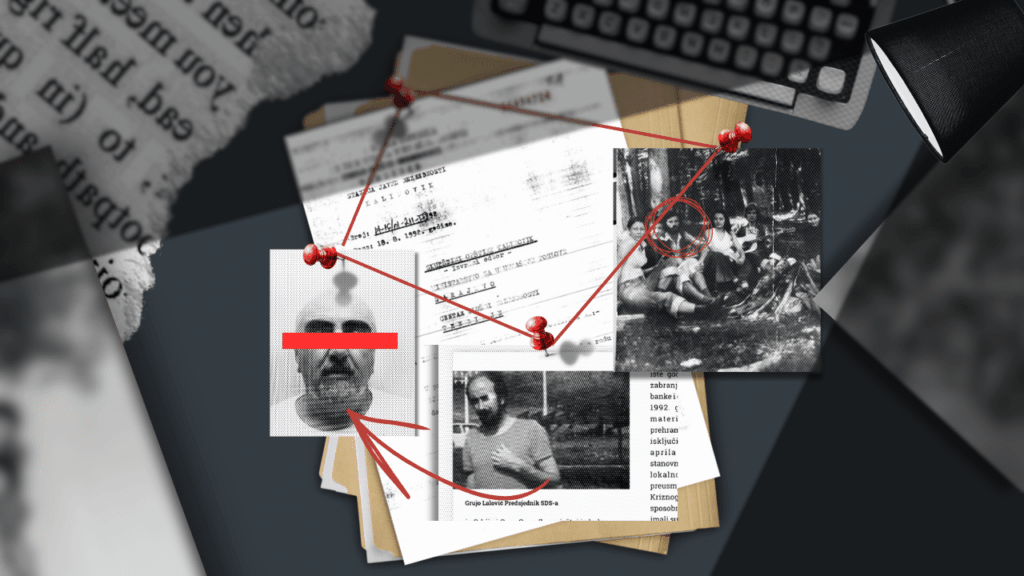
According to a report on SJB activities in April-August 1992, signed by Govedarica, in July military commanders in Kalinovik requested support from forces in Foca, and a group of 100 armed soldiers arrived.
The court in the trial of Bundalo and his co-accused found that these soldiers were subordinated to the Kalinovik Tactical Group, the military unit led by Bundalo.
The SJB report signed by Govedarica details abuse meted out by these soldiers on detainees in the Kalinovik school, including the theft of jewellery and money.
In the trial of Krajisnik, the ICTY established that the responsible persons of the SJB Kalinovik knew about these events.
The report signed by Govedarica claims that “Muslim military eligible males from the elementary school in Kalinovik, which this SJB was guarding, were transferred to a military prison” under the command of the Kalinovik Tactical Group.
In 2013, Fejzija Hadzic told the ICTY trial of Mladic how, on August 5, 1992, he survived the execution of a group of Bosniaks who had been held at the Kalinovik school and the old gunpowder depot.
“They told us we were going to a prison in Foca to be exchanged,” he said of their Bosnian Serb military captors.
“They tied the hands of the younger ones with wire. They tied my hands too and hit me on the head. They loaded 24 of us into a truck and drove us to a meadow. They lined us up in a column and shot us from the side with automatic rifles. A bullet hit me in my left leg, I fell, like the others, and pretended to be dead.”
According to Hadzic, the soldiers took their victims to a nearby barn, which they set on fire.
“I managed to jump into the lower part of the barn and escape,” he said.
Among the victims was Memna Jasarevic’s husband, Hilmo, who had taught art at the school.
In an interview with Detektor, Jasarevic said Bosniaks were summoned for compulsory labour under an order signed by Grujo Lalovic in May 1992. They were rounded up and eventually killed.
“He [Hilmo] was taken and imprisoned first in the school, then in the detention camp in the Gunpowder Depot,” said Jasarevic.
“People were summoned to respond to work, and they responded, and they detained them,” she said. “So there can be no dilemma as to who was responsible for these people.”
Hilmo’s remains were identified in 2004.
In the trial of Bundalo and his co-accused, the trial chamber found it can be clearly seen in entry and exit records made at the old gunpowder depot that many detainees were regularly removed to carry out work on the approval of Govedarica.
Vranovic, who is still searching for his father, said he remains bitter that only a handful of people have been convicted for the murder of more than 100 in Kalinovik.
“As time passes, we have major obstacles,” he said. “We are not satisfied with the Prosecution of Bosnia and Herzegovina; we are not satisfied with the Prosecution in Serbia either.”