
SPRINGFIELD, Mo. (KY3) – Artificial intelligence has gone from buzzword to bedside. Hospitals tell us they’re using it to support, not replace, doctors.
The use of AI has been a divisive topic for quite a while. KY3 reached out to local health care providers about how AI is being used in hospitals and clinics, and what kind of human oversight is used alongside the AI to ensure the patients are receiving the most accurate care.
“The first models in healthcare in general were the identification of patients that only seen as a risk,” said Byron Yount, Chief Data and AI Officer for Mercy Health. “So at risk for future disease, at risk for a future healthcare-related event, deterioration in the acute care setting.”
“A lot of people, when they think of AI, they think of large language models like ChatGPT or what they’re used to working with. But AI is a lot broader than that,” said Dr. Shannon McMurtrey, assistant professor of cybersecurity at Drury University. “And they’re adding a lot of value. They’re definitely advancing the field of medicine in a lot of interesting and positive ways.”
Artificial Intelligence has been used in healthcare, to some extent, for many years. Recently, new models are taking on a more significant role for providers.
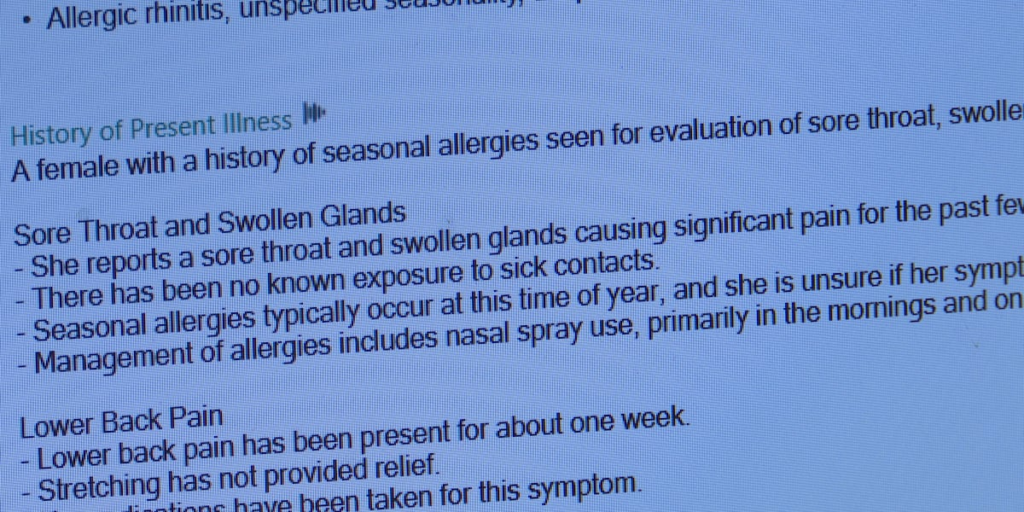
For clinic physicians like Dr. Barbara Bumberry, it used to take detailed notes of patient interactions.
“With AI ambient voice, it is like having a microphone in the corner of the room. It will listen to the conversation that I have with a patient,” said Dr. Bumberry. “Basically, it makes a temporary recording of that conversation, and then it knows how to detect the relevant information in order to put that note together.”
For Dr. Bumberry, she no longer has to spend as much time documenting her patient visits.
“By the time I finish talking with the patient here and I go back to my office, pull up their chart, then the note’s already done. I mean, it’s almost always already completed by the time I sit down at my desk,” said Dr. Bumberry. “So at the end of the day, instead of having 20-something notes that I have to dictate, I just have 20-something notes that I just have to go through and review real quick. So that definitely does save time.”
For radiologists, like Dr. Patrick Mullin, it identifies urgent findings and prioritizes them for the responding doctors.
“Whether it be CT scans or X-rays, it can expedite the transmission of findings to providers,” said Dr. Mullin.
The AI models used by providers, with the help of those same providers, can continue to learn after they are introduced.
“In talking to the AI team, the improvements really do come on the back end with the feedback of the radiologists. And so, you know, if we notify them of either a false negative or a grossly false positive, then they can go back and tweak their algorithm,” said Dr. Mullin. “It still requires a decent amount of feedback; it’s not necessarily teaching itself. It still requires a human radiologist in order to offer feedback so that they can improve their algorithm.”
“Probably the best analogy there is to think about is like self-driving cars. Tesla at this point has close to 10 billion miles of driving data, where the cameras have gathered data that they use to train their self-driving models. And they’re approaching the point now where they’re more safe than human drivers, and they’ll just continue to get better,” said Dr. McMurtrey. “The more diagnostic images that the medical models are exposed to and trained on, the better they’ll get.
Doctors and leadership alike agree that a human still has to confirm what the system flags, especially because the AI models can sometimes hallucinate or generate false positives.
“It’s better than having false negatives and falsely reading negative scans, but it’ll identify a finding, and we can confirm whether or not that finding is real and whether or not that needs to be conveyed to the ordering clinician,” said Dr. Mullin.
“We’ll always have a need to have a human in the loop. Just monitoring progress and making sure that things are going as expected,” said Dr. McMurtrey. “I think that whole area of regulatory compliance and monitoring the appropriate use of AI, the ethical use of AI, that is probably one of the most important questions that we’ve got to answer right now.”
To report a correction or typo, please email digitalnews@ky3.com. Please include the article info in the subject line of the email.
Copyright 2026 KY3. All rights reserved.