
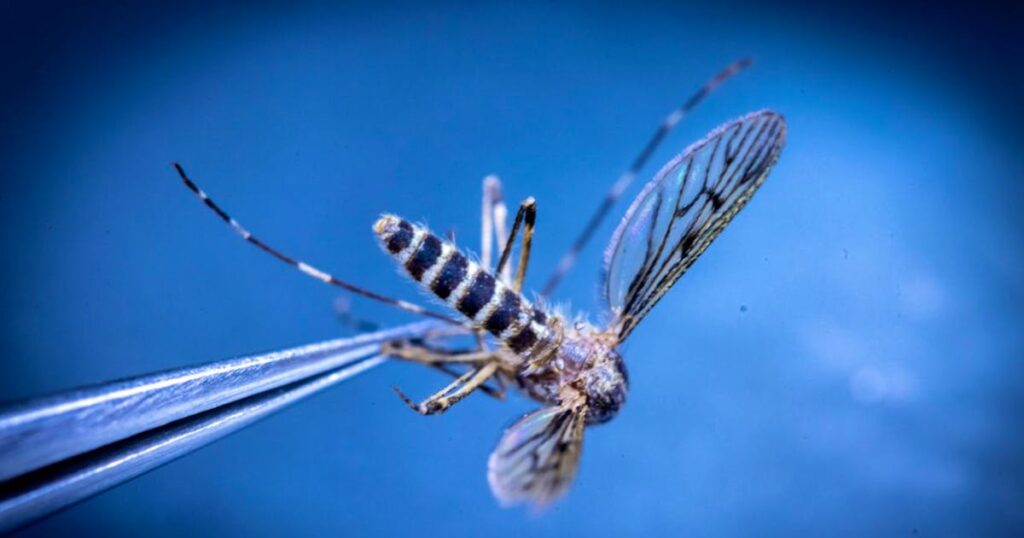
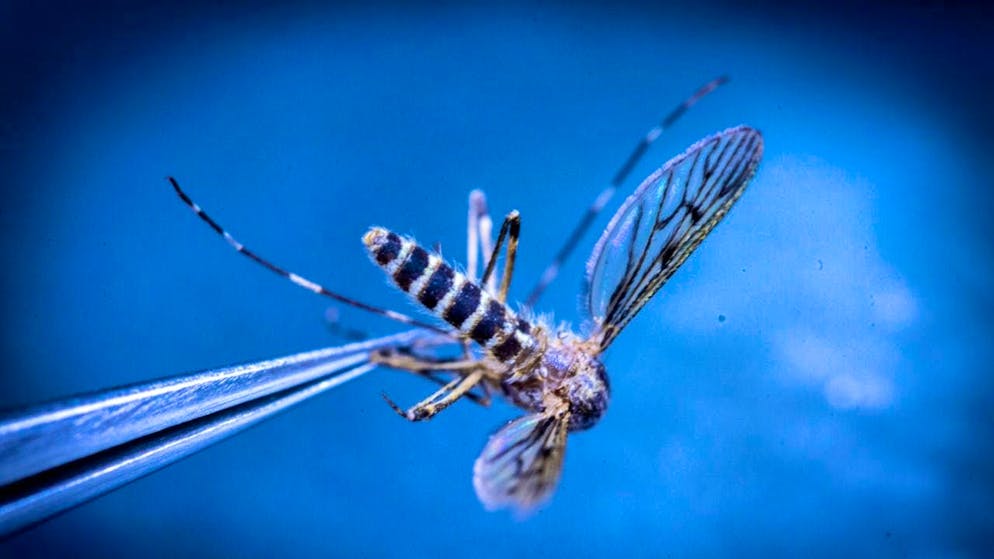
Many consider them to be a nuisance, but their role in ecology should not be underestimated: Mosquitoes.
Archive image:
Keystone
Iceland was one of the few places on earth that was spared from mosquitoes. For researchers, the fact that the bloodsuckers have now also been found there is part of a larger change in the Arctic.
- In October 2025, mosquitoes were discovered in Iceland for the first time.
- Climate change is altering the behavior of insects in the Arctic, which has consequences for the entire environment.
- One example: If insects sprout before chicks are born, they will be missing as food.
Due to the warming of the Arctic and greater human activity, mosquitoes and other arthropods in the region are therefore moving in new ways and on new scales.
This has major consequences for the entire Arctic environment, writes a research team in the journal “Science”. In addition to insects, arthropods also include spiders, millipedes and crabs.
In October 2025, three ringed midges (Culiseta annulata) were discovered in Kjós, around 50 kilometers north of the Icelandic capital Reykjavík.
The Arctic is warming extremely quickly
According to the Icelandic Institute of Natural Sciences, this was the first discovery of mosquitoes on the island. It joins a growing number of new insect species that have recently been identified in the country.
It is uncertain whether the mosquito has settled permanently in Iceland, according to the institute’s statement. However, there is every indication that it can survive under Icelandic conditions.
The Arctic is warming four times faster than the rest of the world, write the authors of the Science article. “Snow is melting earlier, summers are getting longer and disturbances such as forest fires are occurring more frequently.”
Consequences for the ecosystem
US scientists Amanda Koltz (University of Texas) and Lauren E. Culler (Dartmouth College in Hanover) emphasize that all of this has consequences for the birds and reindeer that live there.
If, for example, the occurrence of insects peaks before the chicks of the birds breeding there have hatched due to climatic changes, there is not enough food for the latter.
Reindeer suffer from the increased insect bites, which increases their energy consumption and thus impairs their reproduction, among other things. The authors call for better coordination of the monitoring of mosquitoes and other arthropods in the Arctic.