
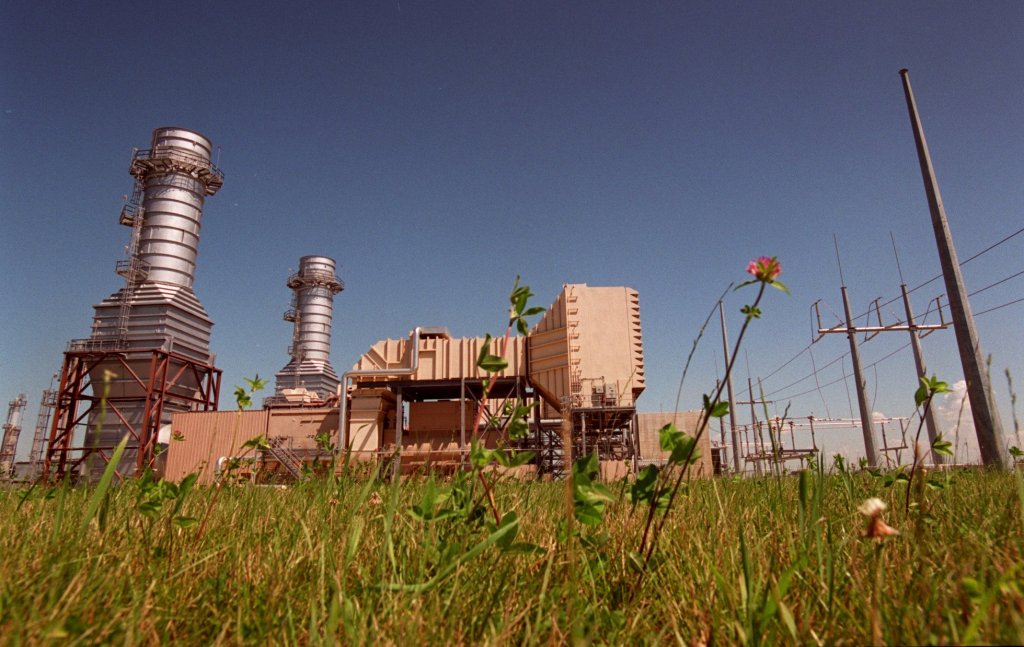
The owner of two-thirds of a massive natural-gas-fired power plant in Will County is moving their part of the facility to Texas.
Literally.
As in, putting huge turbines on flatbed trucks and driving them south to friendlier climes.
We’ve learned that two-thirds of the capacity at the 1,350-megawatt Elwood Energy facility — the largest natural-gas-fired peaker power plant in Commonwealth Edison’s territory and one of the biggest in the nation — now is being shut down thanks to Illinois’ landmark clean-energy law enacted in 2021. The sudden removal of that whopping 900 megawatts of capacity could well drive up local electric bills that already have been rising.
Imagine that an entire nuclear reactor were shutting down for good in northern Illinois. The move at Elwood Energy is the equivalent.
This startling development should raise alarm bells in Springfield, which already has heard warnings from experts that power capacity could fall short of what’s needed in Illinois within the next five years.
Under the 2021 statute in question, the Climate & Equitable Jobs Act, Elwood was required to stop operating by 2030. The law, one of Gov. JB Pritzker’s signature accomplishments, requires Illinois to phase out the burning of fossil fuels for electricity by 2045 and sets an earlier 2030 deadline for closing certain gas-fired plants. The idea was to reduce emissions contributing to global warming while simultaneously replacing those polluting sources with clean technologies like wind and solar power.
But here’s the kicker: At least as it concerns the massive Elwood facility, CEJA isn’t helping the environment while also likely raising power prices for ComEd customers.
Rather, it’s the worst of all possible worlds.
Hull Street Energy, of Bethesda, Maryland, early last year acquired six of the nine 150-megawatt gas turbines that have been running at Elwood. The timing was interesting given that the plant wasn’t likely to be allowed to operate for long.
Now, we have a better idea of the rationale for the deal. The equipment was valuable to Hull Street — but not if it stayed in Will County. The firm’s decision to move the turbines to Texas, where they will continue to operate, makes sense because there’s high demand even for older equipment like this. We’re told there’s a five– to seven-year wait to purchase new gas turbines.
So not only will there be no reduction in overall emissions due to CEJA, the Chicago area will lose 900 megawatts of power that had been critical to meeting peak demand and helped dampen prices during those peak periods.
Here’s some context on just how much juice that is. Just down the road from Elwood is Morris, home to Constellation Energy’s Dresden nuclear station, where two reactors combine to generate up to 1,845 megawatts. The six Elwood gas turbines that are heading south are the equivalent of one of Dresden’s reactors in terms of capacity.
There’s yet more to this story.
The remaining three units at Elwood will continue to operate at the site and now will be permitted to do so under the law until 2045. Why? Because the previous owner, J-POWER, sold those three units to Dairyland Power Cooperative, of LaCrosse, Wisconsin, which by virtue of being a nonprofit is allowed by CEJA to operate gas-fired power plants over the next few decades that otherwise would have to shutter in a few years.
So those emissions also will continue well into the future, but only because ownership changed from a private company to a nonprofit.
Yes, that’s how CEJA works. If you’re not a privately held gas-plant operator, you can continue to pollute.
And, if the optics of the Elwood Energy saga weren’t bizarre enough, Dairyland over the next year will sell the output from those three remaining Elwood turbines into a separate power market that serves downstate Illinois but not the northern part of the state. So, at least in the short term, what’s left of Elwood Energy won’t contribute to meet demand in Chicagoland, potentially inflating prices here that will be reflected in electric bills. That’s 1,350 megawatts — poof, gone.
A Dairyland spokeswoman tells us the cooperative will determine after that two-year period whether to serve northern Illinois or downstate Illinois, as market conditions change. Presumably whichever region fetches the higher price will be the one Dairyland chooses in the future.
Does any of this make any sense in a rational world? No, it doesn’t.
But it is a sorry reminder of the unanticipated consequences that can and do occur when policymakers interfere in such heavy-handed ways in complex industries like power generation that they usually don’t understand. With CEJA, the Pritzker administration bowed to the demands of environmentalists and imposed inflexible timelines on gas-fired plants that have proven critical to keeping the lights on in the Chicago area as old coal burners that once accounted for half the region’s capacity gradually retired.
The industry warned Springfield five years ago that the 2030 deadline wasn’t realistic. The warnings went unheeded.
For its part, the governor’s office notes that Elwood wasn’t required to shutter for another three-plus years. “Operators ultimately make business decisions based on a range of factors,” a spokesperson tells us.
Team Pritzker lauds last year’s amendments to CEJA, which included a new surcharge on electric bills to support the construction of batteries that can store power from intermittent sources like wind and solar and deploy the juice when later needed. The law importantly also gave regulators at the Illinois Commerce Commission new authority to temporarily lift the law’s plant-closure mandates if facilities are needed. This page backed those CEJA changes.
But it turns out that ICC authority comes too late for at least some operators facing 2030 deadlines, industry representatives tell us. The ICC’s determinations under the new regulatory regime won’t be made any earlier than late 2027. And plant operators must notify PJM Interconnection, the grid operator for a multistate region that includes northern Illinois, by this coming December whether they intend to bid into PJM’s next capacity auction. Successful bidders must be able to deliver over a three-year period from June 1, 2027, until May 31, 2030, so plants required by CEJA to close Jan. 1, 2030, can’t qualify.
In other words, Springfield didn’t solve the short-term Chicagoland power crunch last year. Lawmakers should do so now. It will anger the green lobby, but the governor should call on legislators at a bare minimum to extend CEJA’s 2030 plant-closure deadlines by at least another couple of years.
Submit a letter, of no more than 400 words, to the editor here or email letters@chicagotribune.com.