
Even before the start of Russia’s full-scale war in Ukraine, Radev argued that Western sanctions imposed on Russia over the 2014 annexation of Crimea should be lifted.
On April 19, Bulgarian citizens will head to the polls for the eighth snap parliamentary election in the past five years. Pollsters are giving a solid lead to former president Rumen Radev and his party, Progressive Bulgaria. Notably, the party is being formally established today, April 17, just hours before the end of the election campaign.
Radev is a former military pilot and former commander of the Bulgarian Air Force. He was first elected president in 2016 and won a second term in 2021. Radev resigned from the presidency once it became clear that Bulgaria was heading to yet another election. His resignation followed years of speculation that he might eventually leave the presidency and enter party politics.
During his time as head of state, Radev appointed a total of seven caretaker governments. His opponents accused him of exploiting the political crisis and the absence of a regular cabinet in order to govern through administrations appointed by him.
Ever since he emerged on the political scene in 2016, the geopolitical orientation of the now former president has been under constant scrutiny. Even before the start of Russia’s full-scale war in Ukraine, Radev argued that Western sanctions imposed on Russia over the 2014 annexation of Crimea should be lifted. During a presidential debate in 2021, he stated bluntly that Crimea was Russian. He later tried to soften that position, saying he had meant that Crimea legally belonged to Ukraine but was de facto under Russian control. Still, the public, both in Bulgaria and across Europe, did not forget the remark. Just days before the end of the campaign, one of Progressive Bulgaria’s lead candidates, Ivan Demerdzhiev, a former caretaker minister under Radev, also refused to answer the questions “Whose is Crimea?” and “Is Putin an aggressor?”
At the beginning of Russia’s aggression, Radev argued that Ukraine could not succeed on the battlefield and that diplomacy was the only possible path to peace. In 2023, during Volodymyr Zelensky’s visit to Bulgaria, the two heads of state clashed openly. The reason was Radev’s opposition to military aid for Kyiv. In his view, such assistance would “only prolong the conflict.”
The former president is an outspoken opponent of sanctions against Russia, claiming that they do more damage to those who imposed them than to Vladimir Putin’s regime. In his latest appearance on one of Bulgaria’s major YouTube podcasts, Radev defended the position that Europe should resume its economic ties with Russia. He said that for both Bulgaria and Europe, Russian energy sources would always remain the cheapest option.
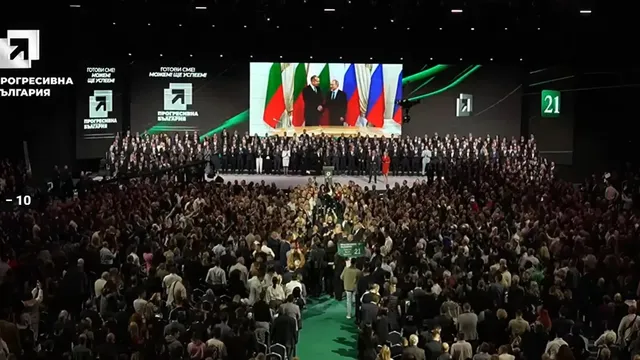
Even at the close of his campaign, Radev refused to dispel doubts about his sympathies toward Russia. On the giant video wall in the hall, a video was projected showing Radev shaking hands with Putin.
The election in Bulgaria comes just one week after Viktor Orban lost the parliamentary vote in Hungary on April 12, bringing his 16-year rule to an end. Orban was the European leader with the closest ties to the Kremlin. The Hungarian prime minister repeatedly blocked sanctions on Russia and aid to Kyiv by using his veto power in the European Council. Many international media outlets describe Radev as “the new Orban” and argue that his victory would benefit above all the master of the Kremlin.
Politico identifies Radev as a possible successor to Viktor Orban’s role as a destabilizing factor in the EU, especially on the issue of Ukraine. The publication recalls his statements that Ukraine was “doomed” and that military aid was deepening the conflict, as well as his tensions with Zelensky in 2023.
The Telegraph writes that a possible victory for Radev would be favorable to Putin, describing him as a Eurosceptic who is critical of support for Kyiv. Reuters also portrays him as a key figure with pro-Kremlin positions, noting controversial decisions by his caretaker governments and the need for him to clarify his stance on Ukraine.
Balkan Insight sees Progressive Bulgaria as his political vehicle, with the potential to attract voters from pro-Russian parties, although so far without openly pro-Kremlin rhetoric.
Western media view the election as a symptom of deep instability, the eighth vote in less than five years. According to Reuters and the Associated Press, the main problem is the absence of a stable majority, turning the country into an example of a blocked democracy.
The Associated Press stresses that political uncertainty undermines trust, fuels populism and makes Russian influence easier. That is why, for the West, Bulgaria is not a peripheral issue but an important factor in preserving European unity.
The Wall Street Journal warns that the election could alter the country’s geopolitical course. The paper links the crisis to anti-corruption protests and new public momentum, seeing Radev as a potential beneficiary of the collapse of the status quo.
At the same time, concerns have emerged over disinformation and foreign interference in the Bulgarian election. EUobserver reports that Radev’s popularity on TikTok has been artificially inflated through a coordinated digital campaign resembling the case seen in Romania. According to Balkan Free Media Initiative and Sensika, he amassed tens of millions of views through networks showing suspiciously inorganic behavior. The publication underlines that Bulgaria’s information environment is increasingly influenced by uncontrolled forces, while the state is lagging in its response, turning the election into part of a broader information war in Europe. | BGNES
—
BGNES News Agency