
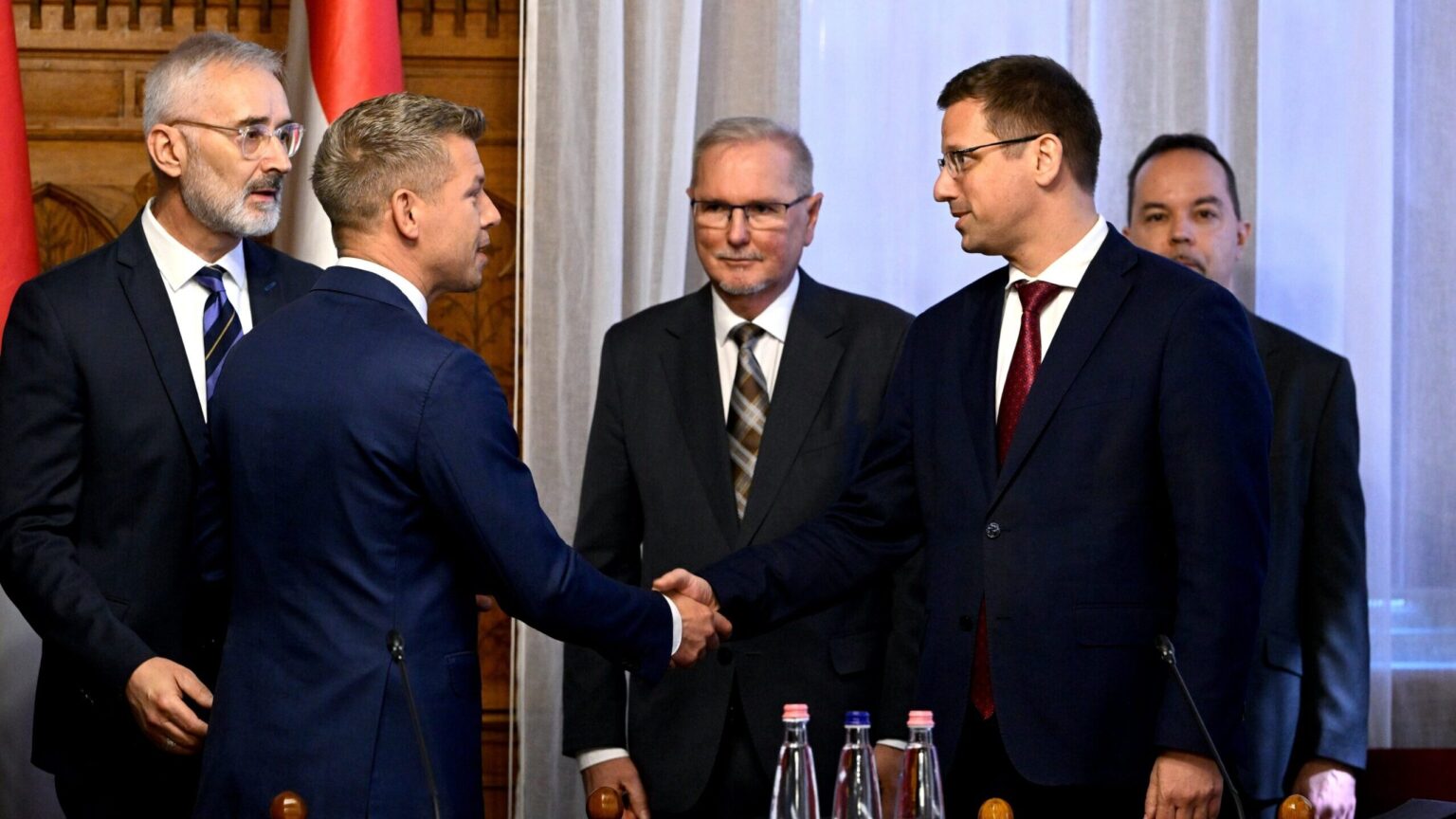
Formal preparations for the inaugural session of the new National Assembly began on Friday, 17 April, with delegations from the three parliamentary parties—the Tisza party, Fidesz–KDNP, and Our Homeland (Mi Hazánk)—meeting in parliament, in what all sides described as ‘constructive and pragmatic’ talks.
Prime minister-elect Péter Magyar, who led the Tisza delegation, framed the meeting as a departure from the political practices of the past decade. ‘We came here to discuss committee positions, parliamentary leadership roles, the functioning of parliament, and the organization of the inaugural session,’ he said. Magyar stressed that the Tisza Party is preparing for a government of compromise and would like to listen to the representatives of other parties as well, despite its supermajority in parliament.
Tisza won a landslide in the 12 April election, ending the 16-year rule of Viktor Orbán’s Fidesz–KDNP. The party, led by Péter Magyar, secured 137 seats— a number that could increase as postal votes are currently being processed—of the 199-member parliament, giving it a comfortable constitutional majority. ‘This is an enormous, unprecedented mandate, which comes with enormous responsibility,’ Magyar said, pledging to represent ‘all Hungarians, including those who did not vote for us.’
‘We do not want an interregnum where the Orbán government remains in place but the prime minister is called Péter Magyar’
Among the concrete proposals discussed during Friday’s negotiations was the timing and structure of the inaugural parliamentary session. Magyar confirmed that Tisza had suggested holding the session on a weekend in early May—potentially 9 or 10 May—to allow for a large public rally on Kossuth Square. ‘We would like to announce a major national public event for the day of the inaugural session and the election of the prime minister,’ he said. He also proposed that the prime minister be elected and sworn in on the same day—an approach not seen since 1990—which, he noted, was accepted by the participating factions.
The outgoing governing parties, represented by Gergely Gulyás, Minister heading the Prime Minister’s Office, signalled a willingness to ensure continuity in the transition process. He requested that parliamentary committees begin hearings of ministerial candidates immediately after the prime minister’s election. ‘We do not want an interregnum where the Orbán government remains in place but the prime minister is called Péter Magyar,’ Magyar recounted, adding that he agreed with the proposal.
Institutional arrangements also formed a central part of the discussions. Tisza proposed expanding the number of parliamentary committees to 20 and indicated openness to compromise on their composition. Magyar also explained that Tisza proposed that opposition parties should have three deputy speakers, one for each party—Fidesz, KDNP, and Our Homeland—marking a shift compared to the previous cycle, when Fidesz–KDNP held four of the six deputy speaker positions.
‘Gulyás acknowledged both the unexpected scale of the loss and the need for renewal’
Our Homeland leader László Toroczkai welcomed the tone of the talks, stating that ‘the negotiations took place in a distinctly constructive atmosphere.’ He added that, unlike in 2022, when talks broke down and the speaker unilaterally determined positions, ‘it now seems that the three sides can reach an agreement.’ Toroczkai also noted that his party had proposed the creation of investigative committees and supported symbolic elements such as taking the oath before the Holy Crown—ideas to which Tisza signalled openness.
For Fidesz, the meeting marked the beginning of a period of internal reassessment following its electoral defeat after 16 years in power. Gulyás acknowledged both the unexpected scale of the loss and the need for renewal. ‘It is clear that a parliamentary group is needed that can symbolize the renewal of Fidesz,’ he said, adding that the party must also rely on experienced policymakers. He conceded that polling failures had contributed to misjudging the race: ‘The surveys were incorrect…it was a mistake to rely on them.’
At the same time, Gulyás described the tone of the negotiations as ‘correct’, stressing that the new two-thirds majority ‘will ensure the same conditions for the opposition that the previous governing side ensured for a one-third minority.’
Related articles: