
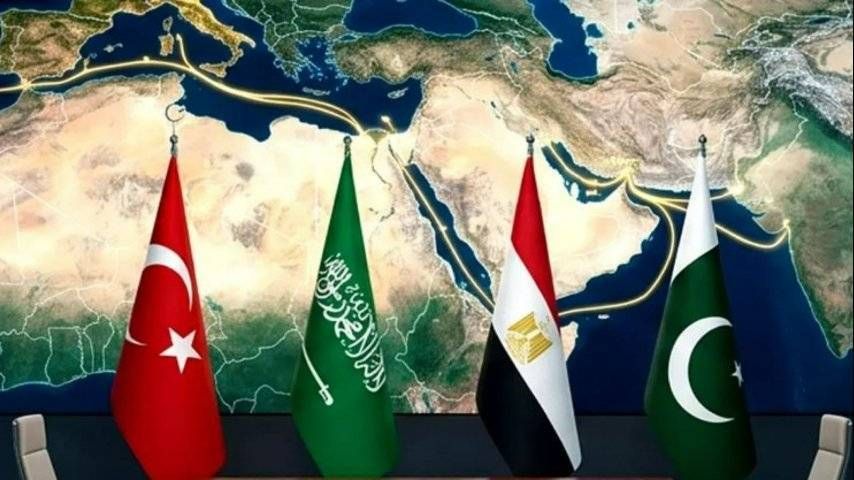

As the gears of global diplomacy turn at the Antalya Diplomacy
Forum, a significant new security architecture is beginning to take
shape. Türkiye is currently spearheading discussions with Pakistan,
Saudi Arabia, and Egypt to establish a structured regional security
platform, a move that signals a departure from traditional reliance
on external powers toward a more autonomous, regionalized defense
framework. With Turkish Foreign Minister Hakan Fidan emphasizing
that regional stability must now rest on the mutual commitment of
local actors to one another’s sovereignty, the proposal is more
than just a diplomatic formality; it is an attempt to
institutionalize a “unity of heart” and action across a vast,
strategic geography.
This emerging quadrilateral alignment, spanning from the Eastern
Mediterranean to the Indian Ocean, seeks to synchronize defense
industries, coordinate maritime security, and provide a unified
response to the crises haunting the Muslim world. However, the true
strategic depth of such an alliance, and the regional power vacuums
it intends to fill, requires a perspective that looks beyond the
official communiqués.
Speaking to AzerNEWS, on the issue, former
military attaché and retired general Yücel Karauz underlined that
the world is witnessing a daily increase in threats and risks. He
noted that against these rising challenges, countries that share
religious, ideological, and political commonalities, and view
events through the same lens, are striving to collaborate and
deepen their cooperation.
“Consequently, the recent pursuit of an alliance between Saudi
Arabia, Egypt, Pakistan, and Türkiye must be evaluated within this
framework. All four nations possess the potential to lead the
Muslim world and geography, occupying positions and locations
capable of steering other countries,” former military attaché
said.
Mr Karauz underscored that this alliance covers the Eastern
Mediterranean and North Africa through Türkiye and Egypt, the Gulf
and the Red Sea through Saudi Arabia, and South Asia and the Indian
Ocean through Pakistan, it can develop measures against
developments in four distinct regions.
“Viewed from this perspective, the platform’s primary goals are
coordination in counter-terrorism, maritime security, defense
industry cooperation, and a synchronized reaction to crisis zones
such as Gaza, Sudan, and Libya. Therefore, rather than a classic
military alliance, this partnership is a flexible, multi-layered
structure designed to create a consensus of thought and a “unity of
heart” against shifting threats and situations.
Why is this happening now? Because there are regional power
vacuums in the world. For instance, the diminishing influence of
Iran has created a power vacuum in the Middle East. Concurrently,
countries like Türkiye, Egypt, Saudi Arabia, and Pakistan have
continuously evolved into mid-sized regional powers. As a result,
the nuclear capabilities, military capacities, and
security-oriented approaches of these nations are converging,” he
said.
Yücel Karauz opined that history often sees the emergence of
regional pacts, such as the Baghdad Pact or the Saadabad Pact. This
current pursuit of power is intended to elevate these countries to
a position where they can be “playmakers” rather than “pawns” in
someone else’s game. Furthermore, it should be read as a “third
way”—an architecture of security, diplomacy, and a shared spiritual
unity.
“As mentioned, the combined geographical locations,
political-military strength, and defense industry potential of
these four countries give birth to a new capacity. In this respect,
it is a formidable partnership. However, challenges remain. For
example, relations between Türkiye-Egypt and Saudi Arabia-Türkiye
have historically been fragile. Additionally, each country
perceives threats differently. To bridge these differences, they
could form a partnership that addresses issues similar to those in
NATO’s scope, such as counter-terrorism or contemporary challenges
like irregular migration and drug trafficking. To be clear, this is
not a NATO; it is not a formal military pact” he emphasized.
Retired general noted that Türkiye’s leadership in such an
initiative is particularly significant following the events in
Gaza, Lebanon, and Iran, as there is a universal search for justice
and rights. Türkiye’s role in leading this togetherness should be
viewed through its status as a regional power that can engage in
dialogue with China, Russia, and the USA alike.
“If steered correctly—moving forward through mutual interests
rather than divisions—this cooperation will benefit both the region
and Türkiye. Otherwise, without creating a genuine synergy, it
risks remaining a project that exists only on paper,” he
concluded.