
In a show of complete cross-party consensus, all 17 Bulgarian Members of the European Parliament have signed a joint letter to their colleagues firmly rejecting any attempt to reopen or reinterpret the EU’s 2022 Negotiating Framework with North Macedonia. The letter, obtained by EUalive, warns that initiatives such as Amendment 108 in the upcoming annual progress report risk undermining the credibility of the entire enlargement process and the principle of pacta sunt servanda.
MEP Waitz questions Bulgaria-North Macedonia protocol in draft report, sparking political pushback
The Bulgarian delegation – spanning EPP, S&D, Renew, ECR and other groups – is reacting to recent media reports in Skopje about a North Macedonian non-paper and letter circulating in the European Parliament, as well as Amendment 108 tabled by rapporteur Thomas Waitz (Verts/ALE). That amendment calls on the Council’s Legal Service to “urgently clarify all ambiguities” regarding the legal status of the Second Protocol to the 2017 Treaty of Friendship, Good Neighbourliness and Cooperation between Bulgaria and North Macedonia.
“There is no legal uncertainty to clarify,” the Bulgarian MEPs state unequivocally. “The Protocol is an integral part of the European Consensus of July 2022, explicitly reflected in the Council Conclusions and fully embedded in the Negotiating Framework.” Questioning it, they argue, is not a technical exercise but “a direct attempt to reopen a settled issue” that was unanimously endorsed by all 27 Member States and North Macedonia itself.
The 2022 European consensus: binding and non-negotiable
The letter recalls that the July 2022 Council Conclusions – reached under the French Presidency – constitute the comprehensive roadmap for North Macedonia’s accession. Both the Prespa Agreement with Greece and the 2017 Treaty with Bulgaria, including its annual Protocols under Article 12, are explicitly incorporated into the Negotiating Framework adopted on 18 July 2022 and operational since the first Intergovernmental Conference the following day.
The Second Protocol, signed in Sofia on 17 July 2022 during the second meeting of the Joint Intergovernmental Commission, contains concrete, mutual commitments: construction of cross-border rail links and Corridor VIII infrastructure; enhanced sectoral cooperation in economy, culture and mobility; protection of the rights of persons identifying as Bulgarian in North Macedonia in line with Copenhagen criteria; mechanisms to combat hate speech; opening of Yugoslav-era security archives; and continued work of the Joint Multidisciplinary Expert Commission on historical and educational issues.
Bulgarian MEPs stress that North Macedonia’s current government appears to be shifting from implementation to “creative” solutions outside the agreed framework — for example by portraying the Negotiating Framework as a mere “draft” open to revision. This, they warn, contradicts the explicit provision that constitutional amendments recognising Bulgarians as a constituent community will automatically trigger the next Intergovernmental Conference without further Council deliberation.
Bulgaria has delivered – now it’s Skopje’s turn
The letter highlights that Bulgaria has already fulfilled its obligations under the 2022 consensus, including lifting its reservations on the FRONTEX agreement with North Macedonia. Sofia’s position, unanimously endorsed by the Bulgarian National Assembly, is crystal clear: there are no additional bilateral conditions beyond those already reflected in the EU acquis and the Negotiating Framework.
“We remain firmly committed to supporting North Macedonia’s European future,” the MEPs conclude, “but this support is inseparable from the principle that agreements must be respected and implemented.” They urge the European Parliament to reject any amendments or compromise texts that would legitimise attempts to undermine the 2022 consensus, warning that such moves would create institutional inconsistency between Parliament, Council and Commission and erode trust in the enlargement process.
Echoes of last year’s successful defence
The letter builds on similar unified action by the Bulgarian delegation last year, when two joint letters to EP President Roberta Metsola and colleagues helped block unacceptable wording in the previous progress report. MEPs such as Andrey Kovatchev, Andrey Novakov, Ilhan Kyuchyuk, Radan Kanev and others have repeatedly emphasised that the framework is not open to selective reinterpretation.
Signatories include: Andrey Kovatchev, Andrey Novakov, Elena Yoncheva, Emil Radev, Eva Maydell, Hristo Petrov, Ilhan Kyuchyuk, Ilia Lazarov, Ivaylo Valchev, Kristian Vigenin, Nikola Minchev, Peter Volgin, Rada Laikova, Radan Kanev, Stanislav Stoyanov, Taner Kabilov and Tsvetelina Penkova.
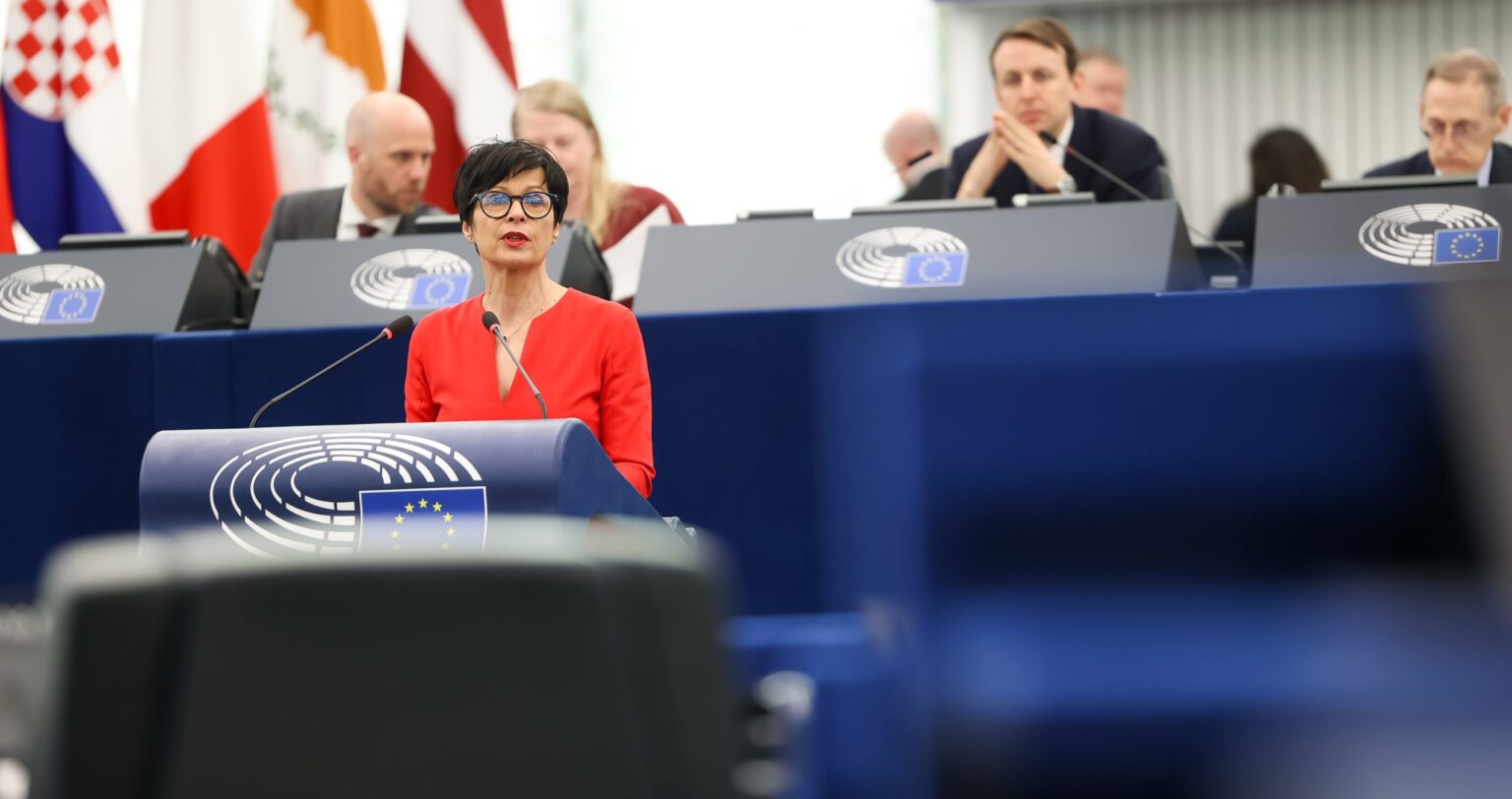
Caption: Plenary Session – EU enlargement strategy, 10 March 2026
Updated: April 18, 2026 – 08:48