

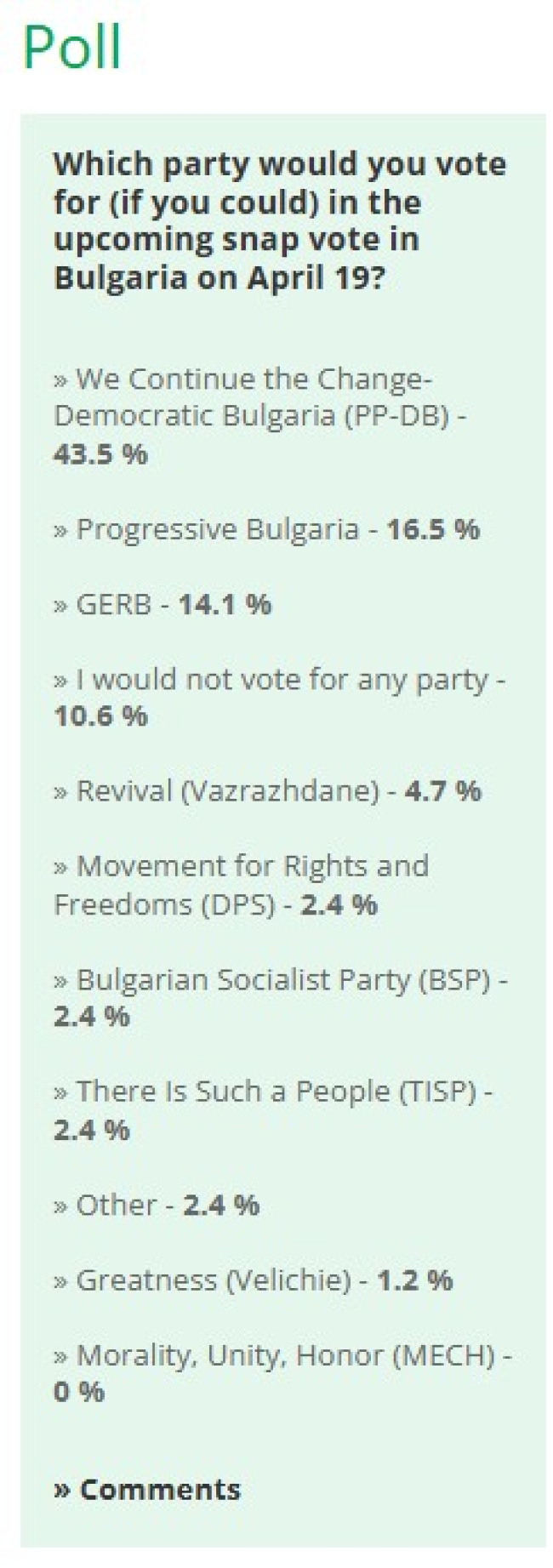
With Bulgaria heading to the polls tomorrow for the snap parliamentary elections, a reader survey conducted by Novinite.com shows strong support for the reform-oriented coalition “We Continue the Change-Democratic Bulgaria” (PP-DB), which leads by a significant margin among respondents.
According to the poll, 43.5% of readers said they would vote for PP-DB if they could take part in the election. The result places the coalition well ahead of all other political forces in the survey and highlights clear backing among Novinite’s audience for its pro-European and reform-focused platform.
In second place comes Progressive Bulgaria with 16.5%, followed by GERB with 14.1%. The gap between the leading PP-DB coalition and the next closest contender is substantial, suggesting a strong preference among readers for parties presenting themselves as alternatives to the traditional political model.
Notably, 10.6% of respondents said they would not vote for any party, reflecting continued frustration with the political system and distrust in political leadership, a sentiment often seen ahead of repeated snap elections in Bulgaria.
Among the smaller parties, Revival (Vazrazhdane) received 4.7%, while the Movement for Rights and Freedoms (DPS), the Bulgarian Socialist Party (BSP), and There Is Such a People (TISP) each received 2.4%. Another 2.4% selected “Other,” indicating support for smaller or less represented political formations. Greatness (Velichie) was backed by 1.2% of respondents, while Morality, Unity, Honor (MECH) received some support on our Facebook page.
The discussion around the poll also continued on Novinite’s Facebook page, where readers shared strong opinions about the political climate. One comment reflected a broader sense of public disappointment: “Honestly, the feeling that all politicians are the same is not accidental. It comes from years of disappointment and unfulfilled promises. Too often we see personal and party interests come first, while people are left behind.”
The same reader argued that political apathy only strengthens the existing system: “When people withdraw, they leave decisions in the hands of a few. The truth is that people are disappointed and see no hope that anything will change. Maybe it is not about fully believing in someone, but choosing more wisely and demanding more. Change does not come with one election, but with constant pressure and an active position.”
The results are not a nationally representative sociological study, but they offer a useful snapshot of the political mood among Novinite.com readers on the eve of the vote, most of whom are foreigners. With Bulgaria once again facing uncertainty over whether a stable government can be formed, turnout and post-election coalition talks remain the central questions.
Tomorrow’s election will determine not only the composition of the next National Assembly, but also whether the country can finally move beyond the cycle of political instability and repeated early elections.