
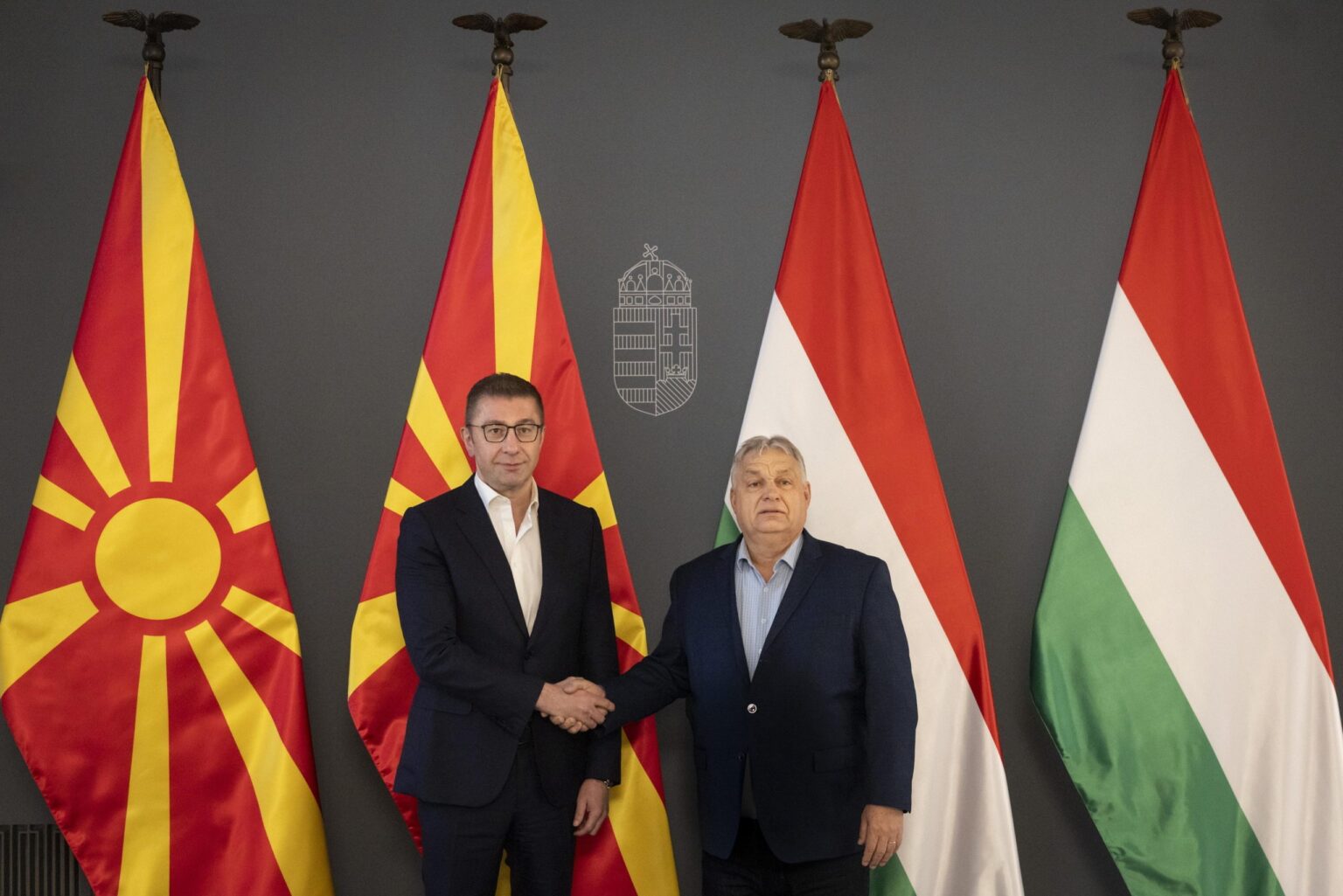
North Macedonia’s Prime Minister Hristijan Mickoski said former premier Nikola Gruevski would be sent straight to prison if he reappears in the country, underlining that a final court ruling against him remains in force despite years of political controversy surrounding his escape to Hungary.
“If Gruevski appears in North Macedonia, law enforcement authorities will immediately send him to serve his prison sentence,” Mickoski said, stressing that the government is obliged to enforce all laws equally and that any further legal remedies available to the former prime minister could only be pursued after his detention.
The remark is politically striking not only because it comes from the country’s current prime minister, but because Mickoski is also Gruevski’s party successor at the helm of VMRO-DPMNE. Gruevski personally designated Mickoski as his political heir before fleeing the country, yet relations between the two have long since deteriorated.
The issue has returned to the centre of public debate after Hungary’s incoming prime minister Péter Magyar described Gruevski as an “international criminal” who has no place in Hungary, signalling that the former Macedonian leader’s political refuge in Budapest may be nearing its end.
Magyar to Orbán’s refugees: Gruevski, Ziobro, Romanowski – pack your bags
Gruevski, who served as prime minister from August 2006 until January 2016, was sentenced in September 2018 to two years in prison. Days before he was due to be arrested, he fled North Macedonia on 12 November 2018, crossing through Albania, Montenegro and Serbia with the help of Hungarian police before receiving political asylum from Viktor Orbán’s government later that same month.
His escape became one of the most controversial episodes in recent North Macedonian politics, intertwining domestic power struggles with wider regional alignments. Gruevski and former president Gjorge Ivanov were central figures in the “antiquisation” project, a nationalist state-building effort that deepened the country’s international isolation and effectively froze its Euro-integration path for years.
Now, as political change in Budapest reshapes the external environment around the case, the Gruevski question is once again testing the internal balance of power in Skopje.
Opposition leader Venko Filipče welcomed Orbán’s electoral defeat and linked Magyar’s rise to what he described as the broader weakening of entrenched regional strongmen. In his reading, the shift in Hungary could foreshadow political change elsewhere in the Western Balkans, including in Serbia and North Macedonia.
Yet Mickoski, Filipče and even Mickoski’s coalition partner Maksim Dimitrievski all publicly congratulated Magyar, despite their sharply different domestic agendas.
Mickoski today exercises near-unmatched authority within both the party and government after his sweeping 2024 election victory over the Social Democrats. He has consolidated the party around a hard line on constitutional changes, particularly the refusal to include Bulgarians in the constitution, a move that continues to block Skopje’s path toward opening European Union negotiations.
At the same time, parts of the party base have historically retained sympathy for Gruevski, while some networks linked to the former premier are still believed to remain influential.
This explains why the prospect of Gruevski’s return is politically sensitive far beyond the legal dimension. For Mickoski, enforcing the prison sentence would affirm his message on the rule of law and distance him from accusations of protecting his predecessor. But it would also reopen old internal fractures within VMRO-DPMNE and could revive dormant rivalries inside the ruling camp.
The personal relationship between the two men has been strained for years. As early as 2023, while still opposition leader, Mickoski publicly accused Gruevski of holding secret talks with the authorities for personal benefit, describing it as a “strange twist of fate” in which the former premier was “stabbing the party in the back”.
The unresolved legal cases surrounding Gruevski may further complicate any return scenario. Another case in which he is listed as a defendant has already seen prosecutorial changes, raising fresh questions over how quickly the judiciary could move if he were extradited or returned voluntarily.
Much now depends on developments in Budapest. As Magyar prepares to assume office in the coming weeks, his government is expected to revisit the status of foreign political figures sheltered by Orbán, including both former Polish officials and Gruevski.
“Hungary will not be a landfill for foreign criminals,” Magyar said, explicitly naming Gruevski among those he believes should no longer remain under Hungarian protection.
Sources: BGNES, Dnevnik.bg
Caption: A handout photo made available by the Hungarian PM’s General Department of Communication, Hungarian Prime Minister Viktor Orban (R) receives Northern Macedonian Prime Minister Christian Mickoski in the government headquarters in Budapest, Hungary, 30 March 2026. EPA/AKOS KAISER / HUNGARIAN PM COMMUNICATION DEPARTMENT / HANDOUT
Updated: April 17, 2026 – 05:22