
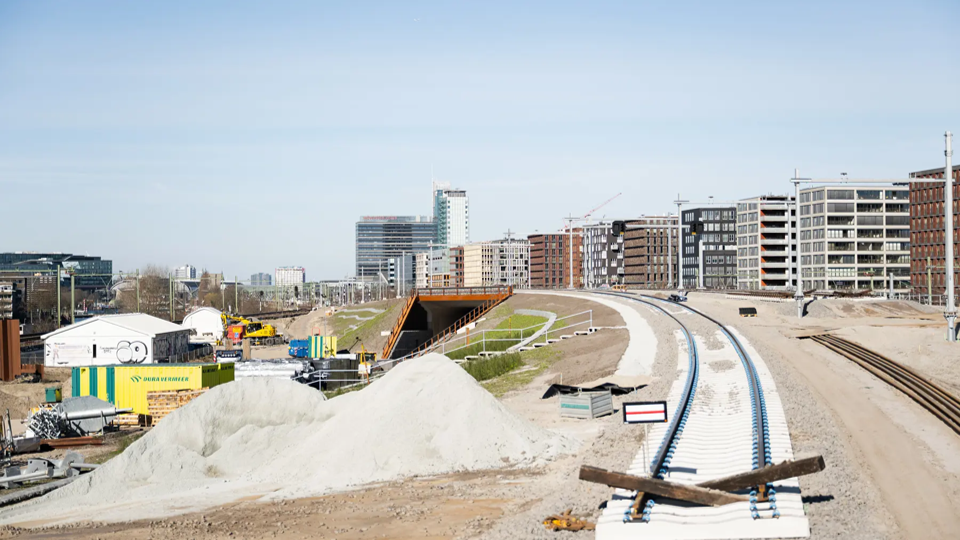
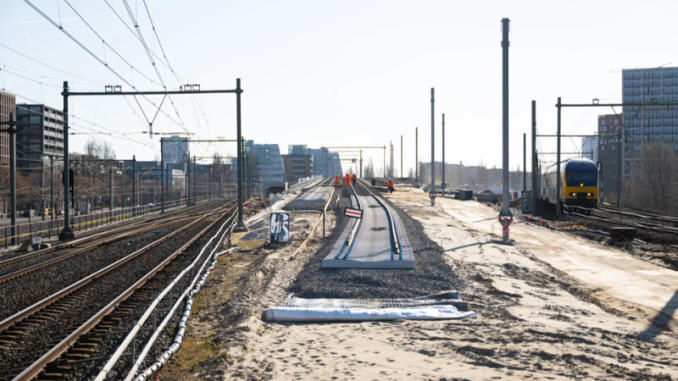
 The concept of neighborhoods along the railroad tracks is gaining increasing importance in the Netherlands, amid a persistent housing crisis and growing pressure on major cities and existing infrastructure.
According to official data from the Dutch government, the country faces a shortage of approximately 400,000 homes, equivalent to about 5% of the total national housing stock. This imbalance stems primarily from the fact that the number of households is growing faster than the capacity to build new homes, given that the annual target of approximately 100,000 housing units is not consistently met.
This situation is also influenced by structural factors such as strict environmental regulations, high construction material costs, and a labor shortage in the sector. Consequently, the real estate market is under constant pressure as housing prices and rents rise, access to housing becomes increasingly difficult, and the social housing system is overburdened, with very long waiting lists in major cities.
In the medium and long term, authorities believe that this shortage is not merely a temporary issue but a structural one, requiring a shift in approach to how cities are planned and developed.
Neighborhoods and Mobility
The housing crisis, however, has effects that extend beyond the real estate sector. It also directly influences how mobility is conceived, particularly public and rail transport. As urban sprawl pushes development toward the suburbs or less densely populated areas, dependence on efficient transport increases significantly. In this context, direct access to the rail network becomes an essential element for the functioning of modern cities.
Integrating housing with rail infrastructure is no longer viewed merely as a mobility option, but as a necessary condition for sustainable urban development. This reduces pressure on road traffic, improves connectivity between residential areas and economic centers, and supports a more energy- and space-efficient urban model.
From this perspective, planning new housing near rail lines or in areas directly connected to public transit becomes a strategic solution for both the housing crisis and urban mobility.
ProRail Encourages the Construction of Neighborhoods Near the Railroad
In this context, the Dutch railway infrastructure manager, ProRail, is promoting a more integrated approach between housing planning and the rail transport network.
 At a meeting held in The Hague on April 8, ProRail CEO John Voppen emphasized that the development of new neighborhoods should be closely linked to the existing capacity of the rail infrastructure. According to him, such coordination allows for reduced infrastructure costs, shorter project implementation times, and the avoidance of future accessibility issues for residents.
“Housing can never be built separately from infrastructure. So we need to prevent accessibility issues from arising,” John Voppen stated during the meeting.
His central message was that housing and infrastructure cannot be planned separately, as the lack of a direct connection to public transportation generates long-term social and economic costs.
Urban development linked to the rail network
Analyses conducted by ProRail show that the Dutch rail network still has unused capacity in several regions, including the Randstad area in the west of the country, sometimes even in places where this potential is not immediately obvious. Based on this data, the company advocates directing new residential developments toward areas near stations that can handle additional traffic.
Such a strategy would provide residents with direct access to public transportation from the moment they move in, reducing dependence on cars and minimizing the need for major investments in expanding the rail infrastructure. At the same time, this approach would help streamline the urban development process, both in terms of costs and implementation time.
Among the locations identified by ProRail as having development potential are Lansingerland-Zoetermeer, Bunnik, and Veenendaal-De Klomp, and the analysis of other areas continues nationwide, depending on network capacity and urban development potential.
Railways support smart urban expansion
At the same time, ProRail believes that the future of rail and urban development will increasingly depend on the efficient use of already urbanized land. Through densification, mixed-use developments, and the reorganization of existing spaces, a significant portion of urban growth can be accommodated without excessive urban sprawl.
 However, the company emphasizes that additional land will also be needed for modernization and construction projects, as well as for adapting to climate change and the energy transition. These directions are closely linked to how future residential areas are designed and how infrastructure is integrated into urban development.
ProRail has extensive expertise in areas such as mobility, rail safety, spatial planning, and accessibility, and in some cases also manages land located near railway lines and stations. For this reason, the company considers it essential that all stakeholders involved in urban development collaborate from the earliest stages of projects.
Such an integrated approach enables the creation of cohesive neighborhoods where housing, transportation, and the operation of railway infrastructure are planned together, without creating subsequent bottlenecks in operations or maintenance. Furthermore, collaboration with operators such as NS contributes to better project coordination, including in the vicinity of stations.
In ProRail’s view, development near the railway should not be seen as a limitation, but as a real opportunity to create better-connected cities. The existing rail network already provides a solid foundation for urban expansion, and the development of areas around stations through densification projects can support housing growth without compromising mobility.
This trend indicates that the future of urban development increasingly depends on the integration of housing and transportation infrastructure, and proximity to the railway becomes a central element in planning sustainable cities.
Overall, the model promoted in the Netherlands signals a paradigm shift in urban planning, where housing and rail infrastructure are planned together, and neighborhoods near the railway become a key solution for alleviating the housing crisis and improving the quality of urban life.
Share on: 


