
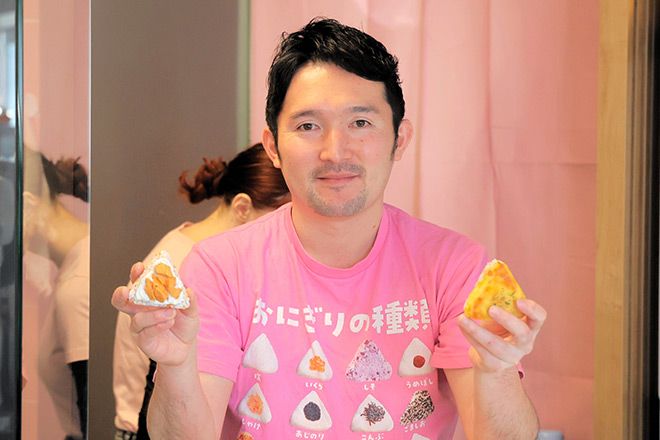
CHISINAU, Moldova—Tomoki Nagashima came to this Eastern European country four years ago as a medical practitioner to provide health care for refugees from neighboring Ukraine.
He now makes onigiri in Moldova every day.
While Nagashima’s change of course may appear unusual, he said his guiding principles have remained unchanged.
“I have always wanted to do work related to people’s livelihoods and lives,” the 41-year-old said. “Both health care and onigiri are the means I have used for doing so.”
Nagashima’s rice ball shop opened in September in a corner of a Japanese grocery store in downtown Chisinau, the capital of Moldova.
He offers six options, including tuna and mayonnaise as well as Japanese pickled plum, which are common fixtures in Japan. Nagashima’s onigiri are packed with a generous filling with prices starting at 45 lei (410 yen, or $2.54) each.
Visibly larger than rice balls sold at Japanese convenience stores, they also come in wrappers typically used for burgers so those unaccustomed to chomping down on onigiri won’t lose any rice.
Salmon and cream cheese is the most popular option and has been adapted to the local palate.
An Asahi Shimbun reporter who interviewed Nagashima found that cream cheese, seldom paired with rice in Japan, is an excellent companion for an onigiri sprinkled with “furikake” rice seasoning; likewise, sushi rolls that incorporate cream cheese into the filling are standard fusion fare overseas.
Nagashima said he set his sights on onigiri because he thought it has the potential to take hold here as a practical pick-me-up option, noting Paris has its own onigiri craze that is spreading to other parts of Europe.
Moldova, which was part of the former Soviet Union, is considered one of the poorest European nations and has a pressing need to develop its industry.
Onigiri could be a perfect fit for the needs of businesspeople who are pressed for time since it doesn’t require cutlery and can be eaten with one hand.
“I want to survive well after the craze is gone, so I will be offering a new lunch option,” Nagashima said.
FROM AFRICA TO MED SCHOOL
Before he even considered a life abroad, Nagashima’s childhood dream was to be a professional basketball player.
However, this was dashed when he realized he “lacked the necessary abilities” while studying at the University of Tsukuba’s School of Physical Education, Health and Sport Sciences.
Nagashima went on to graduate school, only to drop out.
His thirst for a new outlet to channel his energy brought Nagashima’s fondness for wandering foreign countries back into focus.
With the intent to leave Japan, he eventually came across a nongovernmental body’s call for interns in Ghana during his extensive research.
Nagashima took the plunge, spending a year in a town as the only Japanese while working on HIV testing and condom distribution. The experience drove home that he lacked the skills needed for impactful social service work. This time, he did not walk away.
The late Tetsu Nakamura (1946-2019) had a major influence on Nagashima during that period of his life.
Nakamura was a medical practitioner engaged in humanitarian assistance in Afghanistan. He was gunned down seven years ago while serving as the local head of the Peshawar-kai nongovernmental organization.
Nagashima empathized with Nakamura’s dedication to fostering a self-sustaining environment for locals that included undertaking irrigation projects.
He decided to go into medicine after considering other options, such as civil engineering, construction and farming.
After enrolling in 2014 at the Kochi Medical School through a system of undergraduate transfer admissions, Nagashima said that he was fortunate to have good teachers despite seeing himself as not fitting into the medical school mold.
His studies also included training stints at hospitals in Kenya and Brazil, among other locales.
When Russia’s invasion of Ukraine began in 2022, Nagashima had graduated and was working for a hospital in Chiba Prefecture.
“I would have come all the way down here in vain if I didn’t take action now,” he recalled thinking at the time.
Armed with a medical license and confident in his physical abilities, Nagashima contacted various groups. One was Peace Winds Japan, a nonprofit corporation he had connections to thanks to his volunteer activities.
PWJ decided to send him to work in Moldova, which borders Ukraine.
ECONOMIC DOUBTS
There, Nagashima would find himself in the waiting room of a temporary clinic packed with refugees bearing pained expressions. The clinic was located next door to a shelter.
One individual burst into tears while showing Nagashima real-time footage on their phone of their house under attack; the depth of their psychological wounds left him speechless.
Nagashima was subsequently tasked with providing medical equipment and medicine to destroyed hospitals in Ukraine, observing that few fled to safety when air raid sirens blared.
To maintain their mental wellbeing, many had resigned themselves to the idea that missiles were part of their daily lives.
In his work, Nagashima himself began to doubt the gratuitous aid programs that rely on donations and grants. He recalled thinking that excessive medical assistance could establish, in a sense, competition with local hospitals and pharmacies that would obstruct sound economic development.
This, paired with growing to like the hardworking and unaffected national character of the Moldovans, prompted Nagashima to start his own business in the country; his intent was to create new value, jobs and work to improve people’s livelihoods.
Although he initially sought to go into health care, he found it was not easy for foreigners to enter the market, landing him on the idea of onigiri.
Rather than requiring staff to shape them by hand like shops typically do in Japan, rice balls are made with molds to make the process easier and ensure eye-catching uniformity in social media ads.
Nagashima also sells homemade “taiyaki” (fish-shaped pastry) with chocolate or matcha cream filling.
The shop averages just shy of 100 customers daily and has been in the black since opening.
“The onigiri can be prepared quickly and are healthy,” said a 29-year-old woman who is a regular customer, adding, “And they energize me for working until the evening.”
Nagashima said his next target is to open another location in Moldova.
“I hope to go on setting up operations in neighboring countries, including Ukraine,” he said.