
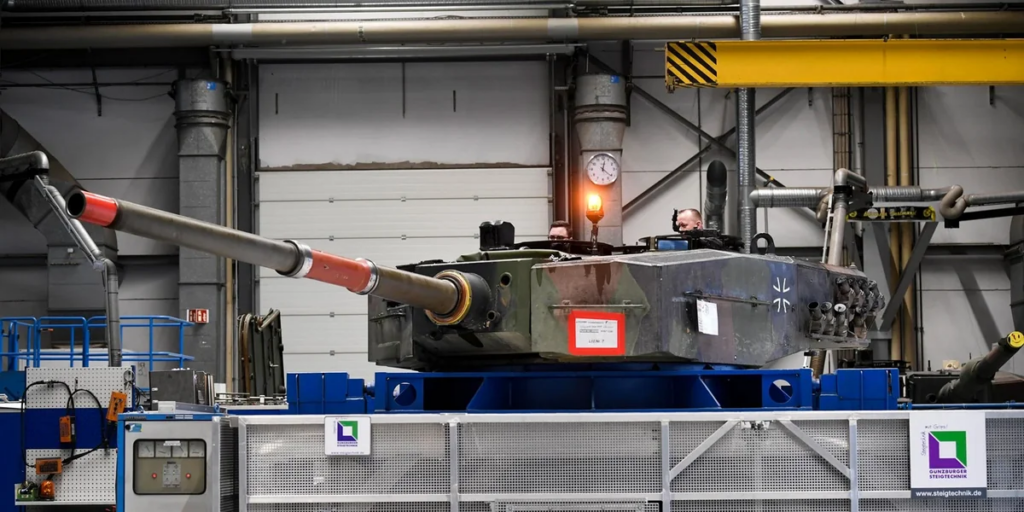

by Alimat Aliyeva
Germany, once the leading economic powerhouse of Europe, is now
facing a period of structural slowdown marked by declining
industrial output and energy-related pressures. The crisis — driven
by reduced production, high energy costs, and supply chain
disruptions — appears persistent rather than temporary. In
response, Berlin is increasingly shifting its economic priorities
toward the defense sector, AzerNEWS reports.
According to reports, Germany is seeking to position itself as a
central hub of Europe’s arms industry. At the same time, its
traditional automotive sector is under strain due to global
economic weakness, geopolitical uncertainty, and intensifying
competition from China. Major suppliers that once dominated car
manufacturing — producing everything from engines to precision
components — are now gradually redirecting capacity toward military
production.
Recent adjustments in German and EU regulations have
significantly improved access to financing for defense companies.
Combined with long-term government procurement programs and
investment schemes, the sector has attracted close to €1 trillion
(around $1.2 trillion) in potential defense-related funding.
Analysts note that this transformation reflects a broader shift
in Europe’s industrial model: from consumer-driven manufacturing to
security-driven production. Some experts argue that this may
stabilize parts of Germany’s economy in the short term, but others
warn it could deepen dependence on military spending cycles and
reduce competitiveness in civilian innovation.
An additional factor is the geopolitical environment. Rising
tensions in Europe and globally are accelerating defense
modernization efforts, effectively turning the continent’s
rearmament into an economic engine. In this context, Germany’s
industrial pivot is not just an economic adjustment, but a
strategic repositioning within a rapidly changing global order.