
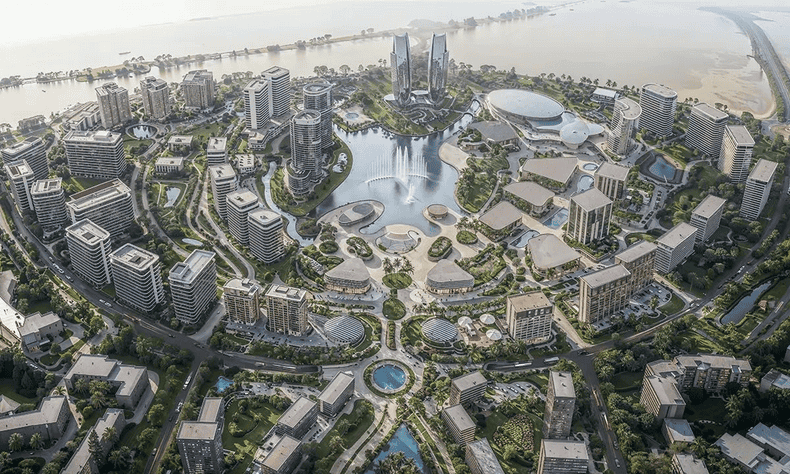
Hisham Talaat Moustafa stood before a bank of cameras on April 18 and declared he was building “the spinal cord of a modern economy.” His company, Talaat Moustafa Group, one of Egypt’s largest real-estate developers, has unveiled plans for a $27 billion (1.4 trillion Egyptian pounds) mixed-use city east of the capital. Dubbed “The Spine,” the project spans more than 2 million square metres and will feature 165 residential, business and commercial towers, plus hotels, retail outlets and generous green spaces.
Developed in partnership with the National Bank of Egypt, the venture carries a paid-up capital of 69 billion pounds. It is expected to create more than 55,000 direct jobs and hundreds of thousands indirectly, while drawing millions of visitors a year. The Ministry of Investment has already approved The Spine as Egypt’s first Special Investment Zone with its own customs area, signalling high-level government backing. Tax revenues alone are projected at roughly 818 billion pounds over the project’s life.
For a country that has spent the past decade pouring money into desert megaprojects – most notably the New Administrative Capital further east – The Spine represents another ambitious bet on urban expansion. Egypt’s Nile Valley is one of the most densely populated places on earth; successive governments have seen new cities as the only way to ease pressure on Cairo’s choked infrastructure and create fresh economic poles. Talaat Moustafa, whose track record includes landmark developments such as Madinaty, is betting that private capital, smart design and Gulf-style ambition can make the desert bloom once more.
Hisham Talaat described the project as Egypt’s first “cognitive city,” integrating advanced infrastructure and AI-driven urban management. The scale is staggering even by Egyptian standards: it equals about 1 percent of national GDP in investment value. Analysts say the timing is telling. Despite regional headwinds – Red Sea shipping disruptions, global inflation and domestic economic strains – investor appetite for Egyptian real estate remains surprisingly resilient. Gulf funds have poured billions into coastal resorts and new urban districts; The Spine aims to capture a slice of that confidence for the capital’s eastern fringe.
Critics, however, point to familiar risks. Past megaprojects have sometimes struggled with occupancy, infrastructure delivery and affordability for average Egyptians. Questions linger about water supply, power generation and transport links to the existing city. Environmentalists worry about the ecological footprint of yet another desert development in a country already facing acute climate pressures.
Yet the announcement has been greeted with cautious optimism in business circles. Real-estate brokers report renewed interest from both local and international buyers. The project’s mix of residential, commercial and tourism components is designed to create a self-sustaining ecosystem rather than another bedroom suburb. If successful, it could become a template for future developments – part of a broader strategy to position Egypt as North Africa’s investment gateway.
For Hisham Talaat Moustafa, the stakes are personal as well as corporate. The family name has long been synonymous with bold Egyptian real-estate vision. With The Spine, he is doubling down on the belief that bricks, mortar and desert sand can still deliver growth, jobs and national pride even in uncertain times. Whether the desert ultimately yields to this latest dream will depend on execution, financing and the unpredictable currents of regional stability. For now, the cranes are poised to rise.