
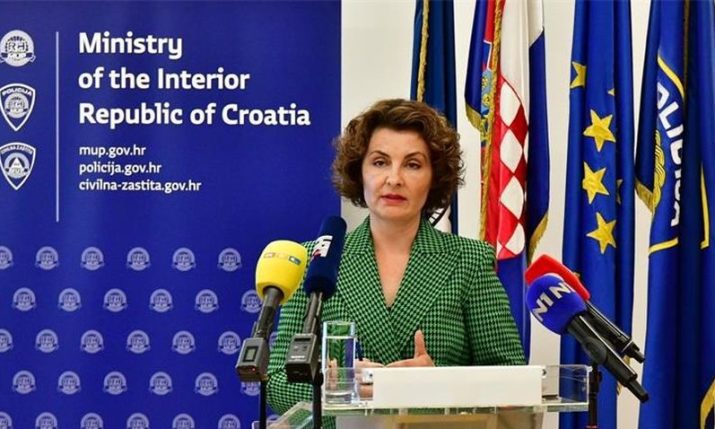
State Secretary Irena Petrijevčanin (Photo: MUP HR)
Croatia has introduced a new rulebook governing the residence of third-country nationals, placing greater responsibility on employers and recruitment agencies, as the number of foreign workers in the country surpasses 105,000.
The new regulation, presented by State Secretary Irena Petrijevčanin from the Interior Ministry on Monday, aims to better define living conditions and employer obligations, with a particular focus on accommodation standards and public health requirements.
Over 100,000 foreign workers in Croatia
Currently, 105,231 foreign workers are registered in Croatia with valid residence and work permits. The majority are employed in sectors such as tourism, hospitality and construction.
In 2026, most work permits were issued to citizens of Bosnia and Herzegovina (10,208), followed by workers from the Philippines, Nepal, Serbia and North Macedonia.
Recent amendments to the Aliens Act have already simplified employment procedures. Workers can now change roles with the same employer more easily, while seasonal work permits are issued for up to three years rather than annually.
Foreign workers are allowed to work up to 90 days without approval from the employment service or up to nine consecutive months within a three-year period. This has led to an increase in permit renewals and seasonal employment.
Inspections reveal widespread irregularities
Authorities identified 10,765 irregularities related to the Aliens Act, mostly in labour relations. A total of 1,328 offences were recorded, with 47% in hospitality and 22% in construction.
Fines for workplace safety violations reached €1.2 million, while penalties for undeclared work totalled €3.2 million.
Key aims of the new rulebook
The new regulation focuses on strengthening employer responsibilities and improving conditions for foreign workers. Its main goals are to:
• Ensure adequate accommodation
• Prevent exploitation by employers or intermediaries
• Avoid segregation of foreign workers
• Support better integration into Croatian society
Stricter accommodation standards introduced
One of the most significant changes concerns accommodation requirements. Employers must now provide proof of suitable housing when applying for work and residence permits.
Housing must meet clearly defined standards, including:
• Separate space for living and sleeping
• Access to sanitary facilities and food preparation areas
• Functional electricity, water and windows
• Safe ceiling height for movement
Minimum space requirements have also been set. Each worker must have at least 14 square metres, with an additional 6 square metres for each extra occupant. A house of 150 square metres can accommodate up to 10 workers, while a 56-square-metre flat is limited to eight.
Employers must submit a notarised rental contract or a property owner’s statement detailing the number of occupants, rent amount and size of the property.
If accommodation is arranged by the employer, rent cannot exceed 30% of the worker’s net salary and cannot be automatically deducted from wages.
Mandatory health documentation
Foreign workers must now provide proof of their health status and vaccination record when submitting their first application, regardless of the length of stay.
Medical examinations must be conducted through regional public health institutes or the Croatian Institute of Public Health.
New forms introduced
The rulebook introduces two new forms:
• Form 17a: Employer declaration confirming adequate accommodation
• Form 18a: Certificate of health and vaccination status
These measures were developed in cooperation with health authorities to ensure better monitoring and protection of public health.
Entry into force
The new rulebook will come into effect eight days after its publication in the official gazette.