
Insights from Electricity Human Resources Canada’s recent Powering Intelligence report.
It’s been several years since artificial intelligence platforms were introduced to the public, but momentum continues to show no signs of slowing in the everyday changes this technology is bringing to the ways we work, live, and perhaps most importantly, build.
Stanford University’s AI Index illustrates the speed of this transformation, showing AI adoption to have jumped from 55 per cent in 2023 to 78 per cent in 2024. Today, AI continues to be inescapable – whether it’s showing up in topics of everyday conversation to the technology we use.
A significant driver of AI’s growth has been its potential impacts on the workplace: not only the possible efficiencies and new skills it may bring in its transformed labour landscape, but also the new subsectors and roles that are emerging to support this technology. A new report from Electricity Human Resources Canada (EHRC) and the Future Skills Centre aims to illustrate what these impacts might look like for Canada’s electrical sector.
Released in November of 2025, Powering Intelligence: AI-Driven Change in Canada’s Electricity Workforce sees EHRC and Future Skills Centre breaking down some of the specific changes that AI is set to bring across Canada’s electrical sector, and the roles and skills required from workers and organizations alike to keep up with this change in an inclusive and sustainable manner.
“AI will not replace human judgment, but it will redefine how decisions are made and who makes them. We must ensure that all communities – urban, rural, Indigenous and remote – benefit from the opportunities AI presents,” shared EHRC CEO Michelle Branigan and Future Skills Centre executive director Noel Baldwin in the report’s joint introductory message.
This commitment to cultivating an understanding of AI’s use cases, benefits, and impacts was reflected in a series of region-specific virtual roundtables that the EHRC hosted from November 25 to 28, 2025.
These roundtables saw Branigan and those involved in the development of the report connecting with groups of electrical professionals across Canada to share their findings on the changes AI is bringing to how they work.
High-speed change
Even with deep research and insights from 20 stakeholder organizations across Canada’s electrical sector comprising the report, the EHRC shared that its conclusions are not immune to the rapid pace of change brought on by advancements in contemporary technology and the resulting difficulties with achieving stable insights.
Branigan detailed these difficulties in her opening statement for the November 26 virtual roundtable on the report, aimed at Canada’s western provinces and territories.
“I’ll be very honest: we put a lot of work into this report, and it looks great, but it’s going to be out of a date in six months – that’s how fast things are changing,” said Branigan. “I think nimbleness and agility are top of mind for us right now, so it’s really important that we’re working together collaboratively to be able to prepare for what is ahead.”
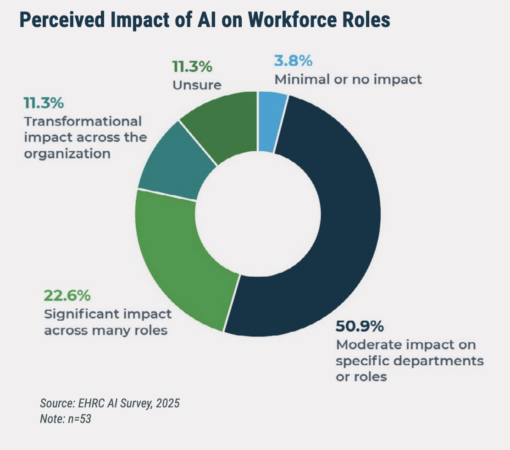
Figure 1: For more than half of respondents, AI has already brought moderate impacts to specific departments or roles. (Source: EHRC, Powering Intelligence report)
Data from respondents reinforced the idea that this change brought by AI isn’t coming, but rather has already arrived: a total of 50.9 per cent of respondents shared that AI has already brought moderate impacts to specific departments or roles, with 22.6 per cent reporting significant impact across many roles and 11.3 per cent seeing transformational, organization-wide impacts (see Figure 1).
The EHRC’s vice president of programs, Mark Chapeskie, added some context to motivation and goals in developing the report. Just as important as illuminating AI’s impact on skills and processes across the sector was showcasing how widespread AI adoption and its demands are also set to influence the type of work and projects that are prioritized.
To this end, the report also looks at the impact that the compute power and grid demand required by widespread AI adoption will have on the needs and responsibilities of Canada’s electrical sector.
“When we started this research, there were two questions we were asked to answer: one was, of course, the jobs and skills piece of it, but the other question we sought to answer was what kind of an impact the forecasted power demand for the compute and cooling power of data centers will have on workforce numbers out to 2031,” said Chapeskie.
Powered by people
Even with potential volatility from AI-associated increases in grid and data infrastructure demands, the electrical sector’s outlook on the impact of this technology remains positive, with 87 per cent of respondents surveyed for the report expecting to see an increase in efficiency and productivity from AI adoption.
The EHRC’s economist Tania Chaar shared that many see this technology as a means of improving areas of operation such as customer service, decision-making, predictive maintenance, and demand forecasting, in addition to helping to manage progress toward Canada’s decarbonization targets and introducing new jobs in data-focused roles.
While AI’s promises for workers across Canada’s electrical sector remain high, Chaar urged that successful adoption across the electrical workforce is not a phenomenon that will occur in isolation: “There is also recognition that to fully realize these benefits, they need external support,” she said.
“Training and upskilling programs are the most requested resources, alongside clear industry guidelines and forums for collaboration,” she said, adding that successfully drawing forth AI’s transformative potential will rely on “collective learning, shared standards, and a focus on people as much as the technology itself.”
Demand for a number of new skills and proficiencies in the electrical sector will emerge from the need for effective AI implementation, including data analytics, change management and organizational design, systems integration, data reporting, and cybersecurity (see Figure 2).
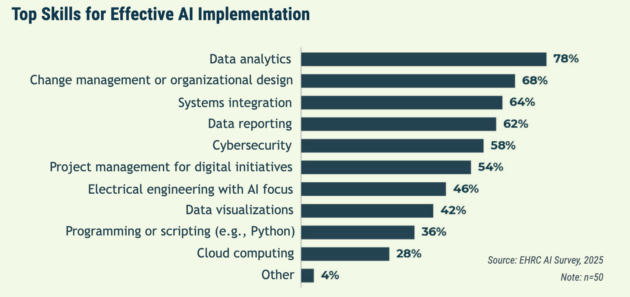
Figure 2: The report found a number of new skills to be emerging from the overall need for effective AI implementation. (Source: EHRC, Powering Intelligence report)
For Chaar, these new skills indicate a shift away from the traditional reliance on manual data processing jobs and routine field inspections, while also illustrating that “not only do you need those technical skills and an understanding of the technology itself, but also the more ‘soft’ skills that come with managing that integration and a multi-faceted approach that will enable employees to leverage this technology properly,” she said.
Supplying the demand
With AI adoption continuing to accelerate, so will the role of data centres as a key player in supporting this adoption. With this changing landscape of major projects, Canada’s electrical sector is also being further transformed by this shift.
“Data centres were always part of the digital infrastructure, especially for areas such as cloud computing and big data analytics, so it was always there,” said Chaar. “However, the surge we’re seeing right now is very much tied to this accelerated adoption of AI.”
A total of 290 data centres are currently located within Canada’s borders, with plans to add many more in the coming years. Current volume and future plans have positioned these buildings and the energy they require as among the country’s fastest-growing electricity loads, the report shared, with this growth brought on by factors such as the constant power needs, specialized cooling systems, and reliability requirements of data centres.
Factors such as cost of space, energy costs, and latency are the primary considerations of data centre providers in deciding where to build, with Chaar stating that these priorities have led to clustering around end-demand centres; oftentimes larger urban areas such as Toronto, Montreal and Vancouver.
A combination of this concentrated pattern of data centre locations, their historical proximity to high-load population centres, and elevated energy needs of these buildings “can place immense pressure on transmission networks, cooling systems, and grid stability overall,” said Chaar.
The increased pressure that data centres place on overall grid stability brings with it new responsibilities for Canada’s electrical infrastructure, along with those who operate, maintain, and build it.
Chaar emphasized this sharp uptick in anticipated grid pressure by referencing news out of Quebec from April of 2025, where the province shared that it anticipates an increase of 4.1 terawatt hours in data centre demand between 2023 and 2032, along with Ontario’s Independent Electricity Systems Operator (IESO) listing data centres as a key growth driver behind commercial power usage.
Building opportunity
Even with the continued push to position data centres as a key component of Canada’s digital and electrical infrastructure plans remaining strong, the report found the long-term employment impacts of these projects under current conditions to be surprisingly muted when it comes to the electricity sector.
According to the report, data centres generate 1,000 to 1,500 short-term jobs related to site preparation and installation per project.
Unfortunately, these levels decline sharply when looked at from the perspective of a wider timeline, with only 50 to 200 long-term employment opportunities introduced once data centres reach an operational state.
“While these roles are specialized and stable, they offer limited opportunities for broader workforce engagement,” the report reads. “This contrast underscores the need for targeted training and regional planning to ensure communities benefit from both construction and operational phases.”
This data underscores the report’s framing of AI as a transformative influence on Canada’s electrical workforce, rather than a replacement for it; further emphasized by the perspective of a union representative shared in the report, who believes AI’s influence will remain limited in the near to medium term.
Elaborating on the representative’s insights, the EHRC shared in the report that “AI is seen as a tool to improve planning and coordination rather than a threat to these jobs,” concluding that, “For trades and utility workers, the near future appears stable, though ongoing dialogue, monitoring and inclusive planning will be essential as technology evolves.”