
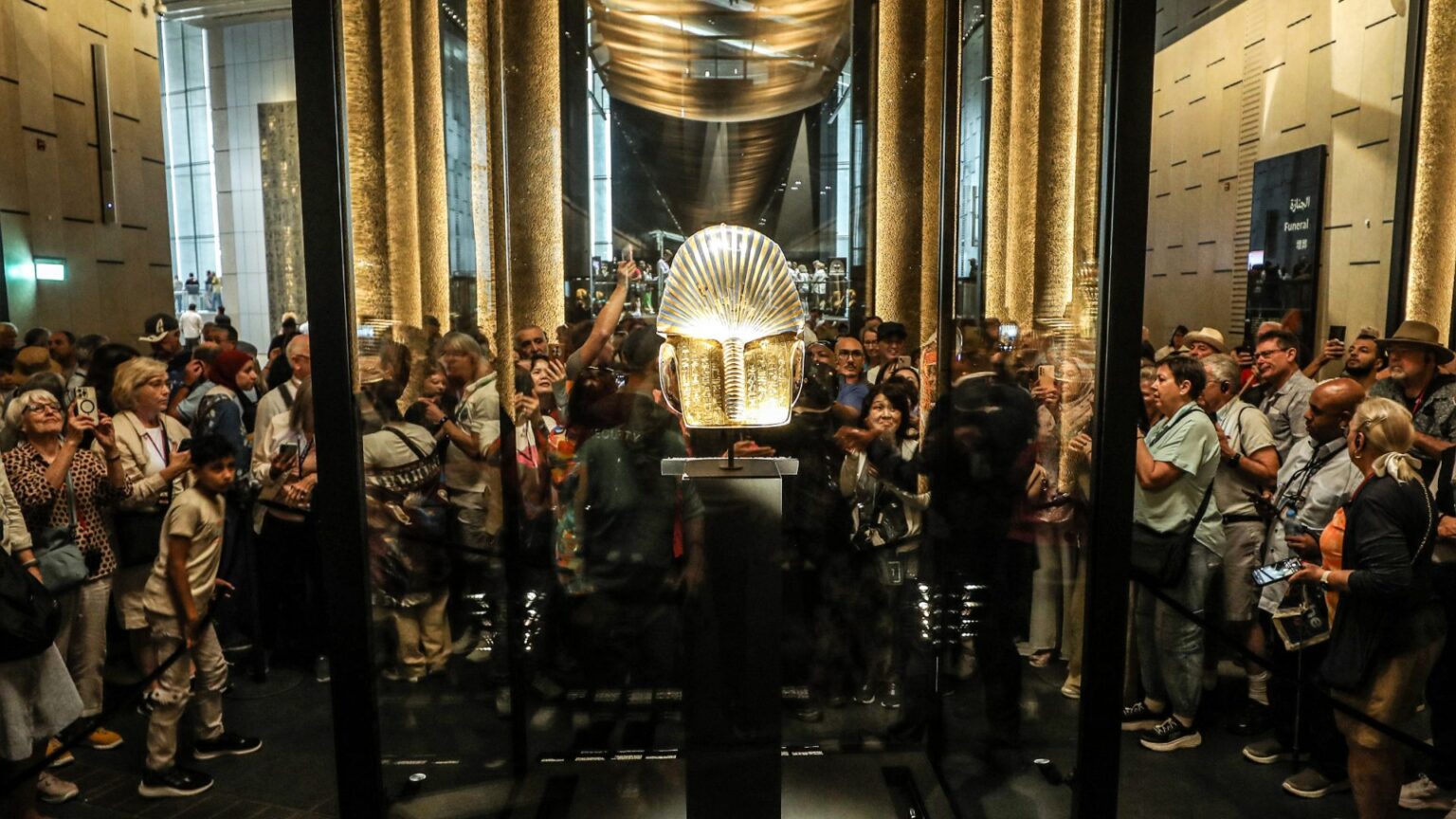
To the Grand Egyptian Museum, Giza. Open since November after 20 years of stop-start development and £1bn. It is quite as nutty as anything the pharaohs put up.
Close to the Pyramids, the new museum has a distinct Las Vegas vibe to it. Enormous scale, towers of angled glass and bronze metalwork jabbing out from the flat plane of the desert in front of you like a wild artist’s impression.
Egypt is betting big on its success – a new eight-lane motorway arrives direct from downtown at the expense of thousands of demolished homes. A new monorail will soon deliver time-poor tourists direct from the airport to the museum. A three-hour stopover will be more than enough in the near future to take a trip through 4,500 years of Egyptian history and take a camel ride around the Great Pyramid.
Once inside, the setting totally swamps its subjects. It’s impossible to consider the exhibits in isolation from the architecture. Even 130 metres of Great Pyramid, framed through vast gallery windows at the western end, feels more like a backdrop than a wonder.
Where the GEM really delivers is in the complete exhibiting of the tomb treasure of its most famous star; Tutankhamun. Everything Howard Carter discovered in the Valley of the Kings is laid out, the lighting dim enough that for once the idiosyncrasies of the architecture recede. Hundreds of arrows, scores of slippers, straw lunch boxes packed with food for the afterlife. And all the bling – the golden coffins, the chariots, the thrones, and of course the solid gold death mask; it’s altogether stunning.
Actually, there is one thing; something lost in the necessary accommodation of selfie culture.
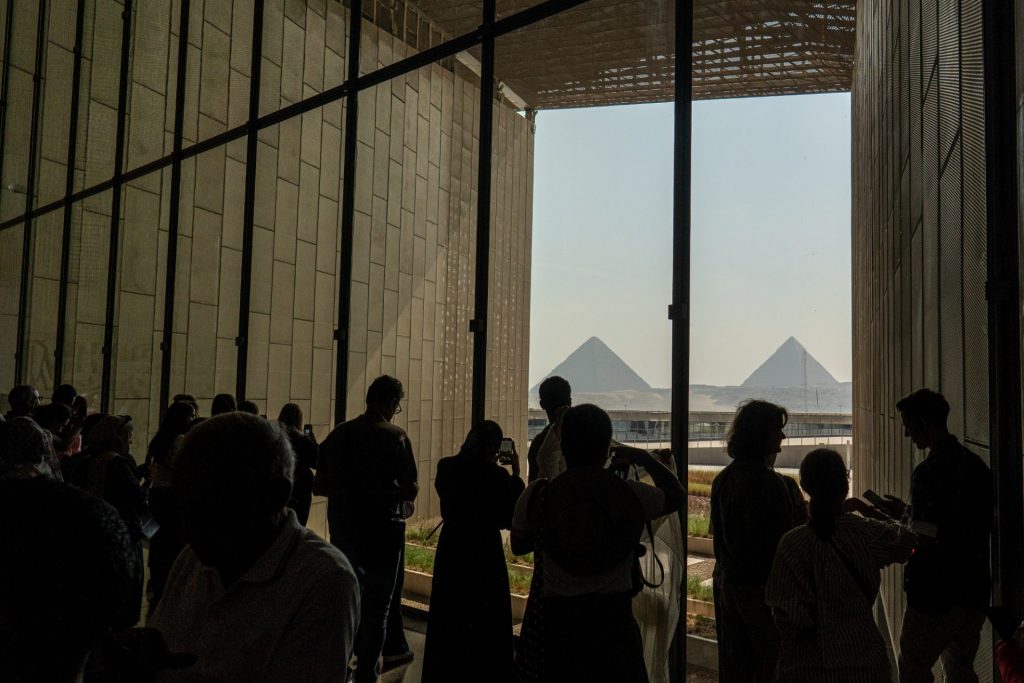 The pyramids framed through the vast gallery windows
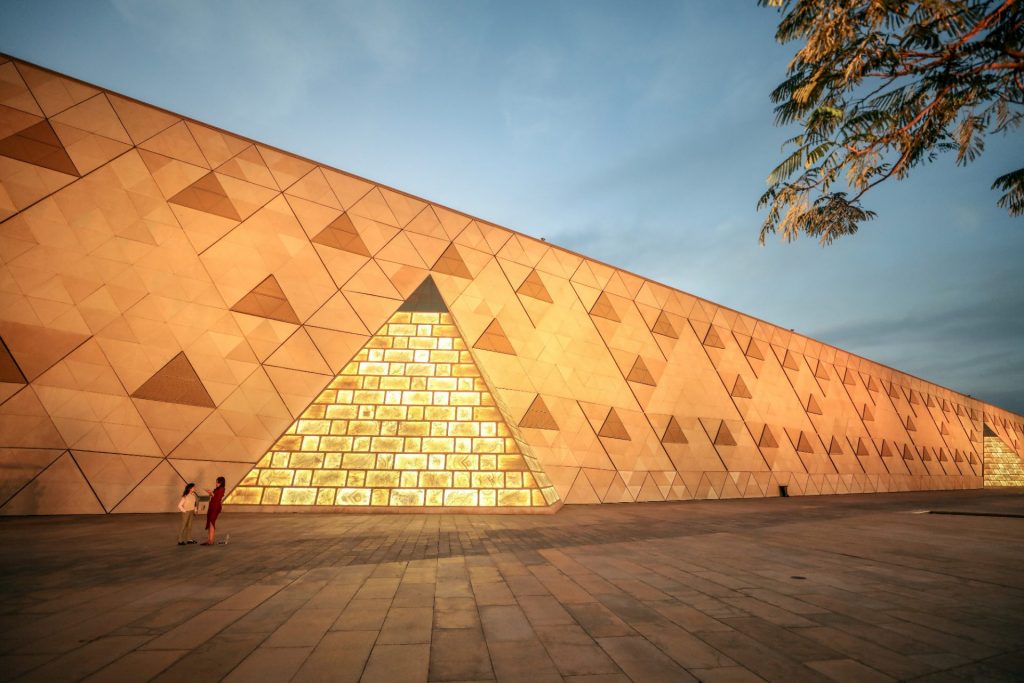 An exterior view of the museum
Images: Ali Moustafa; Mohamed Elshahed/Anadolu/Getty
The last time I saw Tut’s solid gold death mask was 30 years ago, in the old Cairo museum. It was presented at eye level in a simple glass case protected by nothing more than a close velvet rope. You could lean in and eyeball the pharaoh – close enough to experience the genuinely uncanny sensation of invading his personal space.
If you’ve ever stood face to face with a waxwork and experienced the shudder of proximal violation, it was that. A surprising sense of direct connection with another human across more than 3,000 years that has lived with me ever since.
Today, in the new museum, the mask is positioned higher, perhaps eight or nine feet from the ground. Tut gazes serenely above the crowd, constantly cajoled to keep snaking around him. He is beautiful but detached. No connection to be had. Just a quick selfie.
The gift shop is as large and glittering as any of the galleries. To their credit, nobody is forced through it on exit. But it’s hard to know where the antiquity ends and the merchandising begins. Or whether there is, in fact, any real distinction.
This is, emphatically, not something you would say about the old museum, squatting like a grand, pink Victorian train station on the edge of Tahrir Square, 10 miles away in downtown Cairo.
Now formally rebranded as the “Egyptian Museum in Cairo” and shorn of its most famous occupant, you might assume the old place to be diminished. It has never been better. The ensemble, freed from the obligation to support a single superstar, turns out to be considerably more interesting than anyone remembered. Like Paris Saint-Germain when Messi left; there seems so much more to look at now.
Whatever the opposite of state-of-the-art is, the old museum is it. The labelling is haphazard if it’s there at all. Much of the time you have zero indication of what you’re looking at. The curation is chaotic; old-fashioned wooden display cases stuffed to capacity. In every technical sense, it is a terrible museum, and an absolutely magnificent one in every sense that matters.
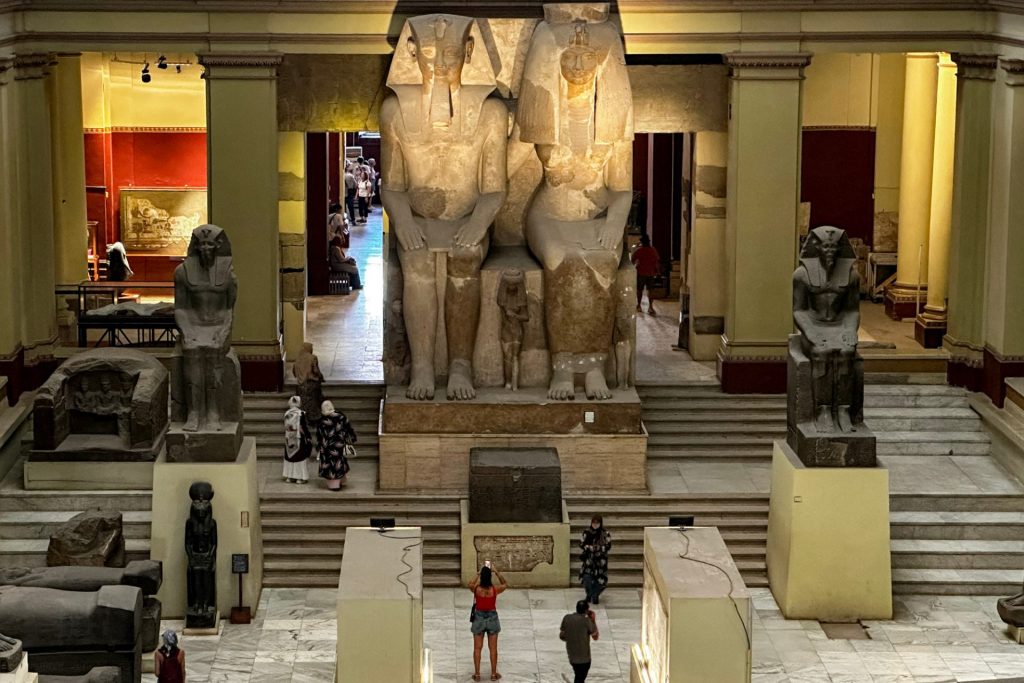 The eight-metre-tall statues of the ancient Egyptian king Amenhotep III and his consort queen Tiye
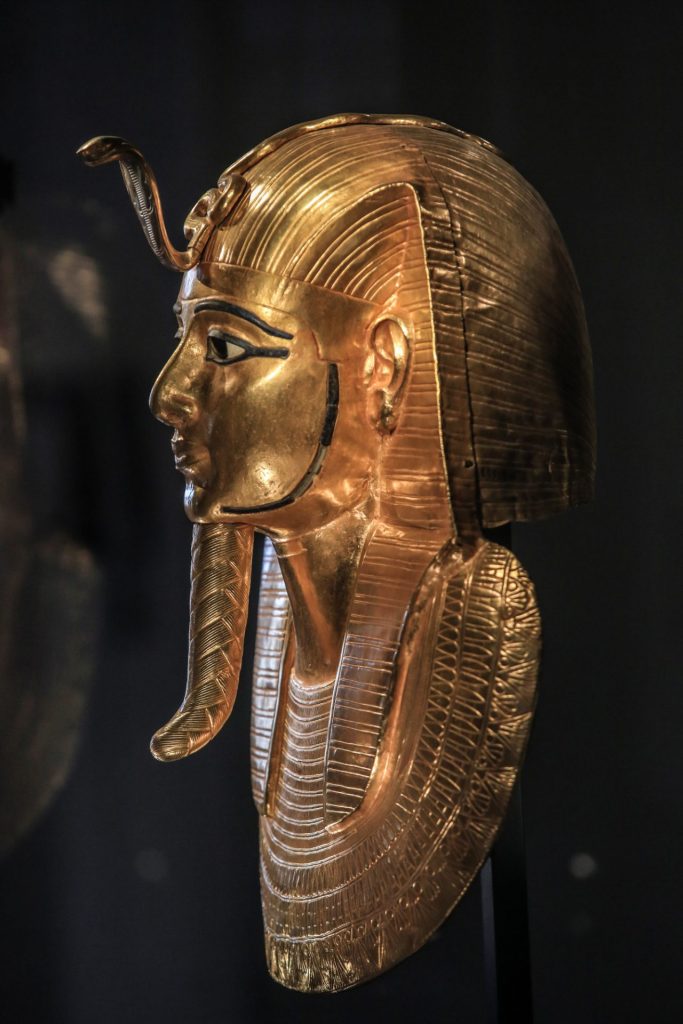 The golden funerary mask of Psusennes I.
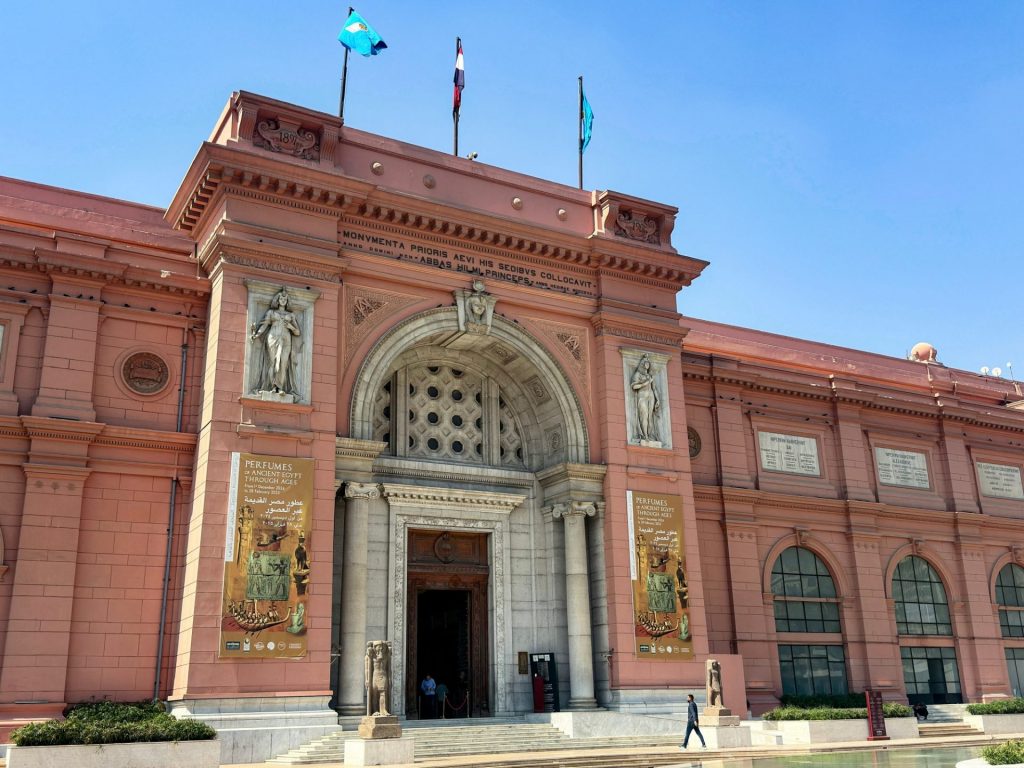 The main entrance of the ‘old’ Egyptian Museum in Cairo’s central Tahrir Square
Images: Khaled Desouki/AFP; Mohamed Elshahed/Anadolu/Getty
Silver pharaohs (silver was more rare and precious in ancient Egypt than gold; so you’re looking at a Tut upgrade here). Royal mummies of terrifying countenance. Books of the Dead. Rooms of objects so ancient and so casually displayed that it sometimes feels more attic than museum. And all of it for the equivalent of a little over a fiver, as opposed to the £30 you handed over in Giza.
Best of all, it’s practically empty. The tour buses are all at the end of that eight-lane motorway in Giza. Here, you have the time and the stillness to absorb the true insane awesomeness of ancient Egypt.
So, if you really want to imagine yourself as Howard Carter in 1922, peering through that small hole he had broken in the tomb wall, marvelling by flickering candlelight at the chaotic jumble of “wonderful things”, there’s only one place to go. And it’s not the Grand Egyptian Museum.
Matt Kelly is founder and editor-in-chief of The New World