
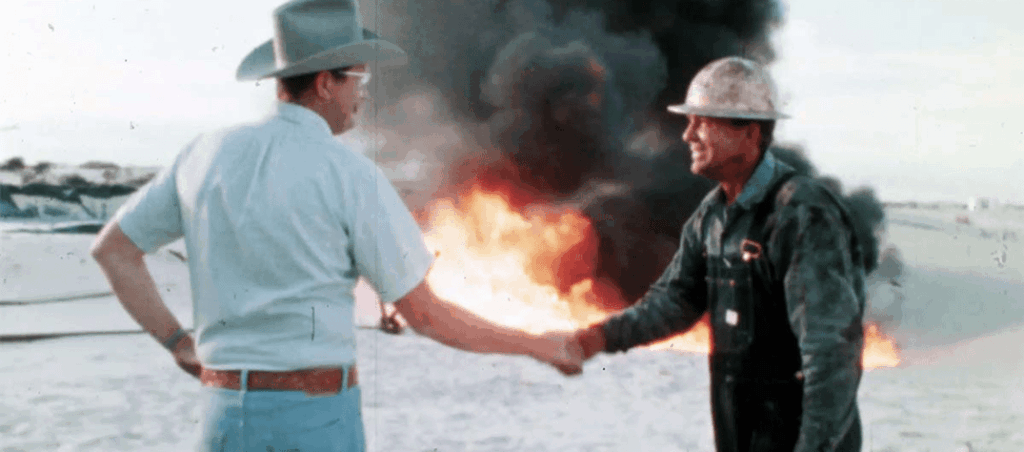
The Wexner Center for the Arts will host a screening of “The White House Effect” Wednesday. Credit: Courtesy of the Wexner Center for the Arts
On Earth Day, the Wexner Center for the Arts will host a screening of “The White House Effect,” a documentary that looks back at a time when the conversation on climate change was less divided.
Concluding the environmental history documentary series, the film will screen Wednesday. According to the center’s website, the film covers how global warming was actively blocked during George H.W. Bush’s Presidency. The title “The White House Effect” derives from Bush’s play on words referencing the greenhouse gas effect.
“We’re having it on Earth Day as a way of kind of hoping to focus people’s attention on these questions,” said Nicholas Breyfogle, professor of history and director of Ohio State’s Harvey Goldberg Center for Excellence in Teaching.
Breyfogle said the film was picked for its focus on topics covering how climate change was non-partisan in the 1970s and became highly politicized by the 1990s.
“We picked this film because it is an absolutely remarkable exploration of the ways in which we’ve seen shifts in how people think about climate change,” Breyfogle said. “And how climate change, as a sort of topic, changed from being basically a non-partisan issue in the 1970s, into being a highly contentious and highly politicized issue by the time we get to the end of the 1990s.”
“The White House Effect” takes a different approach from typical documentaries, as the content is primarily original footage rather than narration in the film.
“You’re watching, you know, TV footage of the news, you’re watching interviews with people on the streets, you’re watching interviews with politicians and you’re hearing their words directly from them,” Breyfogle said.
By using archival footage, Chris Stults, curator of film at the Wex, said the film is able to immerse audiences into that period in time.
“One of the strongest things about the film is that it’s made up entirely of archival footage,” Stults said. “It gives you the sense of living through history, you know, for somebody who did live through it like me, it’s kind of reminding you of all these things you’ve forgotten about. But then I think for younger folks, for students, it’ll be an amazing history lesson in a way that it doesn’t feel like somebody telling you a story because it’s all archival footage.”
Breyfogle said the film highlights how the understanding of climate change as an issue used to be collectively understood.
“People agreed that this was a very real problem, a very serious problem, and one that needed to be addressed,” Breyfogle said. “And while they might disagree in terms of how to address it, what was clear is there was a shared understanding of the science of what was going on and of the very real threat that was happening.”
Breyfogle said the film remains relevant today reflecting ongoing tensions within the issue of climate change.
“It reminds us that things have changed dramatically and they also have not changed,” Breyfogle said. “There’s a lot of patterns and they continue through, you know, from those decades to today.”
Breyfogle said he hopes the film encourages discussions after viewing.
“I hope that they’ll go and first of all, they’ll learn that lesson, that this has to be a partisan issue, and that we can have conversations about this,” Breyfogle said. “I think they should also walk away, talking about this topic with people they meet, getting people to come see this film.”
The showing takes place at 7 p.m., and tickets are free and available on the Wex’s website.