
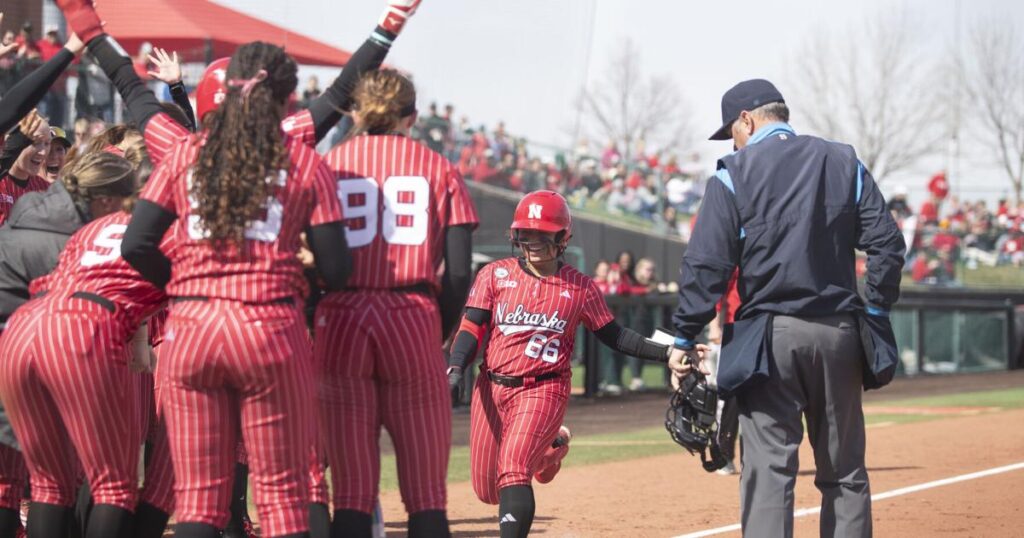
The award came as a surprise to Katelyn Caneda, but in a lot of ways, it felt like something that had been building long before she ever heard its name.
When she was called into Nebraska Life Skills coordinator Keith Zimmer’s office and he told her that she had been nominated for the Jackie Robinson Award, the Husker senior infielder didn’t immediately think about everything she had done to earn it. There wasn’t a single moment that came to mind, no checklist she mentally ran through. If anything, she was caught off guard.
“I was like, ‘Wait, what?’” Caneda said, laughing. “I didn’t really know much about it.”
The moment itself was brief. It was just a conversation, a quick explanation, and a name attached to an honor she hadn’t spent much time considering. But later, when she looked into what the award represented — given to student-athletes who make a meaningful impact in their communities — it started to make more sense.
Even then, her reaction didn’t shift toward pride in the traditional sense. Instead, it stayed rooted in the same place it always has: the people she’s met and the experiences she’s had along the way.
“I feel like the real award was getting to go into the community,” she said. “Getting to see those smiles from the kids, the senior citizens, anyone that I’m working with.”
That perspective didn’t come from one defining experience. It developed gradually, built through a collection of moments that rarely draw attention on their own but carry weight over time. When Caneda first arrived in Lincoln from Cerritos, California, she already had an interest in giving back. But like many freshmen, she was still figuring out how everything fit together, like classes, practices and a new environment far from home, about 1,500 miles from the small Los Angeles suburb.
At Nebraska, though, involvement in the community isn’t treated as an extra responsibility. It’s part of the culture, reinforced through the athletic department’s life skills program and the expectations placed on student-athletes to represent something bigger than themselves.
“I feel like I was always someone who liked being involved,” Caneda said. “But when I got here, it just became more of a priority.”
At first, that meant saying yes when opportunities came up. Over time, those decisions turned into habits, and those habits started to shape her identity. What began as something she enjoyed gradually became something she actively pursued, even when her schedule was already full.
“I’ll see something and check my calendar,” she said. “And if I have time, or I’ll make time, I’m like, ‘Yeah, I’m going.’”
Some of those moments stayed small. There were many conversations with kids, plenty of time spent with local organizations like the Food Bank of Lincoln, People’s City Mission and Matt Talbot Kitchen, and interactions that don’t show up in a stat sheet but leave a lasting impression. Others stood out in a bigger way. Before her junior season, Caneda traveled to Ecuador as part of a service trip with Nebraska Athletics, stepping into an entirely different environment and gaining a perspective that extended beyond anything she had experienced before.
During that trip, she and other student-athletes worked in schools, spending time with children and helping repaint a building in a bright green chosen by the young folks themselves.
“I’ve never had so much joy,” she said. “Just being around those kids and seeing how happy they were. It was really eye-opening.”
It wasn’t just the work itself that stayed with her. It was the feeling that came with it, where the understanding that something as simple as being present and giving time could have a meaningful impact. That understanding carried back with her to Lincoln. Her involvement continued to grow and her connection to the community deepened.
“I’m just very passionate about getting out there and doing those things,” she said.
That same mindset of showing up, staying consistent and focusing on something bigger than yourself has defined her just as much on the softball field. From the beginning, Caneda established herself as a player capable of making an impact and her freshman season reflected that.
But as the roster evolved and new talent emerged, her role began to shift, forcing her to adjust in ways that weren’t always visible from the outside. Instead of focusing on what had changed, she returned to the same core belief that had guided her from the start.
“I’ve always been a team-first person,” she said.
That mindset gave her something steady to lean on as she navigated those changes. Rather than pulling back, she expanded her perspective, finding new ways to contribute even when she wasn’t in the lineup. From the dugout, she began to see the game differently, noticing shifts in energy, momentum and small details that could influence the outcome of an inning.
“I can feel when the energy falls,” she said. “I can see things happening.”
That awareness allowed her to remain fully engaged, communicating with teammates, calling out situations and helping maintain focus in moments that might otherwise slip by. While those contributions aren’t always reflected in statistics, they have become an essential part of her presence within the team.
Freshman Skarlett Jones noticed Caneda’s presence almost immediately upon arriving in Lincoln. For a newcomer adjusting to a new environment, Caneda stood out not just because of what she did, but because of how she carried herself on a daily basis.
“My first impression of Kate was her genuine positivity and how approachable she is,” Jones said. “She always has a smile on her face and is laughing about something.”
That first impression quickly turned into something more meaningful as Jones began to see the consistency behind it. It wasn’t just a moment or a good day; it was something that showed up every single day, regardless of circumstances.
“She shows up the same way every single day,” Jones said. “You always know what you’re going to get.”
That reliability has made Caneda a steady presence within the program, someone teammates can look to regardless of her role on the field. Jones described a balance that isn’t always easy to maintain, especially in a competitive environment.
“She holds herself to really high standards and works incredibly hard,” Jones said. “But she’s also everyone’s biggest supporter.”
For Caneda, that balance isn’t something she actively tries to create. It’s simply how she approaches being part of a team, focusing on what she can control and how she can contribute in any given moment.
“I just try to be there for my teammates,” she said.
That approach was tested again during Nebraska’s March series against Michigan, when injuries forced sudden changes and players were asked to step into unfamiliar roles. Caneda was one of them, returning to the field after spending time contributing in different ways. For her, though, the moment didn’t feel like a spotlight or a turning point. It felt like a continuation of what she had been doing all along.
There wasn’t a sense of needing to prove something or reclaim a role. Instead, it was about doing what the team needed in that moment and embracing the opportunity to contribute.
“It was just like any other day,” she said. “I’m always ready, that’s what I was supposed to do.”
That perspective of being steady, consistent and rooted in something larger than individual performance has shaped how her teammates view her and why her impact extends beyond what happens on the field. Over time, it has also made her a mentor, someone younger players naturally turn to as they navigate their own transitions into the program.
“It kind of feels weird,” Caneda said. “Yesterday I was the freshman being mentored.”
Now, she’s the one providing that guidance — not through speeches or expectations — but through the example she sets every day. Jones said that influence has been clear from the start.
“I’ve learned a lot from Kate, especially about the power of positivity and consistency,” Jones said. “It’s made me want to be someone others can rely on.”
That influence reaches beyond softball, shaping the environment within the team and reinforcing the values that define the program. It’s part of what has made Caneda’s presence so meaningful, both for her teammates and for herself.
“She creates a positive and welcoming environment,” Jones said. “She makes people feel like they belong.”
For Caneda, that sense of belonging has grown over time into something deeper. What began as a place to play softball has become a place where she has built relationships, developed a sense of purpose and found a community she wants to remain part of even after her playing career ends.
“I love being [in Lincoln],” she said. “This community means a lot to me.”
As graduation approaches, that connection is shaping what comes next. A business management major — Caneda hopes to stay in Lincoln and pursue a career in community engagement — continuing the kind of work that has become central to her identity.
The transition into that next phase comes with uncertainty, something she acknowledges openly. Like many student-athletes, she is preparing to step away from a structure that has defined much of her life, while also navigating what it means to build something new in its place. Even so, the perspective she has gained through softball gives her a foundation to approach that change.
“If you’re batting .300, you fail seven out of 10 times,” she said. “But you could be an All-American.”
It’s a way of understanding failure not as something to avoid — but as something to move through — a mindset that extends beyond the game and into whatever comes next.
“So what?” she said. “The sun comes out the next day.”
For now, though, her focus remains on the present. There are still games to play, still time left with a group she knows she won’t have forever. Like many seniors, she has become more aware of the moments that once felt routine, such as the practices, the travel and the time spent simply being around her teammates.
“There’s been so many ‘last firsts,’” she said.
Those moments — especially the ones away from the field — are the ones she knows will stay with her. The bus rides, filled with music that shifts from one genre to another, teammates singing and dancing, personalities blending together in ways that make each trip feel different from the last.
“It’s just fun,” she said. “Everyone’s different, and you get to embrace all of it.”
In the end, those are the memories that define her experience, not just the performances or the recognition, but the relationships and the sense of connection that came with them. It’s the accumulation of those moments that tells the story of her time at Nebraska.
That’s what has defined Caneda’s career. It hasn’t been what she’s done, but how she’s done it, with a consistency and selflessness that has left an impact on everyone around her.
“The way she puts the team first,” Jones said. “That’s what I admire most.”
Long before the recognition came, that’s what people saw.