
RAMSTEIN, Germany – Allied Air Command (AIRCOM) will conduct Ramstein Flag 2026 (RAFL26) from June 8 to June 19, 2026. Now in its third iteration, this large-scale, multi-domain exercise is designed to enhance the Alliance’s deterrence and collective defence. Since its inception in 2024, this year marks the first time AIRCOM will lead the entire exercise independently. Operations will take place simultaneously across Northern and Southern Europe within NATO’s Joint Operations Areas, combining live-fly missions with synthetic training.
“Ramstein Flag 2026 will operate from the northernmost parts of Norway to the southern reaches of Spain,” stated Lieutenant General Jason Hinds, Commander of Allied Air Command. “The exercise reflects our enduring commitment to deliver the Air and Space Power the Alliance needs every day. By focusing on current and future threats, improved tactics, and robust integration, we continue to strengthen our collective deterrence,” he added.
Ramstein Flag 2026 will operate from the northernmost parts of Norway to the southern reaches of Spain
Building on previous successes, RAFL26 maintains the specialized training approach established by the “Flag” series in 1975. These exercises provide realistic combat scenarios in complex environments. Allied Air Forces participate as “Red” (adversary) and “Blue” (friendly) forces, with aerial systems simulating advanced air defence challenges.
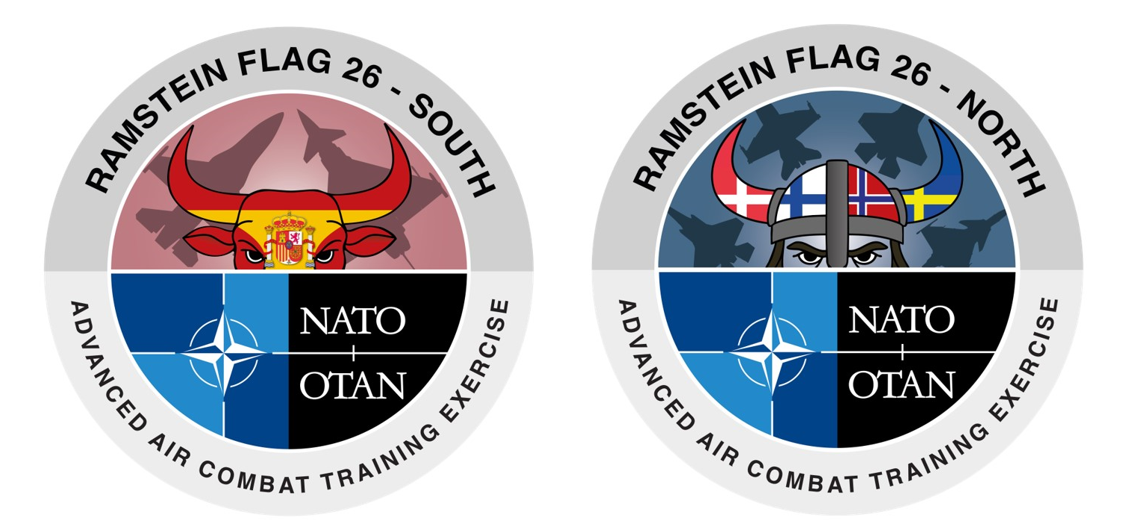
Ramstein Flag 2026 operations will take place simultaneously across Northern and Southern Europe within NATO’s Joint Operations Areas, combining live-fly missions with synthetic training.
RAFL26’s strategic priorities include Counter Anti-Access/Area Denial (C-A2AD), Integrated Air and Missile Defence (IAMD), and Agile Combat Employment (ACE). This exercise also emphasizes seamless data and information sharing among Allies. These objectives ensure NATO air forces remain prepared to respond rapidly to Article 5 scenarios, reinforcing the Alliance’s commitment to collective defence.
The expanded scale of RAFL26 demonstrates NATO’s commitment to countering modern and emerging threats through distributed operations. Hosted primarily by Denmark, Finland, Norway, Sweden, and Spain, the exercise involves 19 nations and over 15 operational locations. More than 150 Allied aircraft, including fighters, enablers, and NATO assets such as AWACS and RQ-4D, will conduct about 150 sorties per day.
Multi-domain integration and the use of surface and sea-based air missile defense assets within a Joint Engagement Zone will further refine NATO’s tactical procedures. Coordinated defensive counter-air missions during RAFL26 will enhance NATO Air Forces’ decision-making in dynamic environments.
With the activation of Enhanced Vigilance Activity (eVA) Eastern Sentry in September 2025 and eVA Arctic Sentry in February 2026, RAFL26 provides an opportunity to consolidate lessons learned and refine tactics, techniques, and procedures to address evolving threats. By delivering advanced training and encouraging innovation, the exercise demonstrates NATO’s ongoing commitment to shared security and stability. Together with Enhanced Vigilance Activities, RAFL26 highlights AIRCOM’s transition from traditional Air Policing to multi-domain Air Defence, strengthening NATO’s distributed posture against a range of airborne threats.
At the 2026 NATO Air Chiefs’ Symposium, Lieutenant General Hinds emphasized the growing importance of air and space power. RAFL26 demonstrates NATO unity as Allies train together to synchronize Command and Control (C2) in realistic scenarios. This multinational collaboration highlights the Alliance’s multi-domain capabilities, working with maritime units and special forces to ensure stability across the Euro-Atlantic area.