
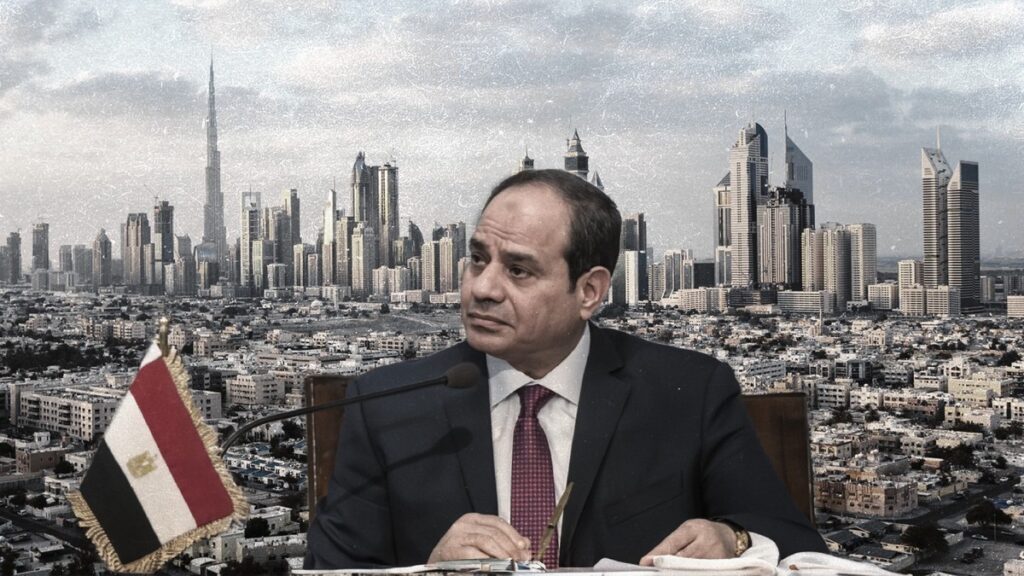
With the start of U.S. and Israeli strikes on Iran on February 28, 2026, and Iran subsequently launching missile and drone attacks on Gulf countries, many social media users shared and reposted remarks made by Egyptian President Abdel Fattah el-Sisi when he was a presidential candidate in 2014. At the time, he said: “When Arab national security faces a real threat and we are called upon, we’ll move decisively and swiftly.”
Many citizens in Gulf Cooperation Council countries commented on the need for Egypt to act in response to Iranian threats, arguing that fulfilling the “one-step distance” pledge had become necessary due to Iran’s attacks on GCC states.
This coincided with calls on social media to reassess relations between Egypt and Gulf countries after the end of the Iran war—something that, if it happens, would represent a pivotal moment in the structure of regional relations and joint Arab action.
Repercussions of the Exchange
Explaining the reasons behind this debate over Egypt’s role and calls in the Gulf to reassess relations with Cairo, Kuwaiti political researcher Mohammed Al-Bughaili said that “popular Egyptian sympathy with Iran has led to tensions on social media.” He stressed to Alhurra that “Gulf countries have not submitted any official request to Egypt to participate in the war.”
Former Egyptian ambassador to the United Nations, Moataz Ahmadin Khalil, agrees with this view. He told Alhurra that “the Egyptian Minister of Information has repeatedly announced that Egypt has not received any such requests, and official statements and declarations accompanying visits and communications at various levels have not indicated this.”
During the war, Kuwaiti writer Fouad Al-Hashem published an article on the platform X titled “A Dog Minus a Quarter for Every Citizen,” in which he criticized Egypt and its stance on Iranian attacks against Gulf states. Egypt’s Ministry of Information responded with an official statement strongly condemning what Al-Hashem wrote, while the Kuwaiti foreign minister informed his Egyptian counterpart that Al-Hashem had been referred to the public prosecutor.
Despite this, Al-Bughaili believes that “there are no strained relations in the official sense, but rather a state of media and popular sparring between the two sides, given Egypt’s status as a major state and the constant public expectation of its intervention.”
As for Kuwait, media figures and social media influencers called for the withdrawal of a Kuwaiti deposit estimated at $2 billion from the Central Bank of Egypt and for a reassessment of relations with Cairo.
This is one of two Kuwaiti deposits totaling $4 billion held at the Central Bank of Egypt, both of which are due to mature this April.
The ongoing media disputes between Egyptian and Kuwaiti figures, along with the Gulf state’s financial exposure to developments in the Iran war, have fueled expectations that Kuwait may withdraw the two deposits.
Kuwaiti Foreign Minister Jarrah Jaber Al-Ahmad Al-Sabah visited Egypt and met President Abdel Fattah el-Sisi on April 19.
In a statement, the Egyptian presidency said that el-Sisi affirmed Egypt’s categorical rejection of any attack on Kuwait or any other Arab country and expressed full support for Kuwait’s stability, considering its security an extension of Egypt’s national security.
Neither side addressed the Kuwaiti deposits.
Khalil noted that “both sides are keen to repair any fractures, and regarding the current situation, my assessment is that the debate on social media will not have a tangible impact at the official level.”
Defense Agreements… Where Is Egypt?
In recent weeks, Saudi Arabia activated the joint defense agreement it signed with Pakistan in 2025. Under this agreement, the Pakistani armed forces deployed a number of F-16 fighter jets and sent military personnel to King Abdulaziz Air Base in the kingdom.
During the war, Gulf states also sought military cooperation with Ukraine. Defense cooperation agreements were signed between Saudi Arabia, the UAE, and Qatar on one side, and Ukraine on the other. These agreements include joint weapons production and the development of new technologies, with a focus on drones, an area in which Ukraine has gained significant expertise since the start of its war with Russia in 2022.
Hani Al-Basous, a professor of international relations in Qatar, believes that “the Gulf approach focuses on self-defense and repelling Iranian aggression. Gulf countries have the right to cooperate with Egypt and other countries to enhance security without requiring direct integration into a unified defense system.”
Khalil argues that Saudi Arabia “turned to Ukraine, for example, because of its extensive experience in countering drones and missiles due to the war with Russia. It has also requested and received specific military assistance from the United States, France, and the United Kingdom.”
During talks with the Finnish president on Tuesday, el-Sisi reiterated “his rejection and condemnation of attacks on Gulf countries and all Arab states,” stressing that “Arab national security is part of Egypt’s security.”
Khalil added that “Gulf governments understand the difference between political relations and popular sentiment, but they hope Cairo’s policies align with theirs regardless of other factors, including Egyptian public opinion—and sometimes regardless of Egypt’s own interests, which is not possible.”
However, Al-Basous emphasized to Alhurra that “Egypt is working in cooperation with the United States to end the war and stop Iranian attacks on Gulf states,” noting that Cairo’s actions with Gulf countries aim to “achieve collective security.”
The Future of Relations Between the Two Sides
Gulf countries provided Egypt with nearly $50 billion in aid between 2011 and 2022. Since 2021 alone, Gulf investments have exceeded $60 billion. The UAE signed a $35 billion deal with Egypt for the Ras El-Hekma project, followed by a recent $29 billion investment agreement between Qatar and the Egyptian government in the Alamein region on Egypt’s northern coast.
This comes despite differences between the two sides on several regional issues, including Sudan, Libya, and Yemen.
Khalil pointed out that “talk of reshaping relations between Egypt and the Gulf recurs from time to time for various reasons, even before the war. There have been previous instances where certain types of Gulf aid to Egypt were suspended, but such situations do not last long, as both sides are keen to repair any fractures.”
Regarding the current situation, Khalil said that Gulf public discourse about economic aid to Egypt “stems from two reasons: first, in response to the rapprochement between Egypt and Iran at the level of the president and foreign minister; and second, out of frustration with popular Egyptian sympathy toward Iran.”
Al-Bughaili, for his part, noted that “some Gulf public circles had hoped for a greater Egyptian role, similar to what Saudi Arabia did by opening its airports and ports to GCC countries, and also based on Egypt’s central role within the Arab League.”
Despite ongoing tensions and exchanges between Egyptian and Gulf parties, Al-Basous stressed that “relations between Egypt and the Gulf states are generally good.” He added that “since the Iranian aggression against Gulf countries, relations have actually begun to show noticeable improvement, moving toward a more collective level of cooperation and coordination.”
The article is a translation of the original Arabic.