
HYANNIS — For the most part, Sunday, April 19 looked like a typical spring day at the Margaritaville Resort on Iyannough Road.
 Provincetown resident Ivan Ivanov casts his ballot for the Progressive Bulgaria party. (Photo by Jack Styler).
Kids in bathing suits ran through hallways to the indoor waterpark and arcade. A musician played steel drums in the lobby, where framed quotes on the walls extolled the virtues of the “Caribbean soul.”
Signs decorated with red, green, and white balloons marked the way to something unusual, however: the basement conference room had been converted into a polling station where 174 Bulgarian citizens voted in their country’s closely watched parliamentary elections.
The government of Prime Minister Rosen Zhelyazkov had resigned on Dec. 11 after large protests in the capital, Sofia. Sunday’s election for a new parliament was the eighth in just five years — a rudderless era of cascading political crises and increasingly evident corruption.
Following those protests, the country’s two-term president — a largely ceremonial role in Bulgaria — resigned and formed a new political party that won decisively on April 19. Rumen Radev, a former fighter pilot and commander of the country’s air force, will now lead a party that got 45 percent of the vote and will have a majority in parliament without needing a multi-party coalition.
At the Margaritaville polling station, Radev’s “Progressive Bulgaria” party won by almost the same percentage as in Bulgaria: 80 of 174 votes, or 46 percent.
The pro-European “We Continue the Change” party came in second in Hyannis with 45 votes, or 26 percent, double the roughly 13 percent it carried in Bulgaria. At the Boston polling site, which had 585 Bulgarian voters, “We Continue the Change” won overwhelmingly.
The party of outgoing Prime Minister Zhelyazkov won about 13 percent of the vote in Bulgaria but got only five votes in Hyannis — one fewer than the six people who picked “I don’t support any of these parties.”
Voting in Hyannis
In past years, there had been more than 50 polling stations across the U.S. for Bulgarian elections, but a change in Bulgarian law in February capped the number of polling sites in non-E.U. countries at 20 per country.
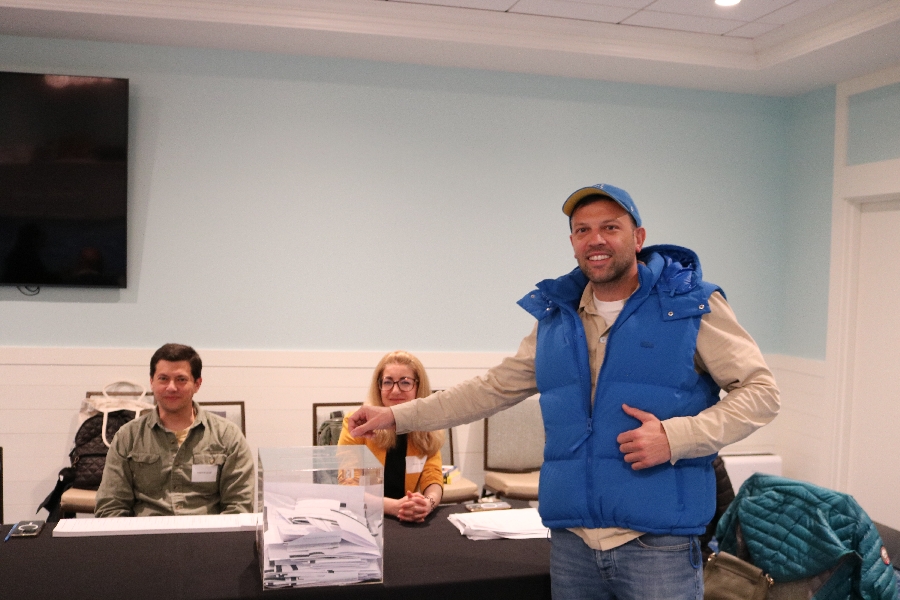 Provincetown resident Georgi Todorov after casting his ballot. (Photo by Jack Styler)
Because Cape Cod has a large Bulgarian population that consistently turns out to vote, consular officials agreed that Hyannis should continue as one of America’s 20 voting sites this year, said Nadia Stoyanova, who has helped organize Bulgarian elections in New England since 2013. A voting station on Nantucket was closed this year, with Bulgarian citizens there directed to vote in Hyannis.
Antonio Mihaylov, who lives in Provincetown and is originally from Burgas, Bulgaria, said on April 17 that he had been urging his Bulgarian friends in town to vote.
“They feel hopeless, and I don’t blame them,” said Mihaylov, who works for Ptown Pedicabs and attends Cape Cod Community College. “We have had many bad experiences in past years.” This election felt different, said Mihaylov; he supported Radev’s party.
Provincetown resident Preslav Mitsov, who grew up in Sofia, said he voted for the pro-European “We Continue the Change Party” but understood the appeal of Radev’s party after years of gridlock. “I think a lot of people have hope that they’re going to unite the whole country somehow, win the majority, and we finally can go in some direction.”
Ivan Ivanov, who owns the cleaning company Steam Guys in Provincetown, said he voted for Radev’s party after skipping parliamentary elections for the last 15 years. “I think this is the last choice for Bulgaria,” Ivanov said.
 Gergana Neykova of Nantucket cast her vote as volunteer poll worker Georgi Zhivkov kept an eye on the ballot box. (Photo by Agata Storer)
The Hyannis polling place hasn’t always been at Margaritaville. Yarmouth resident Teodora Varbanova, the polling station’s volunteer leader, said it used to be at St. Mary’s Episcopal Church in Barnstable, but a scheduling conflict meant a new site was needed this year.
No other mid-Cape church could host the polling place, she said, and her inquiries to several real estate companies went unanswered.
Varbanova was about to give up when she decided to call the Margaritaville Resort Cape Cod, which is owned by the Linchris Hotel Corp., because of its proximity to Route 6 and the ferry terminal. The hotel’s manager agreed to host them for $350 per day, said Varbanova.
On April 18, she and other volunteer poll workers converted the hotel’s conference room into a makeshift polling station so that they could open at 7 a.m. the next day, she said.
Election Day
Voters could register at the polling station with a paper form if they had not already registered online, Varbanova said. Poll workers copied the registrations onto a ledger that they sent to the Bulgarian Central Voting Committee at the end of the night.
 Volunteer coordinator Teodora Varbanova put up signs directing voters to the ballot box. (Photo by Agata Storer)
“The whole government works in Word documents,” Varbanova said. “There is no PDF; Excel doesn’t exist for them. Everything is done manually, and it’s very laborious.”
After registration, each voter presented a passport or ID card to receive a one-question paper ballot, which was stamped by poll workers twice — once before they entered the voting booth and again after. Each voter dropped the paper ballot into a clear ballot box, often smiling as a friend captured the moment on camera.
Because of the seven-hour time difference between Cape Cod and Bulgaria, the election’s preliminary results came out in the middle of the voting that afternoon.
Georgi Todorov, co-owner of Ptown Pedicabs, cast his vote just before 2 p.m. and then pulled up the latest exit poll on his phone; Radev’s party was firmly in the lead. “I think they’ll be able to form a government,” he said, looking at a chart of the projected allocation of parliamentary seats.
Despite the serious purpose, the atmosphere at the polling station felt at times like a family reunion. Some voters arrived with their parents and children in tow. Children drew pictures with colored pencils while their parents filled out registration forms. Poll workers snacked on pizza donated by Kris Jones, a Bulgarian who owns several Dominos on Cape Cod.
Polls closed at 8 p.m., but Varbanova and the other volunteers stayed late into the night to finish their work. The group had to count each ballot by hand, scan all the ballots, and send the results to the Bulgarian Central Voting Committee through a secure email before they could leave Margaritaville.
A Political Wild Card
Radev ran an atypical campaign, giving only two interviews and declining to articulate his political positions in detail, according to an April 16 report from Politico. A longtime Euroskeptic — including of financial and military support to Ukraine in its war against Russia — he has sometimes been compared in the Western press to Victor Orbán, the pro-Russian Hungarian leader who was just voted out of office after 16 years in power.
 Signs in the Cape Cod Margaritaville lobby directed voters to the basement polling station. (Photo by Agata Storer)
E.U. leaders have largely welcomed Radev’s election, however. On April 21, the European Council on Foreign Relations predicted that while Radev is “ready to criticize the European Commission,” he “will generally not attempt to block big E.U. decisions on Ukraine or elsewhere.”
Radev earned a master’s degree from the U.S. Air War College in 2003, according to NBC News. His campaign was focused on relentlessly condemning what he called Bulgaria’s “mafia state” and in particular the leadership of three-time prime minister Boyko Borissov and the media oligarch Delyan Peevski, who is under U.S. and British sanctions.
After the election, Radev told reporters that he wanted to “develop practical relations with Russia based on mutual respect and equal treatment” while continuing the country on a “European path” with “critical thinking” and “pragmatism.”
For Momchil Kirkov of Sandwich, a native of Stara Zagora, Bulgaria who has lived on Cape Cod since 2002, Radev’s vague positions and association with Russia were red flags.
“He’s very ambiguous in his speeches, like he’s always gauging public opinion,” said Kirkov, who voted for “We Continue the Change.” “I firmly believe he’s just an apparatchik of the Russians.”
Provincetown resident Mihaylov agreed that Radev “feels a little different” from other Bulgarian politicians but said that “we feel like he’s our last hope.”