
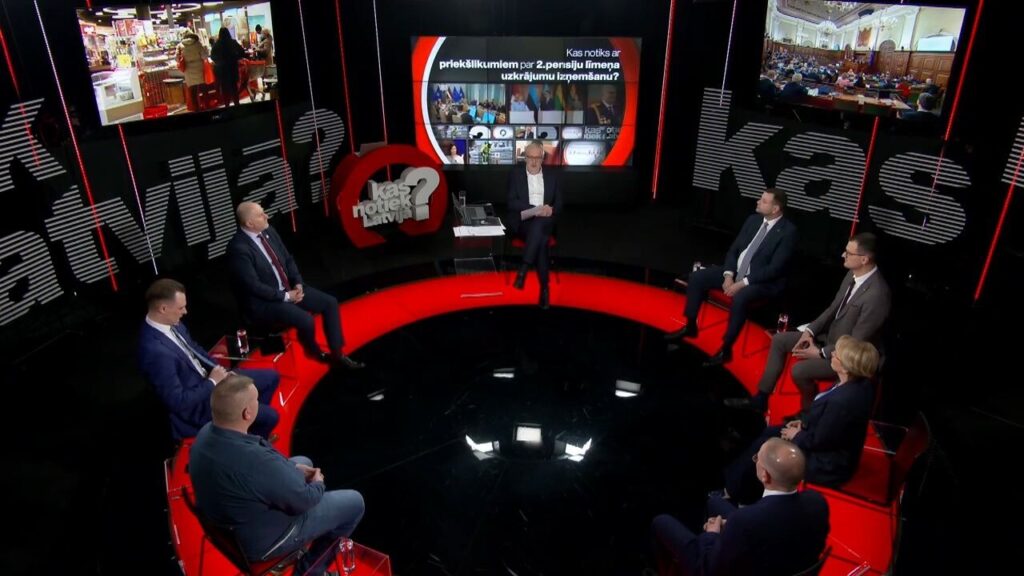
The parties represented in the Saeima have different opinions on the rules regarding withdrawal of second-pillar pension savings, according to politicians’ statements on the Latvian Television programme “What’s happening in Latvia?” (KNL).
Currently, such pension capital can only be accessed by individuals after the granting of an old-age pension or in the event of the death of the scheme participant.
The opposition party “Latvia First” (LPV) believes that people should be allowed to withdraw money accumulated in the 2nd pension pillar, because, as pointed out by Saeima member Edmunds Zivtiņš (LPV), “It is people’s privately earned money, not state money.” The party has also applied to the Central Election Commission with an application to start collecting signatures to initiate a referendum on the withdrawal of 2nd pension level savings.
Meanwhile, the Greens and Farmers’ Union (ZZS), which forms party of the ruling coalition, believes that savings should be allowed to be withdrawn only for healthcare purposes, and not “like in Lithuania, where the money went to online stores,” said Welfare Minister Reinis Uzulnieks (ZZS), though as Uzulnieks admitted, the party also has divided opinions on this issue.
Meanwhile, the National Alliance and New Unity parties point out that the withdrawal of savings for medical treatment should be discussed after the Saeima elections, otherwise “multiple voting” in both referenda and elections will complicate matters.
The opposition National Alliance (NA) thinks it could discuss the idea of allowing savings to be withdrawn to “save one’s own life and the lives of family members or to allow one to return to the labour market.”
“That wouldn’t be beauty treatments, relaxation. We don’t want to tear up the second pension pillar, that’s not far-sighted,” said MP Artūrs Butāns (NA).
In turn, Gatis Liepiņš, a member of the Saeima from the coalition New Unity party and chairman of the Saeima’s Public Expenditure and Audit Committee, emphasized that the complete early withdrawal of pension savings is “absolutely unacceptable”, but that allowing them to be disbursed to cover medical expenses is debatable.
“If it is necessary to save lives, we can discuss it, but not before the elections. We can talk about it after the elections, with a fresh perspective, not in a charged atmosphere, when each other’s parties are campaigning and part of parliament is ready to tear up the second pension pillar,” said Liepiņš.
The pension systems in all three Baltic countries are based on a three-tier or ‘pillar’ model. The first is a state-guaranteed pension, paid from the contributions of today’s residents. The second is personal savings in tandem with the state. This money is invested to receive more in old age. And the third tier is an additional private voluntary fund for those who want to save for an even more secure future. Until 2021, participation in the first two tiers was mandatory for all workers in all Baltic countries.
Estonia was the first to reform its system, opening up the possibility of abandoning the second pillar. When the new rules came into effect in 2021, about 150 thousand people withdrew from the second pension pillar – about a fifth of the system’s participants. They withdrew more than 1.3 billion euros, and after paying taxes, about 1.1 billion ended up in the accounts of residents. Many used it to buy cars or household appliances. Others simply left the money in their accounts for everyday consumption. It gave them a short-term financial boost, but it remains to be seen what the effects will be when they reach pensionable age without their second-pillar contributions.
Lithuania decided to follow a similar path – from 2026, residents will no longer be automatically enrolled in the second pension pillar. Those who are already participating in it will be able to leave the system or withdraw up to 25% of their savings.
The Ministry of Welfare, which is responsible for state pensions in Latvia, when asked whether Latvia could also consider allowing people to withdraw savings from the second pension pillar early, responded briefly in early December last year: “Discussions with specialists in the field are currently ongoing. Amendments to the State Funded Pensions Law will be made after the most suitable solution is found.”
The official position at the moment remains that the Ministry of Finance, the Ministry of Welfare and the Bank of Latvia are against allowing people to withdraw their second pillar pension funds.
Select text and press Ctrl+Enter to send a suggested correction to the editor
Select text and press Report a mistake to send a suggested correction to the editor
Tell us about a mistake