
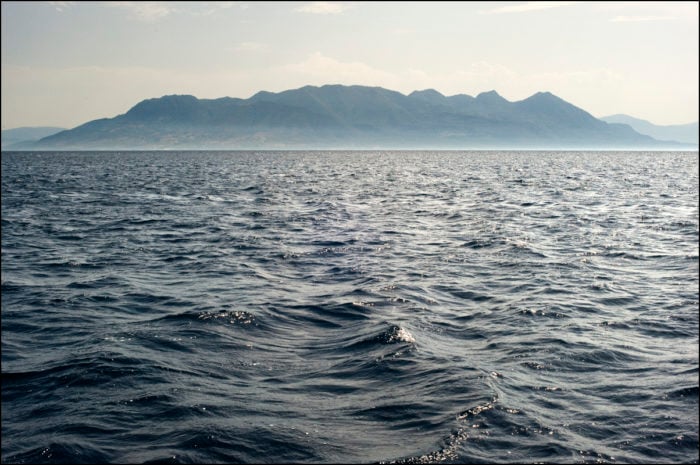
 Methana seen from the sea. Credit: Ggia – Own work, CC BY-SA 3.0
New research published in Science Advances has challenged the long-held assumption that the Methana volcano in Greece, located about 50km from Athens, is extinct. Despite showing no signs of activity—such as ash clouds or lava flows—for over 100,000 years, the volcano has been quietly accumulating vast quantities of magma within its subterranean chambers.
To reach these findings, scientists analyzed more than 1,250 zircon crystals extracted from the Earth’s crust beneath the volcano. Because these crystals preserve data about the conditions under which they formed, researchers were able to map the volcano’s history with remarkable detail.
As ETH Zurich volcanologist Olivier Bachmann explained, “We can think of zircon crystals as tiny flight recorders. By dating more than 1,250 of them across 700,000 years of volcanic history, we’ve reconstructed the volcano’s inner life with precision.”
The study reveals that the volcano’s magma chambers have been active almost continuously, suggesting that a lack of surface activity does not necessarily indicate extinction. Bachmann further noted, “What we learned is that volcanoes can ‘breathe’ underground for millennia without ever breaking the surface.”
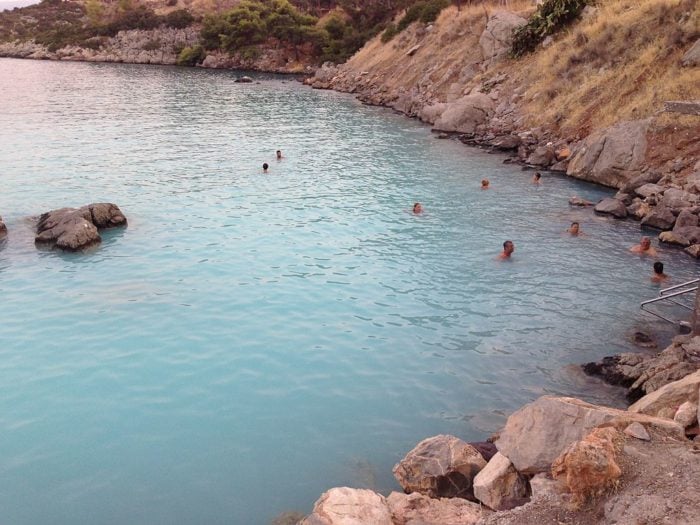 Sulfurous baths of Methana. Credit: Agustin Bartolome – Own work, CC BY-SA 3.0
The risks from Greece’s Methana volcano
The research team discovered that the magma feeding the volcano is exceptionally water-rich, which may actually influence the frequency of eruptions. According to co-author Răzvan-Gabriel Popa, “We actually believe that many subduction zone volcanoes might be periodically fed by particularly wet primitive magma, something that the scientific community has not yet fully recognised.”
These findings carry significant consequences for global safety protocols regarding volcanic risk. The authors emphasized that the study “highlights the importance of monitoring dormant volcanoes, even in the absence of recent eruptions,” and suggested that current threat levels for long-quiet volcanoes should be re-examined.
Bachmann stated: “For volcano hazard authorities, for example, in Greece, Italy, Indonesia, the Philippines, South and North America, Japan, etc, this means re-evaluating the threat level of volcanoes that have been quiet for tens of thousands of years but show periodic signs of magmatic unrest.”
Ultimately, the study serves as a warning that a long period of dormancy can mask the development of a large, potentially dangerous magma system.