
Slovakia has invested just over half a billion euros in the Barak MX from IAI and the first battery of the system has now been delivered. However, for NATO there are some policy hurdles in the way of a truly integrated air defence capability.
By Sam Cranny-Evans, editor of Calibre Defence, published on April 24, 2026.
The Israeli Ministry of Defence has delivered a Barak MX air defence battery to Slovakia. Under a 2024 contract value at €560 million, the Slovak MoD ordered the system to replace S-300s that were donated to Ukraine.
The contract covered six batteries for the system, which provides different interceptors for different threats. Delivery of all six was expected by 2030 when the contract was signed. Some industry sources indicate that the delivery is behind schedule due to the Iran war. The April 23 press release from the Israeli MoD however states that it was completed ahead of schedule.
“We are already seeing growing interest from additional countries, with further significant agreements expected to be signed in the near future,” Israel’s Defence Minister, Israel Katz, said in the press release.
The delivery was confirmed ahead of the Israeli MoD’s press release by Slovakia’s Minister of Defence. Speaking on April 16, Robert Kaliňák said that battery was defending the intersection of the country’s two nuclear power plants. The defence minister also added that production had been delayed by the wars in the Middle East.
The country’s nuclear power plants are located near the town of Mochovce and another near Bohunice. Nuclear power provided 55% of Slovakia’s electricity according to a 2020 IAEA report. So, with Russia’s focus on Ukraine’s power infrastructure, and Slovakia’s dependence on two nuclear plants, defending them makes good sense.
Tech profile: Barak MX

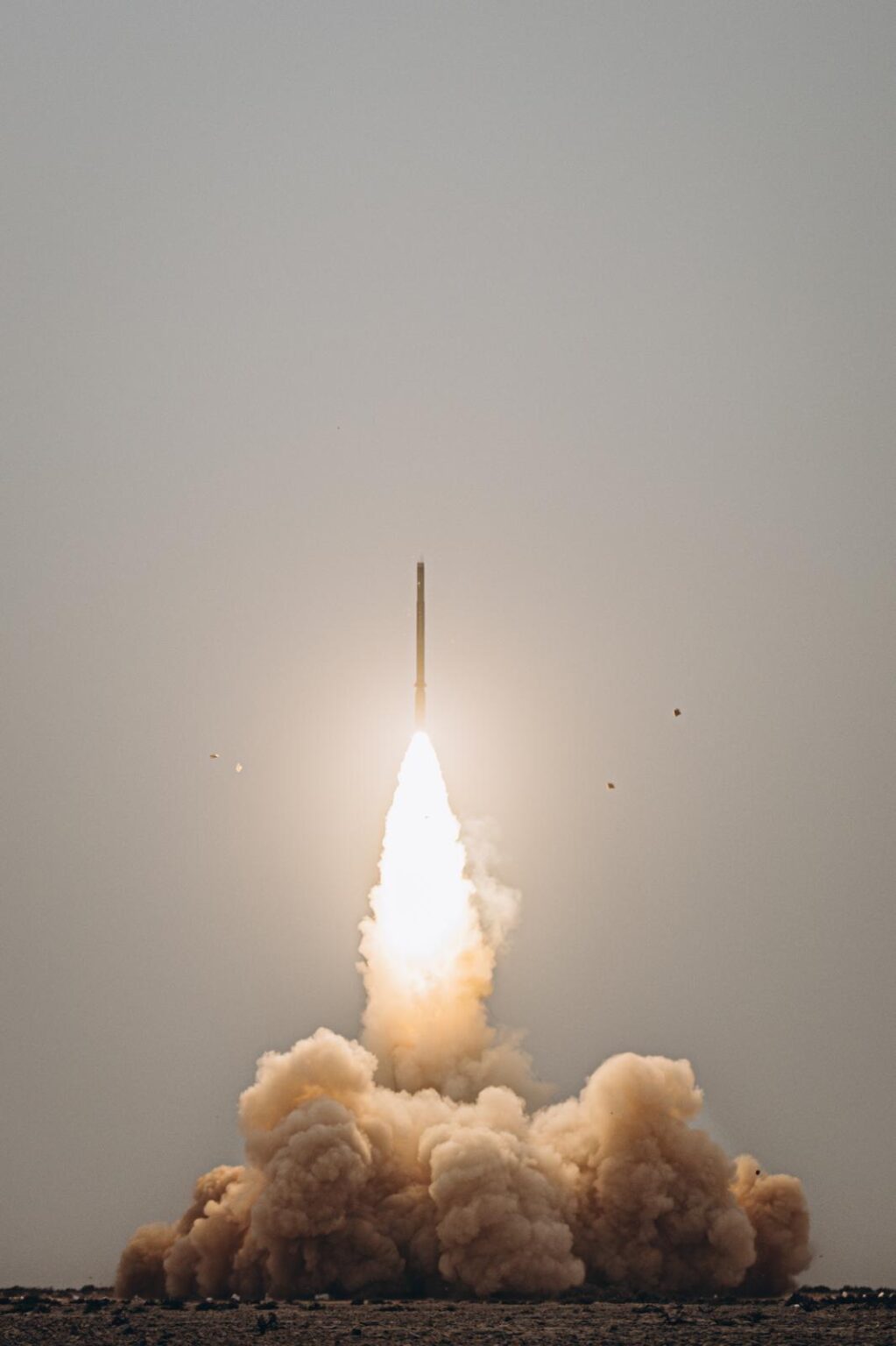
Barak MX air defence fire unit as a missile is launched. Credit: IAI.
The Barak MX is an integrated air and missile defence system manufactured by IAI that is defined by its modular, network-centric architecture. It is composed of three primary elements: a family of vertically launched interceptors, a Battle Management Centre (BMC) available in various stationary or mobile configurations, and fully digital AESA radar sensors. The system’s open architecture allows it to function as a unified framework, seamlessly connecting these components across land and naval domains.
The system utilizes independent vertical launchers that can be interconnected across a wider networked area. This connectivity enables different fire units to rely on shared assets, allowing the system to engage targets that may be beyond the individual reach of a single unit. Each launcher is designed to support the rapid deployment and firing of multiple interceptors to counter simultaneous threats.
Operational range is determined by the specific interceptor selected for the mission. The BARAK MR provides coverage up to 35 km, while the BARAK LR extends this to 70 km. For high-altitude and long-range requirements, the BARAK ER utilizes a dual-pulse rocket motor and booster to reach distances of up to 150 km.
In terms of engagement, the Barak MX is designed to neutralize a broad spectrum of modern aerial challenges. It provides a comprehensive solution against fighter aircraft, cruise missiles, and unmanned aerial vehicles (UAVs). Additionally, the system is capable of intercepting more complex threats such as tactical ballistic missiles, sea-skimming missiles, and helicopters.
Calibre comment: NATO’s air defence – it’s a policy issue
During the Cold War, alliance members procured air defence systems in the understanding that they would be delegated to NATO. In the event of war, the Supreme Allied Commander Europe (SACEUR), could – in theory – call upon the combined air defences of the 16 members. It took time for NATO to build those defences, but it meant that it could effectively establish a SAM belt across Europe. There was defence in depth too, with Patriots forming much of the belt and other systems defending airfields. Importantly, SACEUR would take control and was expected to run the military aspects of the war once it had started.
NATO has of course expanded, with 32 members many of which are upgrading their air defences. Slovakia and its Barak MX system is one example, but Germany, the Netherlands, Denmark, Poland, Italy, the UK, and many others are adding their own systems. This creates several challenges for NATO as a military organisation. There is the question of integration, which is technically demanding but not impossible. But perhaps the biggest challenges when it comes to air defence are political.
At present, some states feel that it is more important to protect their domestic infrastructure than contribute air defence to the Alliance, according to speakers at the SAE Media air defence conference in 2025. There is also a level of political demand that may mean SACEUR would not be able to act freely. Both matters require policies and slight changes in political standing if they are to be addressed.
The lead image shows the Barak MX air defence system. Credit: IAI.