

A new ‘A0’ class is to be introduced for specially low-emission homes that do not use fossil fuels
BER is a measure of the energy performance of a building and allows prospective buyers or tenants to objectively compare its energy performance with different dwellings on a like-for-like basis.
The new regulations under the EU Energy Performance of Buildings Directive (EPBD) will come into effect on May 24, streamlining energy ratings of properties while simplifying comparisons on a scale of A to G.
In addition, a new “A0” class is to be introduced for low-emission homes that do not use fossil fuels.
Housing Minister James Browne said the new system will provide a “much higher standard” of efficiency and comfort.
Below is a list of answers to questions you may have about changes in the energy rating system for homes across Ireland.
How does the current rating system work?
The current rating scale looks similar to the energy rating labels for household appliances. It rates the home on a scale from A to G with 15 sub-categories of A1, A2, A3, B1,B2, B3 and so on.
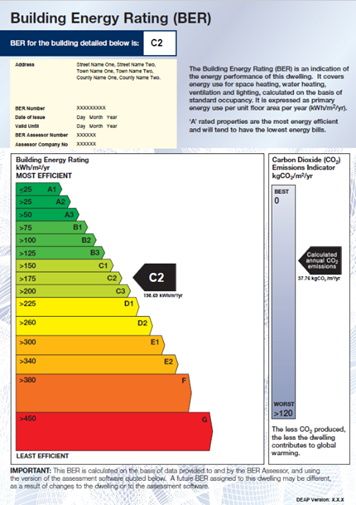
The current BER breakdown chart
A is rated the most energy-efficient, while homes that are designated a rating within the G range typically require a lot of energy to heat to a comfortable level.
It functions to help housebuyers understand the energy efficiency of a home and can be used as an indicator of the running costs and carbon emissions associated with heating the home to a comfortable level.
How will the new rating system compare?
The incoming system will simply run from A to G without sub-categories.
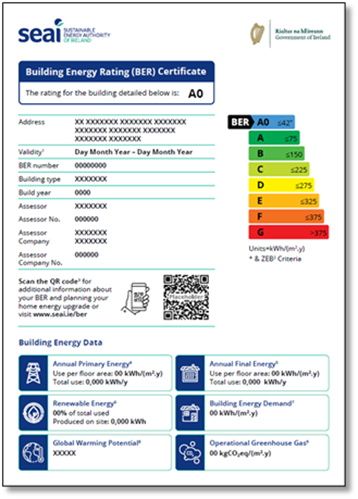
The new BER breakdown chart
A-rated homes will be the most energy-efficient and comfortable and G-rated homes will denote the lowest energy-efficiency. They typically require a lot of energy to heat the home.
With the rollout comes additional information on energy use, renewable energy contribution, and the amount of carbon emissions involved in the whole lifecycle of the building.
Will the new BER apply to me?
The altered standards will apply to all properties that do not possess a BER cert before May 24 of this year.
All existing BER certificates remain valid for 10 years from their date of issue.
Mr Browne confirmed this in a statement, saying “Most homes will not be impacted by these changes as all existing BER certs will remain valid for 10 years from their date of issue,” confirming that all homes with valid BERs will continue to suffice for sale and rent in spite of the new system.
Why is the BER changing?
The goal is to make BERs easier to understand and improve comparability across Europe.
It will also champion the most environmentally sustainable homes through its inclusion of the new A0 category.
What will be in the new BER cert?
On your new cert will be the simplified scale in accordance with the new EU standards, a guide to energy use, global warming potential and a QR code linking to your BER details and tailored home upgrade information.
Will this impact my SEAI grant?
The requirement to reach a post-works BER of B2 under the One Stop Shop Scheme or Community Energy Grant will now become a requirement to reach a B post-works BER.
The minimum required improvement in energy efficiency remains the same.