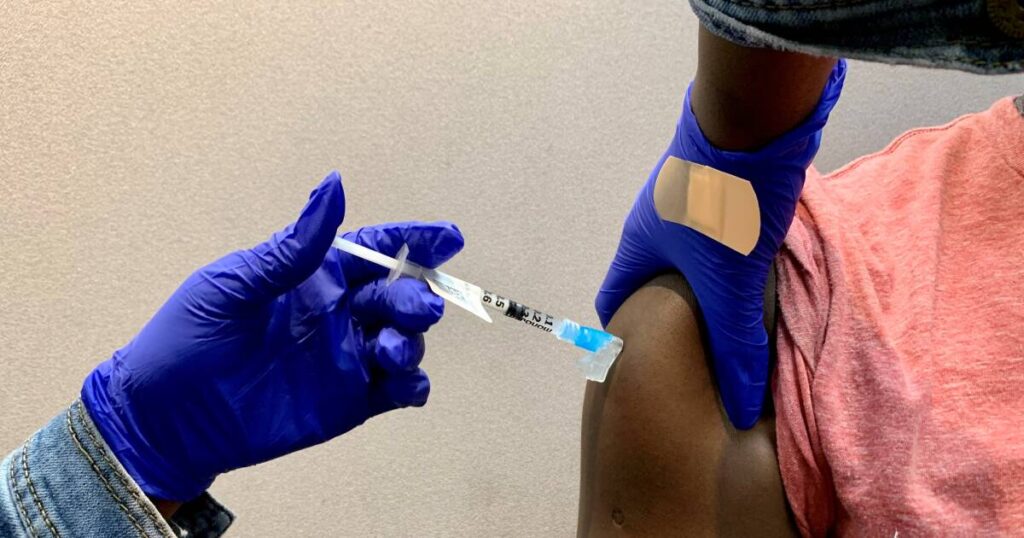
Massachusetts Commissioner of the Department of Public Health Dr. Robbie Goldstein joined GBH’s Morning Edition to talk about the latest news out of the Centers for Disease Control — including the halting of a report for a study on Covid vaccine effectiveness, as well as guidance surrounding ticks for warmer weather. The following transcript has been lightly edited for clarity.
Mark Herz: So, starting with the CDC — recent reports have shown the organization delaying studies or withholding information, and not for medical or scientific reasons. We recently learned the CDC is canceling a report showing that the COVID-19 vaccine cut the likelihood of emergency department visits and hospitalizations for healthy adults last winter by about half. As I like to remind our listeners, you were a high-ranking CDC official, so we want to get your take on this and any effects you see for Massachusetts residents. So what do you think of this?
Robbie Goldstein: I think this is actually a really important issue, even if it may seem a little bit wonky or esoteric for a lot of people who are listening. For decades, the CDC has put out scientific information free of political ideology, but instead really focused in data and in evidence, and importantly, how the data and how the evidence impact our decisions in public health. So think about things like the first cases of HIV/AIDS in the 1980s. Those came out from CDC in an unbiased publication. We think about the vaping crisis, when we were having a huge public health crisis in youth across this country. Those data came out of the CDC, completely unbiased.
The same is true for the first case of COVID and the response to COVID during 2020-2021, where we saw CDC put out information without political ideology, without that additional lens. So this is a huge shift from where CDC was to where it is now. And I think it has big implications for public health across this country. It means, one, we can’t trust what is coming out of CDC. We have to apply additional scrutiny. Two, [it means] we don’t have the information that we need. So in public health, we need to know what’s happening. We need to know what’s happening not only in Massachusetts, but in every state across the country, so that we can make good decisions about how to protect the health and wellbeing of people here in Massachusetts. CDC isn’t gonna be our partner in that anymore, or at least that’s what they’re saying by hiding some of these publications.
Herz: What’s your perspective on the nomination of Dr. Erica Schwartz as next head of the CDC?
Goldstein: I think we need to see what happens in the months and year ahead. Certainly she has to go through a nomination hearing, and I hope that she’ll answer questions openly and honestly about how she views public health in this moment. We know that she’s a supporter of vaccines. I think that’s really important. And she has said that that support comes from her evaluation of the data behind vaccines. What we don’t know is how she’ll interact with other senior leaders in the federal government, in particular, [Secretary of Health and Human Services Robert F. Kennedy Jr.,] who has made it very clear that he disagrees with her on her perspective with vaccines.
Herz: And finally, let’s talk ticks. It’s spring, people are outdoors more and more and we have the usual tick-borne diseases to look out for, like Lyme. And now we’re hearing about more people being at risk for alpha-gal syndrome which can make you allergic to meat and dairy. So what do you want folks to know and to do?
Goldstein: I think folks should be aware of what’s happening here in Massachusetts. So for a couple of decades, maybe three or four decades, we have all been surrounded by Lyme disease, an infection that comes from the bite of a tick, in particular, the deer tick. And we know how to protect ourselves from that. Folks need to do tick checks when they come in from outside. They should wear long sleeves. They should have long pants if they’re outside. There are ways that you can protect yourself with DEET as well, so that the tick doesn’t latch on. And then we know how to treat Lyme disease because it’s an infection.
What’s changing now is that there’s a different type of tick that’s come into Massachusetts, and that’s the Lone Star tick. It’s a tick that really started in the Southeast of this country and has moved up the Eastern seaboard and is now here in Massachusetts. And what’s unique about this tick is just the bite, not an infection from the tick, but just the bit of the tick, can cause alpha-gal syndrome, which is that allergy to red meat. And so that means there’s no treatment. There’s no way for us to give an antibiotic or to give a medication. Instead, the best way to prevent it is to prevent the tick bite in the first place. Wear long sleeves, wear long pants, do a tick check when you get from outside.