
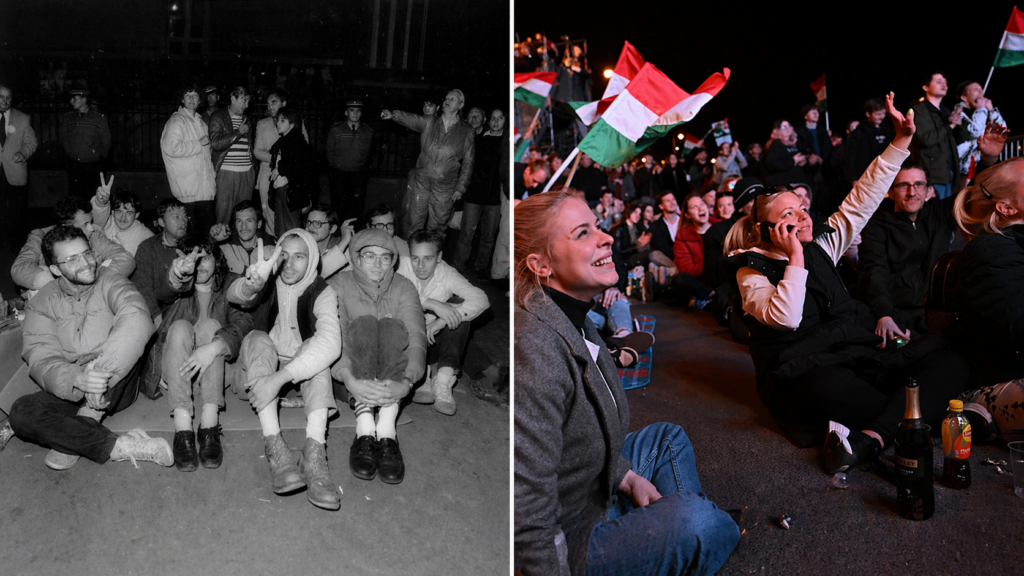
During the lunch break, a senior student came into our room and casually asked if anyone wanted to join KISZ. No one applied, and he was apparently not surprised by this; he left with his list. The Communist Youth League was the youth organization of the party state, but no one was interested. We were in the first year of high school; it was 1988, and the news just kept coming down the hallway that an opposition group of university students had been formed, organizing demonstrations and was made up of good fellows.
On the eve of the regime change, we, teenagers, were also more or less aware of what was happening around us. Hearing the suppressed or already quite open political discussions and conversations of our parents’ groups of friends, we knew that this was a historic time, and everything was changing. Several of the older members of my circle of friends and acquaintances had joined Fidesz, and my father’s childhood friend Laci Lánczky would sometimes come to visit us; he was excitedly organizing the Christian Democratic People’s Party (KDNP) in Budapest—(almost) everyone was involved in politics.
When I first participated in a Fidesz demonstration in front of the Romanian embassy in 1989, I was captivated by the power of the street protests, the sense of belonging, and the crowd of young people convinced me that instead of a worn-out, grey, oxygen-deprived reality, a better world was coming—with us.
‘When I first participated in a Fidesz demonstration in front of the Romanian embassy in 1989, I was captivated by the power of the street protests’
And the better world could only be Western, since the country had been languishing in the Soviet bloc, and the Russian occupying soldiers were still with us. In my narrower homeland, in Gödöllő, there was a social home in one wing of the old, patinated Grassalkovich castle. We went there because of my friend’s mother, who worked there, and we often saw the Russian soldiers wandering around in the dirty barracks set up in the other wing of the Baroque-style building.
We expected a Western world because we listened to Western music, wore clothes imported from the West, visited Western-style entertainment venues opening at the time, and had already had personal experience of the difference between the two worlds separated by the Iron Curtain. Hungarians could already travel to Western states with their world passports; I saw Vienna, and five friends and I spent an amazing week in (East and West) Berlin, the last summer before the fall of the Wall.
While we were scratching our heads under the influence of countless new stimuli, the experiences that defined youth, the National Round Table agreed on the conditions for a peaceful transition and carried out the regime change through negotiations. I was getting ready for an evening house party, so I only watched Viktor Orbán’s speech at the reburial of Imre Nagy and his associates on 16 June 1989, in a hurry.
‘And the better world could only be Western, since the country had been languishing in the Soviet bloc’
And a few months later, on 23 October, I was there only with my schoolmates for the proclamation of the republic, after our teacher had indicated in the morning that instead of attending a history class, we could be part of history itself if we went to Kossuth Square with him.
We were euphoric, we shouted. We would not have thought that politics could be as exciting as a rock concert.
Ten years later, with two university degrees and two years spent studying, working, and seeing the world abroad, another defining generational experience came to me in Kossuth Square in Budapest, this time with a different outcome: the 2002 campaign assembly, between the two rounds of elections, when it was already obvious that the first Orbán government would fail. For conservative youth in their late 20s, the 2002 Fidesz defeat was a milestone, a real trauma—many of us felt that after four years of good governance, the vision of a civic Hungary had been undeservedly lost.
‘We would not have thought that politics could be as exciting as a rock concert’
A civic Hungary—it was not a political product for us, but a real alternative to the post-communist system that did not disappear with the change of regime, the ‘old order’ that survived with the privatization of assets and the old networks of relationships, and with it the old mentality. We hoped for a Western, civic meritocracy, which in a decade or two would bring about a change not only in the daily routine, in the management of government and public administration tasks, but also in the style and, ultimately, in the way people think.
In 2002, the Fidesz headquarters was full of bright-eyed youth at Millenáris; thousands of 20-somethings lamented their futures slipping away as the campaign team of the old socialist party cadre Péter Medgyessy triumphed. And it was devastating how this young stratum was written about in the left-wing press at the time. Just as at the height of the crisis following the leak of the Őszöd speech, during the street protests of 23 October 2006, the protesters were often described as a young mob of rioters. As a journalist reporting on the scene for HírTV, I saw something different.
Perhaps it can be deduced from what has been written above why I describe my own youthful experiences in such unnecessary detail. On the one hand, it was a generational experience that tens of thousands of my like-minded contemporaries shared. On the other hand, on the eve of the Tisza victory, crowds of young people celebrated in the streets, and a quarter of a century later something similar happened to them as happened to us, and the right-wing public was scandalized by this.
Every generation and every political community needs its own catharsis, its own myth. The X generation of Fidesz had the identity-forming defeat of 2002 and the future-opening victory of 2010—through them, it became a community. The socialists and liberals, although they won in 2002 and 2006, did not have great visions and could not win the hearts of 20-year-olds either.
‘Every generation and every political community needs its own catharsis, its own myth. The X generation of Fidesz had the identity-forming defeat of 2002’
What we saw now on 12 April was partly a generational rebellion against the existing order. A rebellion against the ‘rebels’, since Fidesz, by its own definition, was a pillar of patriotic resistance to globalism and EU dictatorship, an improver of the chances of the younger generations, a vanguard of the rebellion against the spirit of the times. Yet, in the past decade and a half, members of the age groups that have reached voting age have grown up knowing only one system, the 16-year continuous ‘era’ of Orbán governments—and for many of them, this monolithic reality, with its positives and negatives, has become rather undesirable. Fidesz governments offered family home creation discount (CSOK), family support, low-interest loans, income tax exemption, home renovation grant, yet Generation Z expected something else: diversity, mobility, greater freedom of expression and opinion, more West and less East, a European living environment, more study and work opportunities, and especially the Erasmus programme.
The Association of Young Democrats (Fidesz) was surprised by the success of the Tisza Party among young people. Presumably because it accumulated a handicap in two of the realities indicated by the three words in the party’s name. Over the course of a quarter of a century, the demographic situation has reversed: the conservative youth of my generation rightly feared that our future would be consumed by the post-Kádár, 60+ social class, which lived massively under the spell of the socialists—and by 2026, today’s 20-year-olds felt the same threat from the age groups that had become 60+ in the meantime, and who mostly voted for Fidesz.
It didn’t sit well with me as a young man when we were called fascists, far-right extremists, and it probably doesn’t sit well with today’s young people, who want a lot of change when they are spoken of as irresponsible, immature, Libs, and possibly drug-addicted hordes. These kids are our younger brothers, our children, who are part of the same society, the same nation, and now, in this political-economic environment, they have made just such a decision. A good or a bad.
‘The Association of Young Democrats (Fidesz) was surprised by the success of the Tisza Party among young people’
So, I am not unfamiliar with the phenomenon, but I hope, in conclusion, that they will not be disappointed. Because there is certainly one factor that a young person cannot acquire, even with strong determination, and that is life experience. And yet—according to the ancient Greek sages and Sándor Márai—over the age of 40, a person ‘already knows everything’, specifically that he is ‘mortal’, and therefore views the rapid changes of the present and their value from the perspective of long-term, lasting matters.
Related articles: