
From the Age of Oil to the Age of Electrons
Controlling for confounding variables—not least the vagaries of human behaviour—each historical epoch coheres around a material logic that organises energy production and consumption in line with its prevailing and aspirational developmental horizon. Across modern history, systemic transformations have been both underpinned and upended by shifting constellations of dominant energy regimes: biomass and muscle power structured agrarian-imperial orders; coal enabled nineteenth-century industrial acceleration; oil anchored twentieth-century geopolitical hierarchy.
The twenty-first century is increasingly reorganising itself around an electricity-based regime—not as a mere input, but as a civilisational operating system. Electricity demand is projected to account for the largest share of global energy consumption growth over the coming decades, driven by electrification across transport, industry, and digital infrastructure. This is not a simple substitution of energy sources alone, but a reconfiguration in the grammar of power itself: from extraction to circulation, from scarcity to reproducible abundance, and from geological sovereignty to infrastructural suzerainty.
Where petro-modernity grounded power in control over what lay beneath the earth’s surface, electro-modernity locates it in the systems that sustain and reproduce industrial life—grids, storage, conversion technologies, and the supply chains that bind them. The shift from petrostate to electrostate therefore marks not a linear transition but a structural inversion: from depletion to flow, from territorial control to systemic embeddedness—unfolding through uneven and staggered realignments across energy regimes and the global order.
The electrostate has emerged as a new geopolitical energy regime on the global stage. Among major powers, China represents its most advanced transitional iteration—not as a clean break from petro-modernity, but as its most systemically integrated evolution. Yet every emergent hierarchy conceals a structural contradiction. Even the most advanced electrostate formations remain inseparable from petro-modernity. Analogous to nuclear power—often misread as post-carbon autonomy but deeply reliant on fossil-intensive extraction, enrichment, and infrastructural systems—electrified industrial regimes expand atop, rather than beyond, a hydrocarbon substratum.
The petrostate and electrostate are not sequential stages but interdependent structures embedded within the same global system. The petrostate derives sovereignty from extraction and depletion. Its power is concentrated in oil fields, pipelines, shipping lanes, and maritime chokepoints. It operates through scarcity, rent capture, and price volatility, making it geopolitically exposed but structurally central.
The stakes of this transformation extend beyond energy to the architecture of world order itself. If petro-modernity was governed by scarcity, chokepoints, and extractive rents, electro-modernity is undergirded by systems integration, standards control, and infrastructural dependency. Yet these logics coexist rather than displace one another, producing a dual-infrastructural world order in which power shifts from wells and pipelines to grids and protocols—while remaining anchored in hydrocarbon circulation systems.
From Chokepoints to Standards: The New Geography of Power
The electrostate fundamentally reconfigures geopolitical power from chokepoints to standards.
Petro-modernity was structured around control over physical bottlenecks: oil fields, pipelines, and maritime routes. Power operated through disruption and scarcity. Electro-modernity, by contrast, rests on control over technological standards and infrastructural ecosystems: battery chemistry, charging protocols, HVDC systems, rare-earth processing, semiconductor-dependent controls, grid software architectures, and compute infrastructure.
Within the electrostate, power no longer flows from blocking circulation but from structuring indispensability. The key form of dependency is not vulnerability to embargo but embeddedness in technical systems of reproduction.
This asymmetry deepens further: exclusion becomes costly not because it restricts supply, but because it disrupts entire industrial ecosystems spanning energy, manufacturing, and computation.
This shift carries at least four profound consequences.
First, it gradually erodes the classical leverage of oil-rich rentier states, compelling them towards difficult diversification. Their strategic centrality does not disappear overnight, but the long arc bends towards relative downgrading as electrified transport and storage reduce hydrocarbon primacy.
Where petro-modernity grounded power in control over what lay beneath the earth’s surface, electro-modernity locates it in the systems that sustain and reproduce industrial life—grids, storage, conversion technologies, and the supply chains that bind them. The shift from petrostate to electrostate therefore marks not a linear transition but a structural inversion: from depletion to flow, from territorial control to systemic embeddedness—unfolding through uneven and staggered realignments across energy regimes and the global order.
Second, it privileges manufacturing-centred hegemony. The state that controls the electrotech stack—minerals, refining, cells, grids, software, and standards—also controls the pathways through which other societies modernise. Dependency is reproduced not by fuel scarcity, but by infrastructural indispensability.
Third, it relocates geopolitical contestation from oil fields to lithium, cobalt, copper, nickel, graphite, and rare-earth ecosystems. The new “oil field” is often less a drilling zone than a refining and processing complex, where the real leverage lies in conversion capacity rather than in raw extraction alone.
Fourth, it inaugurates a new bipolarity between hydrocarbon persistence and electron-driven industrial sovereignty. The geopolitical struggle of the coming decades may increasingly be defined by this tension: whether states remain anchored to twentieth-century fuel logic or succeed in entering the twenty-first century’s circuitry of electrified power.
The Electrostate as Structurally Dependent Formation
The petrostate and electrostate are not sequential stages but interdependent structures embedded within the same global system.
The petrostate derives sovereignty from extraction and depletion. Its power is concentrated in oil fields, pipelines, shipping lanes, and maritime chokepoints. It operates through scarcity, rent capture, and price volatility, making it geopolitically exposed but structurally central.
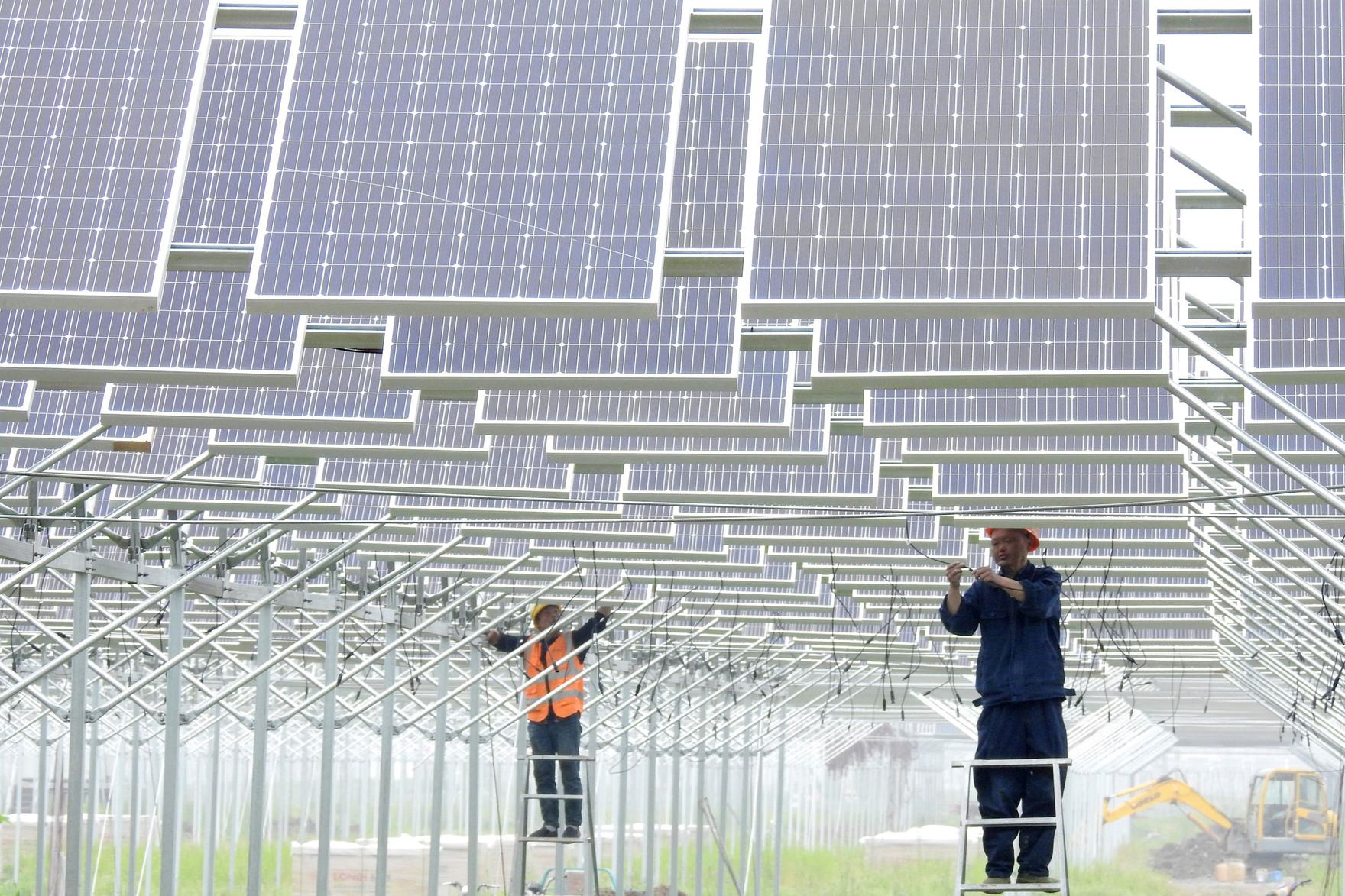
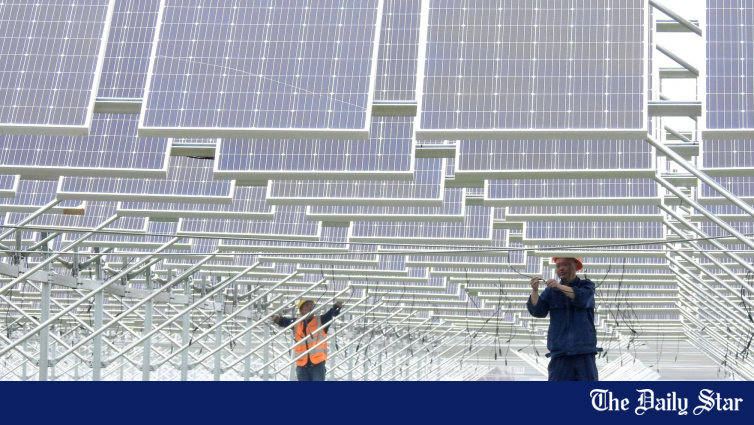
As the pre-eminent electrostate, China’s dominance in solar technology shifts the geopolitical focus from maritime chokepoints to technological standards. Photo: Reuters
The electrostate, by contrast, rests on systems of reproducibility: electricity generation, transmission, storage, and the industrial ecosystems built upon them. Its critical assets include grids, batteries, semiconductors, rare-earth processing, and software-mediated energy systems.
This shift marks a transformation from stocks to flows. Petro-modernity extracts value from depletion; electro-modernity multiplies value through systemic recombination.
Yet this distinction is not absolute. Electro-modern systems remain materially dependent on petro-infrastructures that sustain global production: petrochemicals, fertilisers, aviation fuels, logistics systems, and industrial inputs that cannot yet be substituted at scale—sectors that together still account for a substantial share of global oil demand. The electrostate is therefore not autonomous but structurally dependent—an emergent layer within a persistent hydrocarbon substrate.
Sovereignty itself is reconfigured under this condition. Petro-power operates through chokepoint disruption; electro-power operates through infrastructural indispensability. But neither logic has fully displaced the other. This dual-infrastructural condition is likely to persist for the foreseeable future, absent a post-electro regime decoupled from hydrocarbon substrates.
China as Advanced but Structurally Dependent Electrostate
China’s rise is best understood not as decarbonisation or mere sectoral leadership, but as systemic integration across the electrification stack within a still-entangled global energy order.
Petro-modernity was structured around control over physical bottlenecks: oil fields, pipelines, and maritime routes. Power operated through disruption and scarcity. Electro-modernity, by contrast, rests on control over technological standards and infrastructural ecosystems: battery chemistry, charging protocols, HVDC systems, rare-earth processing, semiconductor-dependent controls, grid software architectures, and compute infrastructure.
It dominates solar photovoltaics, battery chemistry, EV production, ultra-high-voltage transmission, rare-earth refining, and grid optimisation systems—accounting for the majority of global solar module manufacturing, a commanding share of lithium-ion battery production, and near-monopoly positions in rare-earth processing. Its key advantage lies not in isolated sectoral superiority but in vertical integration—from extraction and refining to manufacturing, deployment, and system orchestration.
This generates cumulative industrial reinforcement: scale reduces cost, cost accelerates adoption, and adoption further reinforces scale. The Belt and Road Initiative increasingly reflects this shift. Beyond ports and pipelines, it incorporates transmission grids, renewable energy parks, EV ecosystems, and battery supply chains. Infrastructure export becomes, simultaneously, standard export.
However, this systemic advantage does not imply autonomy from petro-modernity. China remains embedded in global oil pricing regimes, maritime energy flows, and petrochemical input chains. Its electrification leadership coexists with structural exposure to hydrocarbon systems that continue to underpin global industrial life.
China’s power, therefore, is not post-petro but asymmetrically dependent: it is the most advanced node within an infrastructurally entangled system.
This logic extends into computation. Artificial intelligence systems depend fundamentally on energy infrastructure, with electricity forming the substrate of computational intelligence. Yet this computational layer is still materially grounded in hydrocarbon-intensive industrial production. The “five-layer stack” of AI systems ultimately rests on energy systems that remain partially petro-dependent. China’s advantage lies in controlling the most critical interface between electrification and industrial computation—but not in escaping the broader hydrocarbon substrate.
The global energy transition is not a replacement of petro-modernity by electro-modernity, but the emergence of a dual-infrastructural world order in which both systems remain simultaneously active, asymmetrically powerful, and deeply entangled. Petro-modernity continues to govern chokepoint vulnerability, industrial inputs, and systemic shocks. Electro-modernity governs industrial organisation, technological standards, and long-term structural design. Neither logic fully supersedes the other.
The United States and OECD as Transitional Energy Orders
The US occupies a hybrid condition: a hydrocarbon hegemon in partial transition.
It retains elements of petro-modern power—naval control of maritime energy routes, dollar centrality in the global oil trade, and alliance systems structured around fossil security. Yet domestic shale production—now making the US one of the world’s largest oil and gas producers—alongside technological innovation, has created partial insulation from external shocks.
This hybridity produces a strategic contradiction. The US global posture continues to prioritise the security of oil circulation even as segments of its economy move towards electrification. The result is a dual system: a post-carbon domestic transition embedded within fossil-geopolitical management.
The OECD economies occupy a different liminal position. Europe, Japan, and South Korea are technologically advanced in renewable deployment and policy ambition but remain structurally dependent on external supply chains for critical minerals, battery systems, and grid technologies—dependencies repeatedly exposed by recent disruptions and price shocks.
Their condition is best described as normative decarbonisation without full infrastructural sovereignty. Policy transitions outpace industrial restructuring, producing exposure to external shocks and political volatility.
Together, the US and OECD form a transitional bloc—neither petrostate nor electrostate, but suspended between logics.
US–Iran Ceasefire, Chokepoint Coercion, and the Mirror Logic of the Strait of Hormuz
The fragile US–Iran ceasefire appears less as diplomatic stabilisation than as a pause within a deeper structure of coercive symmetry, in which both sides mirror one another’s reliance on chokepoint leverage as an instrument of strategic pressure.
Recent escalation around the Strait of Hormuz—intensified by US–Israeli pre-emptive strikes and Iranian counter-signalling—reveals this dynamic with particular clarity. Through a narrow maritime corridor carrying roughly 20 percent of globally traded oil flows, Hormuz has become a site of reciprocal vulnerability management, where control is exercised less through monopoly than through calibrated disruption.
The US relies on naval dominance, sanctions regimes, and insurance architectures to secure the circulation of fossil energy flows underpinning global market stability. Iran, in turn, leverages geographic proximity to impose counter-leverage through disruption and the credible threat of closure. Each actor converts vulnerability into instrumentality, producing strategic mirroring.
Yet this mutualisation of coercion deepens systemic fragility. The Strait of Hormuz no longer functions as a stable artery of petro-modernity but as a pressure valve through which geopolitical shocks propagate into global inflation, shipping risk, and macroeconomic instability.
Energy security is increasingly pursued through the weaponisation of the very circulatory systems on which it depends, generating recursive exposure rather than stability.
Crucially, Hormuz is embedded within a broader hydrocarbon-industrial ecology that includes fertilisers, jet fuel, pharmaceuticals, logistics systems, and petrochemical derivatives that cannot yet be substituted at scale. This complicates any linear account of transition.
The electrostate does not signal the disappearance of petro-modernity but its reconfiguration within a hybrid transitional order. Petro-geography therefore retains residual but structurally significant power.
Seen in this light, Hormuz reveals both the fragility of petro-geography and the limits of electrostate autonomy. The transition is not substitution but asymmetrical entanglement.
Toward a Dual-Infrastructural World Order
The global energy transition is not a replacement of petro-modernity by electro-modernity, but the emergence of a dual-infrastructural world order in which both systems remain simultaneously active, asymmetrically powerful, and deeply entangled.
Petro-modernity continues to govern chokepoint vulnerability, industrial inputs, and systemic shocks. Electro-modernity governs industrial organisation, technological standards, and long-term structural design. Neither logic fully supersedes the other.
World order is thus suspended between wells and grids, barrels and batteries, chokepoints and standards.
China’s trajectory signals not post-petro autonomy but the consolidation of the most advanced structurally dependent electrostate formation—one that operates at the leading edge of electrified industrial modernity while remaining embedded in hydrocarbon geographies that it cannot yet transcend.
For the US and OECD economies, the central risk is not immediate decline, but loss of control over the standards and infrastructures through which electrified modernity is organised.
The defining question of the twenty-first century is therefore not whether electro-modernity will replace petro-modernity, but whether this deepening entanglement can be stabilised—or whether it will generate new forms of systemic instability within an increasingly electrified but still hydrocarbon-dependent world order, in which fossil fuels continue to supply the majority of global primary energy even as electrification accelerates. The electrostate is likely to remain structurally dependent on the petrostate for the foreseeable future, with any transition towards a fully renewable energy regime unfolding gradually rather than through a decisive rupture.
This is a follow-up to the article “When ‘America First’ Policy translates into ‘China First’ outcome in a New Cold War,” published in The Daily Star on April 11, 2026.
Dr. Faridul Alam, a former academic, writes from New York City.
Send your articles for Slow Reads to [email protected]. Check out our submission guidelines for details.