
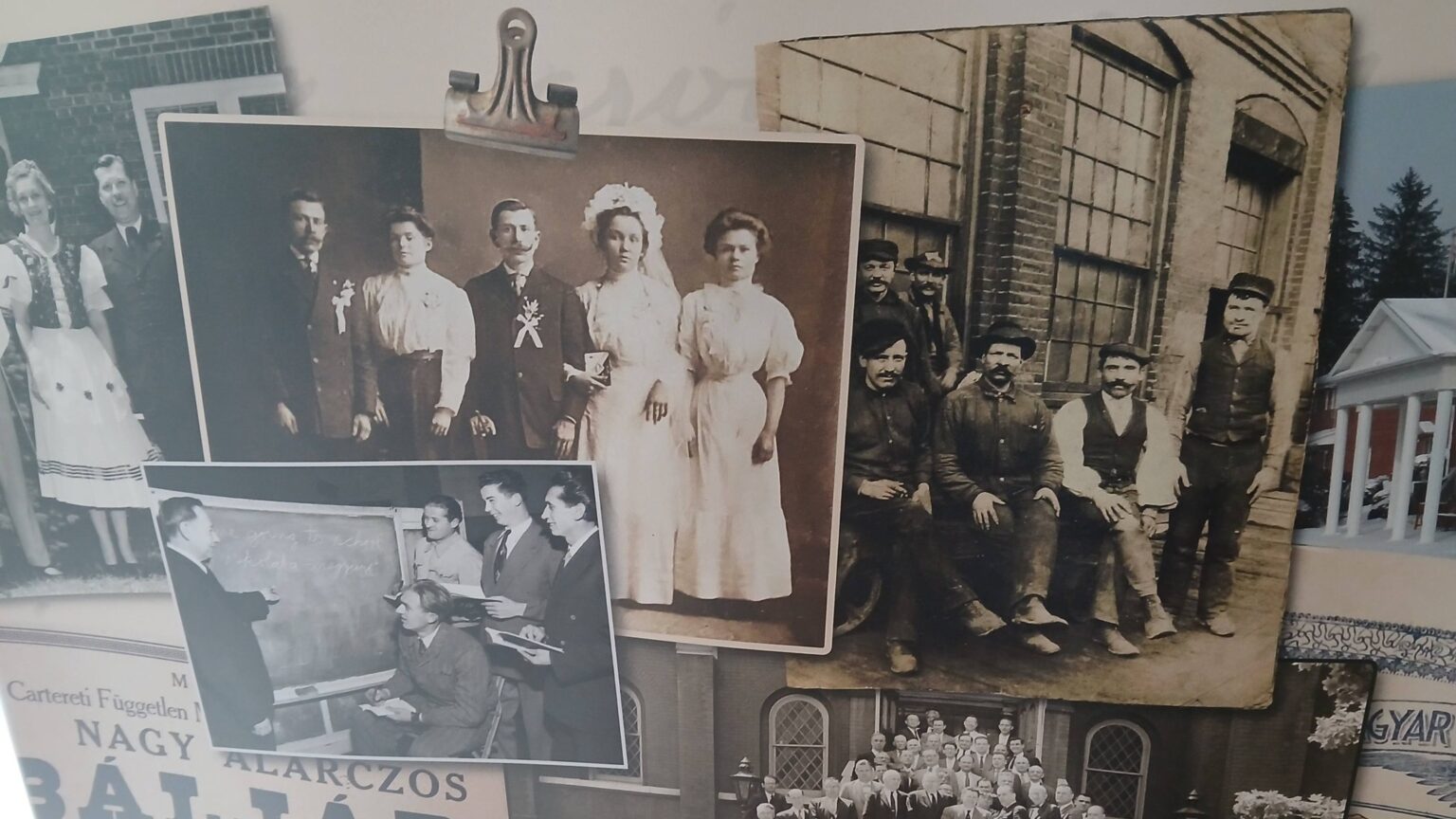
The 50th annual American Hungarian Educators Association (AHEA) conference took place at Cleveland State University on 16–18 April, 2026. The program consisted of panels on history, cultural studies, literature, linguistics, music, and science on the theme of 250 Years of Hungarian Contributions to the USA, featuring presenters from North America and Hungary.
The official program started on Thursday afternoon, with the Hungarian movie How could I live without you? (Hogyan tudnék élni nélküled?) The academic program started on Friday morning with keynote speaker Associate Professor at the Department of Political Science at Kent State University Gabriella Paár-Jákli, PhD, seeking to pinpoint some of the most important intersections between science and diplomacy. Blending international relations and science policy, science diplomacy has emerged as a novel interest and strategic tool in international relations, with great capacity to boost international cooperation, she explained, adding that the essence of science diplomacy is to form knowledge-based partnerships and collaborate to solve problems that humans face collectively.
She also emphasized that Hungarian scientists and educators of various kinds, as well as artists, entrepreneurs, etc., with diverse backgrounds and expertise, have collectively added to the intellectual and cultural wealth, skills, and perspectives they brought to the New World. It’s important to recognize the remarkable achievements of many Hungarians who, for various reasons, crossed the Atlantic, while also trying to maintain a strong cultural heritage and a resilient community, she concluded, listing the names and shortly introducing the contributions of the most well-known Hungarians settled in the U.S.
As lectures were given in three rooms simultaneously, I’m able to report only on a few of them. Associate Professor in the Institute of English Studies at the University of Pécs, Hungary, Mónika Fodor’s research focuses on narrative meaning-making, memory, trauma, identity, and narrative, and the narrative ramifications of reconstructing and digitalizing memories. According to her, in 2025, Hungary still faces deep social and economic fragmentation, with one-fourth of the population living in systemic poverty. She claimed that one of society’s biggest challenges is the lack of social solidarity, adding that voluntary organizations, such as the Hungarian Charity Service of Malta (HCSM), play a crucial role in fostering social solidarity by providing daily help to those in need. Her study examined how volunteers engaged in community service negotiate their experiences and identities through personal storytelling, with a focus on the issue of social solidarity.
She presented findings from an analysis of six focus group interviews with 17 members in three local, small-town chapters of the HCSM. Her study explores how volunteers co-construct their experiences, negotiate their ethnic belonging to build personal agency, and frame the meaning of choice in volunteer work. These narratives construct and reinforce storytellers’ identities by mapping and reimagining the social and cultural context of remembered experiences. Her findings suggest that voluntary community help emerges at the intersection of community narratives and personal stories, enabling volunteers to understand their own life experiences and mentalize and interpret their clients’ socially contextualized needs.
Director of the American Hungarian Foundation (AHF) Melissa Katkó Pepin, of New Brunswick, New Jersey, presented how the AHF has collected, conserved, and celebrated Hungarica (Hungarian American Ethnic Materials) over seven decades. Her presentation situated the significant contributions of individuals of Hungarian origin and descent to the political, scientific, artistic, and cultural fabric of the U.S. within the broader context of diasporic heritage preservation by examining the role of the AHF—now in its 70th year—as a central institution documenting, interpreting, and celebrating Hungarian American experiences.
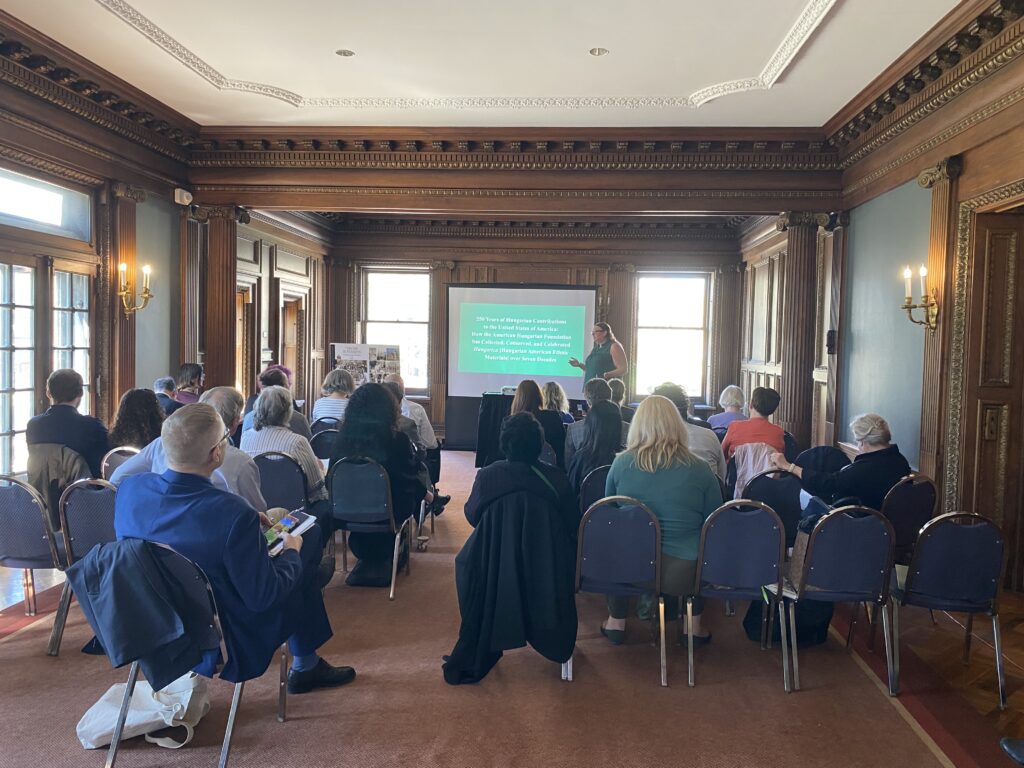 The presentation of Melissa Katkó Pepin PHOTO: courtesy of Ildikó Antal-Ferencz
Drawing upon archival sources, institutional records, and exhibition histories, her lecture explored how AHF has functioned as both a repository and a cultural agent in shaping Hungarian American identity, analyzing three interrelated dimensions of AHF’s work: collection (acquisition and documentation of primary materials and ephemera); conservation (preservation and digitization initiatives, including major partnerships with the National Széchényi Library and Arcanum); and celebration (public exhibitions, lectures, and cultural programming that connect academic inquiry with community engagement). In reflecting on the AHF’s evolving mission, she also addressed broader theoretical questions of heritage mediation, institutional memory, and the ethics of representation in diasporic archives. She positioned AHF as a case study in how ethnic heritage organizations can bridge scholarship, pedagogy, and community identity—by offering a model for sustaining cultural continuity and academic relevance in the 21st century.
‘The filmmaker’s talk examined how one man attempted to build a utopian, Hungarian-led community…in the heart of the Appalachian coalfields’
Associate Professor at East Tennessee State University and international award-winning filmmaker Stokes Piercy’s presentation explored the extraordinary transnational life of Martin Himler (1888–1961), a Hungarian immigrant from Mátraverebély whose journey from poverty and caste barriers in northern Hungary to the coal fields of Eastern Kentucky reveals profound links between Hungarian history and American Appalachia. Drawing from Himler’s autobiography The Making of an American, archival research conducted in both Hungary and the U.S., as well as his current development of a feature documentary, the filmmaker’s talk examined how one man attempted to build a utopian, Hungarian-led community—Himlerville—in the heart of the Appalachian coalfields.
The project illuminates key cultural parallels between Hungarian village life and Appalachian mining towns, including traditions of mutual aid, the role of ethnic identity in labor organization, and the tensions between local autonomy and corporate or state power. As stated, Himler’s story also offers a unique lens into the immigrant experience of the early 20th century, shaped by ambition, ingenuity, and the constant negotiation of belonging. Beyond his Appalachian achievements, Himler later served as an officer in the OSS (Office of Strategic Services) during World War II, interrogating leaders of Hungary’s fascist regime. His life, therefore, embodies a full arc of Hungarian American identity: from immigrant laborer to community builder, from Appalachian entrepreneur to wartime intelligence officer shaping postwar justice in Europe. The presentation integrated historical analysis, transnational cultural comparison, and documentary storytelling. Piercy shared insights from both his archival research and cinematic development process, arguing that Himler’s story not only connects Hungary and Appalachia, but also challenges us to reconsider what it means to become—and make—an American.
Associated Press award-winning journalist and columnist in Arizona and Ohio, Mike Sakal, presented his first book, Dayton Hungarians: Their Stories, Glories and Folklore, a two-volume set chronicling a comprehensive history of the Hungarian community in Dayton, Ohio, from the late 1890s to the present. The author is a second-generation American Hungarian, a member of the Magyar Club of Dayton, and the Hungarian Reformed Church of Lorain, Ohio. The books contain histories of Dayton’s three former Hungarian churches, histories from families, stories about Dayton’s West Side and North Side Hungarian neighborhoods, its longtime businesses, sports, interviews with Freedom Fighters and Refugees from the 1956 Hungarian Revolution, and a chapter about how the current Dayton Hungarian community is maintaining its heritage and culture. Referring to the conference’s theme, the author mentioned that back in 1902–1903, Charles Taylor, who built the engine for the Wright Brothers’ first airplane, demonstrated the engine in a back room of Hungarian Jewish Labor Contractor J.D. Moskowitz’s Clubhouse and Saloon in Dayton’s West Side Hungarian neighborhood. Seeking financial support from the Dayton Hungarian community, the West Side Hungarians provided $300 to Wright Brothers’ Airplane engine that flew in their ‘airplane’ in the first historic flight in Kittyhawk, North Carolina on 17 December 1903—thus, the Dayton Hungarian community played a significant role in one of the world’s biggest inventions: aviation. The author plans to take the books to the next level by marketing them to colleges and universities for possible use in different courses.
Lecturer of English and civilizational studies, as well as a policy analyst of U.S. foreign and security policies at UPS-Ludovika University, Budapest, Zsolt Csutak, PhD, gave a presentation on the vision of America in Hungary over the centuries. As stated, the rather utopian image of a strange, abundant, and free new state over the ocean, called the USA, has experienced significant transformations and distortions in narrative and perception over the last half-century in Hungary as well as among the Hungarians living in the Carpathian Basin. The intellectual idolization of the New World had started from a rather revolting and inspiring road diary written by a seemingly unknown Hungarian traveler, a self-educated scholar from Transylvania named Sándor Bölöni Farkas. Shortly after his book Travels in North America was published first in 1834, the author actually ignited a spiritual revolution in early 19th-century Hungary. As noted, the alarmingly reformist books of Bölöni Farkas and those of Aléxis de Tocqueville, too, were soon after restricted or shadow-banned by the Habsburg authorities.
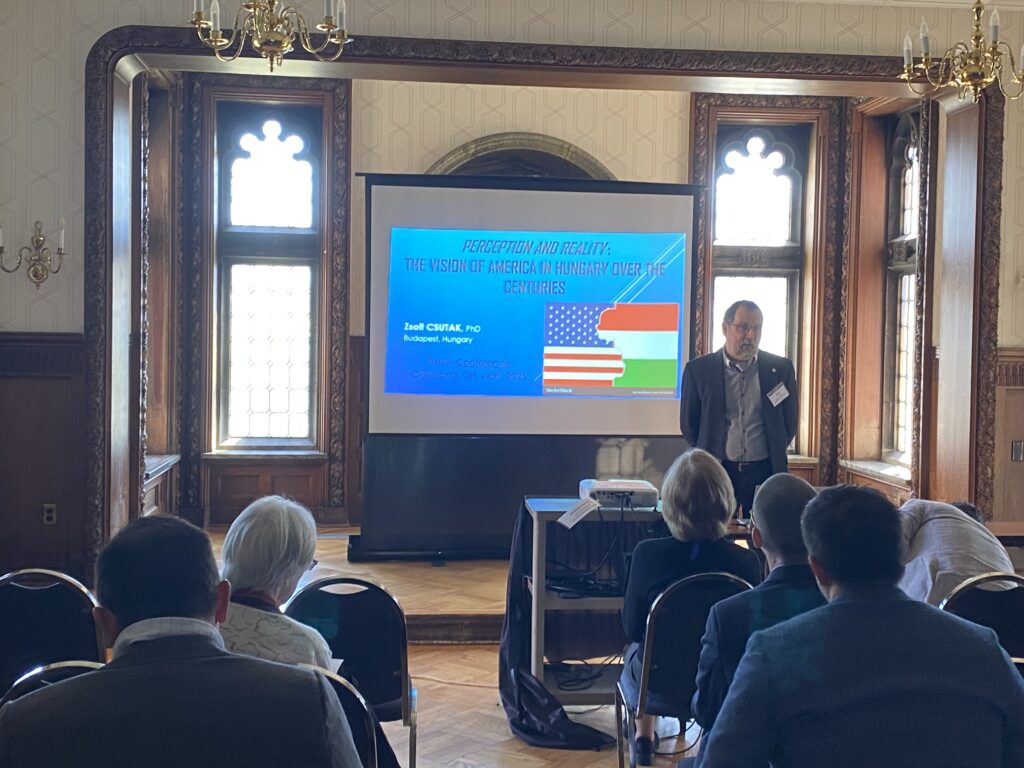 Zsolt Csutak PHOTO: courtesy of Ildikó Antal-Ferencz
The image of America as the haven of freedom and democracy persisted and shone even brighter through the 20th century, among the Hungarians, especially at the time of the flight of 48-er veterans, and Kossuth’s campaign in the USA up until the descent of the Iron Curtain and, then, the dawn of the American era after the fall of the ’Red Block’ in 1990. However, the 21st century ushered in a paradigm shift in mentality and political views, with the looming demise and gradual tarnishing of the image of ‘ideal’ American democracy among Hungarians.
Freelance journalist, Ildikó Antal-Ferencz from Budapest, Hungary, presented the memoir of professor Ács Zoltán, The Road Less Traveled, from the creative editor’s view. As explained, when reading the English manuscript received from MCC Press in 2024, she was very grateful for the opportunity, but the text left her confused. By then, she had already lived in the U.S. for two years, was actively involved in the North American Hungarian diaspora community, and had written about Hungarian Americans, who were proud of their Hungarian roots, language, and cultural heritage and passionately served the local Hungarian communities and organizations that their ancestors or themselves had established.
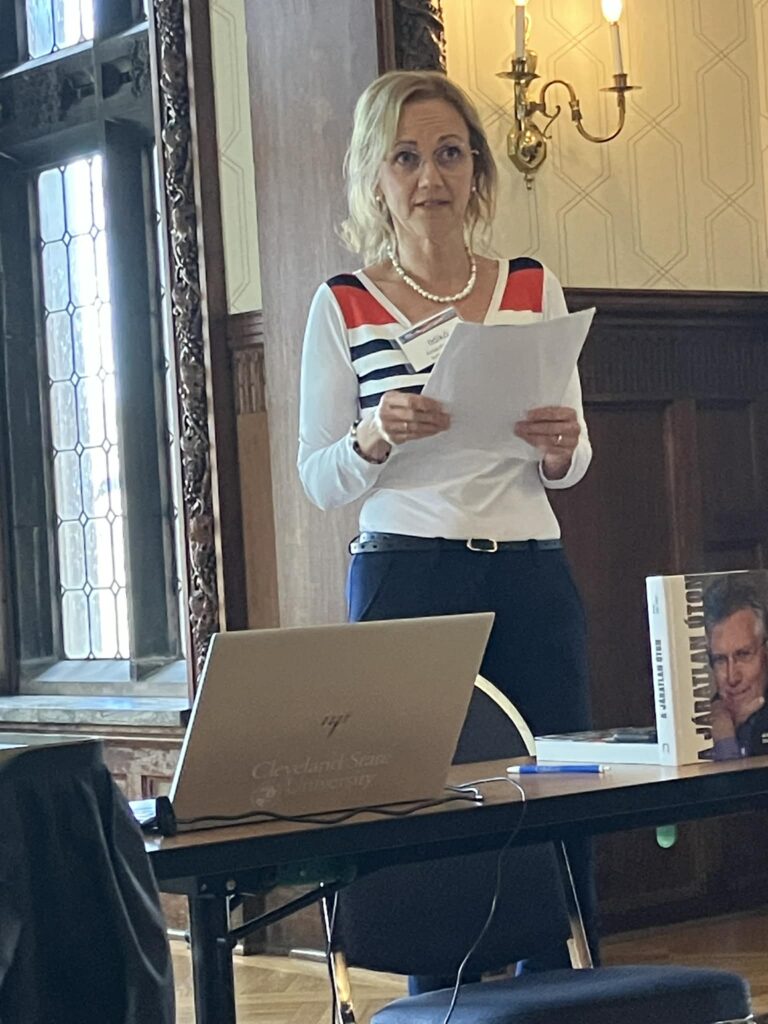 Ildikó Antal-Ferencz PHOTO: courtesy of Ildikó Antal-Ferencz
In contrast, Prof. Ács—born in an Austrian refugee camp to a family with noble and educated ancestors and parents who were deeply committed to the Hungarian cause, but ended up in the projects in Cleveland—experienced his Hungarian identity more as a burden during his youth. He maintained contact with relatives in Hungary; he only began to truly appreciate his Hungarian roots decades later, during the rapid ascent of his professional career, when establishing and benefiting from professional ties in Hungary. His journey along the road less traveled is admirable and exemplary, both personally and professionally, emphasized the editor, who explained: her job was to find the missing pieces—the personal stories and their emotional aspects—of the original manuscript and make the professor’s life journey more understandable and engaging for Hungarian readers living outside the U.S., Hungarian diaspora and his professional field of small business economics.
Linguist and associate professor at Institute of English and American Studies at the University of Szeged, Hungary Anna Fenyvesi provided in her presentation a brief overview of the Hungarian Roots & American Dreams project—a book series that grew out of a Facebook group—showing how family histories of immigration from Hungary to the U.S. (and in some cases, remigration to Hungary) become living family chronicles and tools for preserving collective memory. The 106 stories featured in the two volumes of the series (edited by her and Réka Bakos; published in 2024 and 2025) provide an almost comprehensive picture of the cataclysmic historical events of 19th- and 20th-century Hungarian and U.S. history. The second half of her presentation discussed the results of a survey administered among the authors (61 in total) of the two volumes, mapping out authors’ motivations for embarking on writing their stories, attitudes to the writing process, and changes in their perception of their family and their own place in the world and in history as a result of the writing process. As explained, the results of the survey demonstrate the ways in which the writing of family histories gains meaning for authors, underscoring the importance of these histories not only at the level of preserving accounts of personal and family history as building blocks of community history, but also their role as ‘stories of ourselves’—building blocks of our narrative identity that help us interpret and understand the world around us.
Performer, researcher, and teacher Zina Bozzay gave a lecture on values and worldview in Hungarian Folk Songs. Raised in San Francisco and trained by master folk singers in Hungary, she collected songs from the last living village singers. Deeply committed to the diaspora and cross-cultural work, she founded the Hungarian Folk Singing Circle in 2010, through which she has taught thousands of people from over 50 countries. Her presentation was an immersion into the poetry of the people, she claimed, adding: collectively crafted and shared across generations, these rich and evocative song texts provide insight into older ways of thinking and the values and behaviors of those who sang them. Drawing on hundreds of traditional village folk songs as well as interviews with culture bearers in dozens of villages across the Carpathian Basin, the interpretations of the texts are informed by long-term relationships and lived experiences. These songs may reflect the value systems that generations of Hungarian immigrants brought with them to the U.S., or may conversely help explain why others chose to stay in Hungary, or have recently repatriated from the U.S. to the motherland. The range of topics—including courtship and partner selection, love and loyalty, the natural and emotional worlds, wealth and poverty, and stages of life—covers the full spectrum of the human experience, she concluded.
Anna and Istvan Gergely, co-founders of Gimi2US, a Hungarian American educational and cultural exchange initiative designed for high school students, together with Sidonia Nicolae, Honorary Consul of Hungary for Indiana, presented the Gimi2US model launched in 2024, providing Hungarian high school students from Transylvania with an intensive, experience-based academic immersion in the U.S. The program enhances students’ linguistic competence, global awareness, and cultural sensitivity, while reinforcing their personal and community identity. In spring 2025, 26 students from Transylvania—Székelyudvarhely (Odorheiu Secuiesc) and Marosvásárhely (Târgu Mureș)—participated in this two-week academic mobility program, in which the educational modules were hosted by partner institutions in Indiana, including the University of Evansville, North High School, Evansville Day School, and Reitz Memorial High School.
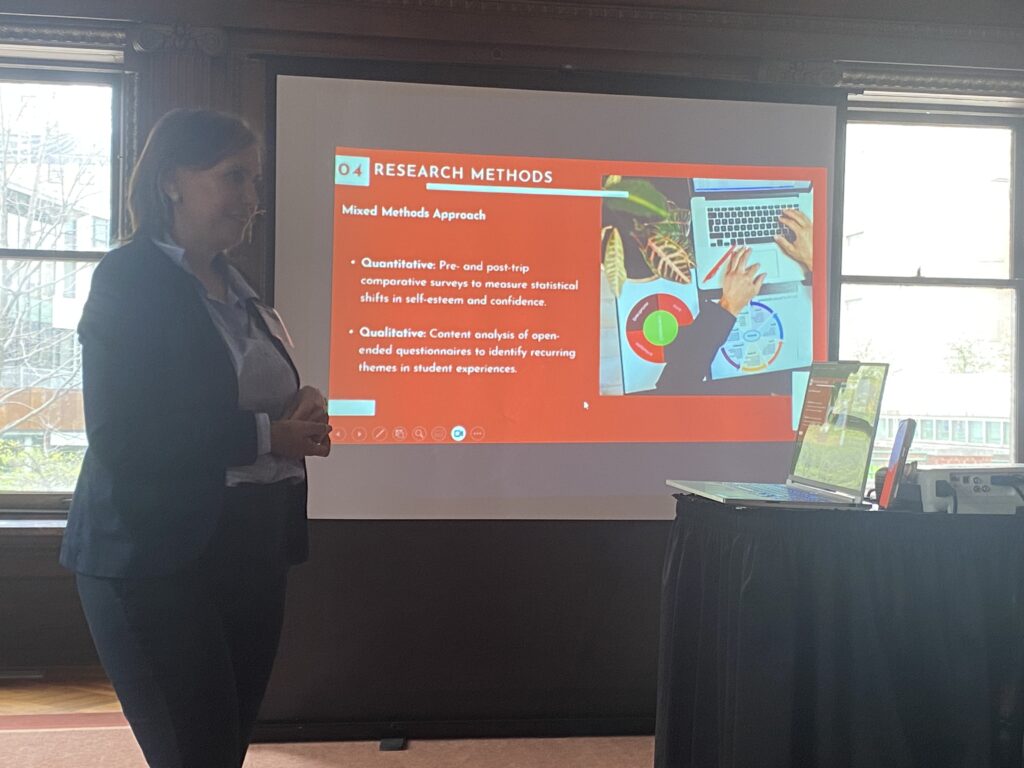 Anna Gergely PHOTO: courtesy of Ildikó Antal-Ferencz
As described, students attended U.S. high school and university classes, workshops, and community activities, and lived with host families for full cultural immersion. As a result, 89 percent of participants reported increased English communication confidence, 82 percent experienced the U.S. creative and participatory learning environment as entirely new, and 68 percent expressed a stronger motivation to pursue future international studies. The founders claim that the program also reinforced attachment to the Hungarian community in Transylvania, with most intending to leverage their international experience to contribute to their home region’s development. Gimi2US model shows that well-structured educational mobility programs effectively develop global competencies, reinforce minority identity, attachment to the homeland, and contribute to nurturing future leaders who are both internationally minded and deeply connected to their Transylvanian roots, the presenters concluded.
Related articles: