
“Joe Engel was still living at the time as a member of my congregation, and so I walked in one morning and Joe Engel is sitting there and it was just like, ‘My God, I haven’t seen you in 20 years,’ ” Ravski recalled. “Now he and I had this connection, we have this story. He was a survivor of Auschwitz. He was huge in Holocaust education in Charleston.”
So Ravski began making plans to have his congregation participate in the March of the Living. Engel passed away in 2022 before plans were completed but the trip went on this year. (Ravski said he hoped future marches would be open to teenagers, as well.)

Evan Ravski, rabbi of Synagogue Emanu-El of Charleston, leads congregants in a prayer at the Auschwitz concentration camp before beginning the two-mile March of the Living to Birkenau on April 14, 2026.
Jonathan D. Salant/Provided
Jonathan Lessans, a Charleston business owner, said Ravski brought up the trip during the weekly luncheon that always follows Sabbath services. Lessans was sold.
“I’ve always learned about the Holocaust growing up as a Jew,” he said, “and everything was always black and white, everything was a story. And I wanted to see it in color. I wanted to see it for myself.”
Lessans said he talked to his father, Raymond, a sales representative, and wanted to bring him along. Raymond had never been to Israel, which he said was a big selling point, but agreed to join his son even after that portion of the trip was canceled.
“It wasn’t too hard of a sell, but he did have the selling. Because I grew up also like him,” Raymond Lessans said. “You hear the story, you know what happened. But I didn’t know it was going to be that impactful until I actually went there and experienced it.”
Participants were silent as they walked through actual gas chambers, examining the window-free concrete walls used to ensure that those herded in alive never survived. They snapped pictures of the pallets of shoes taken from the victims, ready to be shipped back to Germany to be reused, and the piles of human hair shorn from inmates that were supposed to be used to weave rugs and stuff pillows.
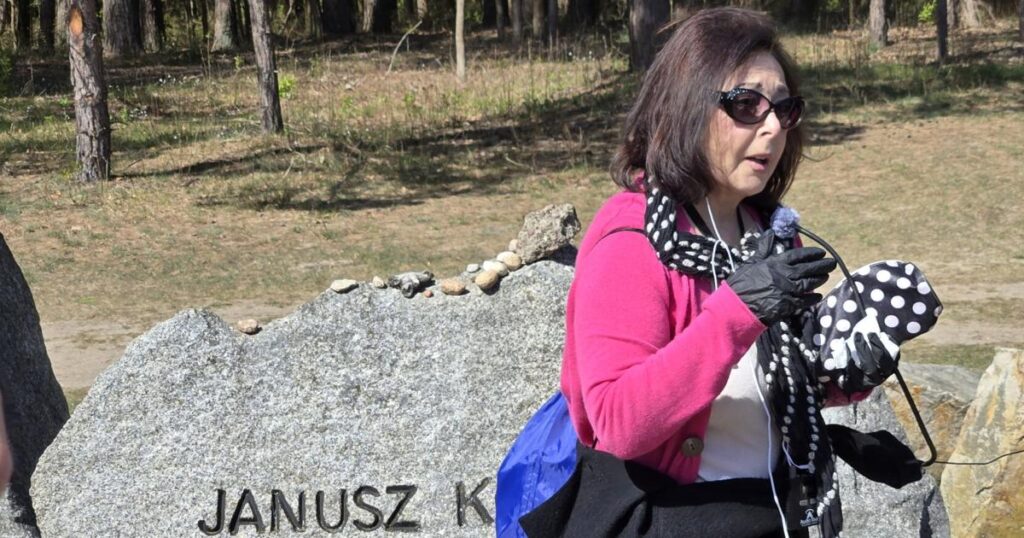
They walked through the towering brick entrance to Birkenau, stood in the old Warsaw ghetto plaza where Jews were shipped off to death camps to be executed, and hiked along a well-cleared trail into the Lopuchowo Forest to view the memorial to 2,400 Jewish residents of the nearby town of Tykocin, who were brought into those woods in August 1941, gunned down by the Nazis and buried in mass graves right there.