
This story is from The Pulse, a weekly health and science podcast. Subscribe on Apple Podcasts, Spotify, or wherever you get your podcasts.
Find our full episode on nuclear energy here.
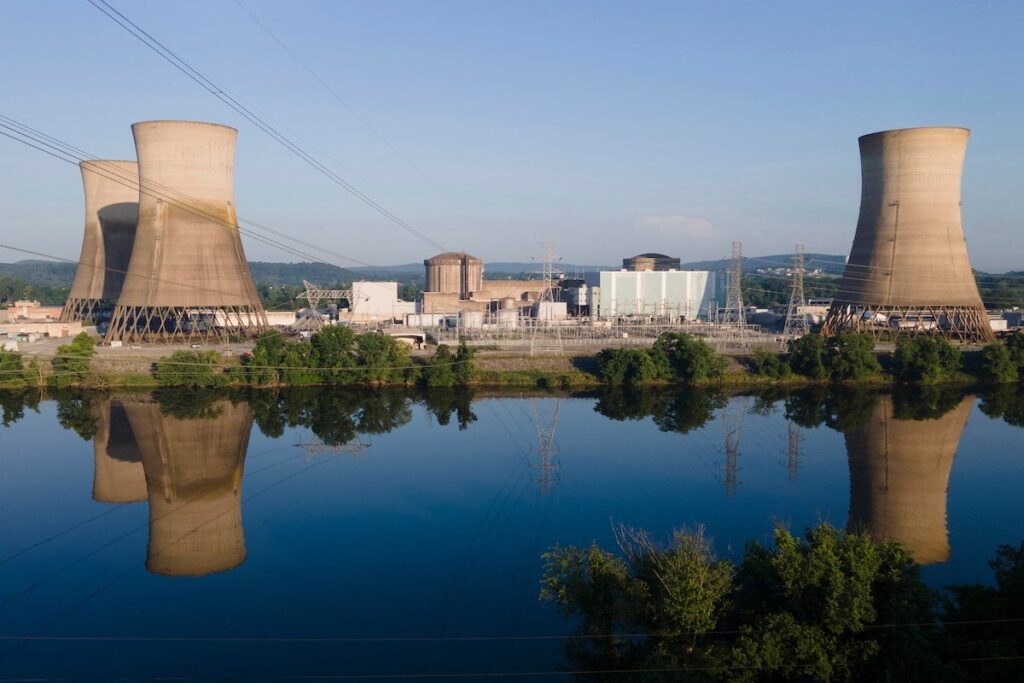
Dave Marcheskie remembers the day Constellation Energy announced it would close the Three Mile Island nuclear power plant in 2019.
“It was such an emotional day, a very sad day. A lot of people were crying because it was an end of an era and we didn’t think this plant was coming back,” he said. “We thought this plant was shutting down forever. The people that were working here, we may never see again.”
Marcheskie had been working as the company’s community relations manager for two years.
The company closed the plant back then because electricity from natural gas was cheap, and the nuclear plant could not compete.
Constellation operated the reactor known as Unit 1, which was not part of the infamous accident in 1979. That happened in another reactor, Unit 2. A mechanical or electrical failure stopped sending water to remove heat from the reactor, causing a partial meltdown. Tens of thousands of people in the surrounding area had to evacuate. The accident led to stricter regulations on nuclear power.
Unit 1 restarted in 1985. Ownership changed hands a few times, and Constellation closed the plant in 2019.
Marcheskie stayed with the company, and worked at another nearby nuclear power plant. But in 2024, Microsoft announced a deal with Constellation to reopen the reactor, and buy power from the plant for 20 years. Constellation would spend $1.6 billion on the project, and the federal government backed the deal with a $1 billion loan.
“The fact that we’re restarting and it’s been like a mini reunion walking around here, seeing folks who I haven’t seen in five years, I’m getting chills just thinking about it now,” Marcheskie said. “I cannot wait for the day until we push the button and go back online and you start seeing water vapor come out of those cooling towers once again..”
The project to restart the reactor on Three Mile Island comes as nuclear power is in the spotlight in the U.S. once again.
Microsoft, Google, and Amazon have all recently invested in nuclear energy to power data centers for artificial intelligence. The Trump administration also set ambitious goals for nuclear power in the U.S., signing executive orders calling for nuclear energy capacity in the U.S. to quadruple by 2050, and for construction to start on 10 new nuclear reactors by 2030.
Public opinion on nuclear energy is also changing.
Following the two high profile accidents at nuclear power plants in Chernobyl in the former Soviet Union and Three Mile Island in Pennsylvania, polls showed Americans became skeptical of nuclear energy. One Gallup poll in 1986 found that more than 70% of Americans polled did not want a nuclear power plant in their area.
But a Gallup poll from last year found that 61% of Americans support nuclear power, the highest point in more than a decade.
That includes some notable changes in how environmental advocacy groups see nuclear power.
The Sierra Club remains opposed to nuclear power, but the Nature Conservancy now supports it.
The Natural Resources Defense Council recently, for the first time ever, publicly supported a plan to reopen a nuclear power plant in Iowa.
Kit Kennedy, who oversees the organization’s advocacy around clean energy, said the NRDC decided to support this project because of a few trends: more demand for electricity for data centers, energy prices going up, and the Trump administration attacking renewable energy.
“Nuclear power is having a moment. There’s a lot of bipartisan support and momentum. And nuclear power will continue to play a role in our electricity system. But I would expect that clean energy, solar, wind, battery, transmission, energy efficiency will play a larger role.”
Even some people who live near Three Mile Island have changed their minds about nuclear energy, said Eric Epstein, who lives 12 miles away from Three Mile Island. He started a nuclear safety watchdog organization called Three Mile Island Alert in 1977, two years before the accident.
“You went from a community that was very pro nuclear to a community where trust was broken. However, we’re three generations away. And so younger people are much more supportive of nuclear power than people that are older and experienced what occurred.”
The changing opinion is due to “the shortness of people’s memories,” said Tim Judson, executive director of a nonprofit called the Nuclear Information and Resource Service, which has advocated for decades against nuclear power, in favor of renewable energy sources like wind and solar.
Judson said Microsoft could have bought cheaper power from Constellation’s other nuclear power plants, without paying to help restart Three Mile Island.