
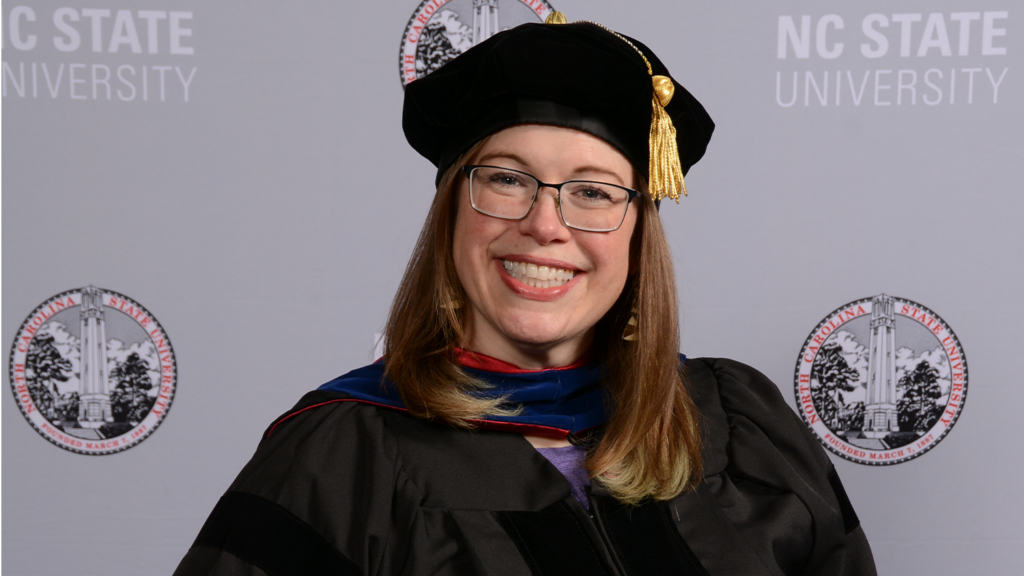
WIth more than two decades of lab experience, Stephanie Teeter ’26PHD knew that scientists love what they do, but often need help communicating that passion with others and in a way that non-scientists can appreciate.
So, she chose to earn a Ph.D. in the Learning and Teaching in STEM science education concentration so she can help scientists share their enthusiasm through outreach efforts as she continues her role as a research technician and lab manager.
Meet Stephanie:
Degree: Ph.D. in Learning and Teaching in STEM Science Education Concentration
Extracurricular activities: I did a lot of outreach activities including participating in the Morehead Planetarium’s Inspiring Meaningful Programs and Communication through Science (IMPACTS) training program, I helped with local science fairs and STEM nights, and I was very active with SciREN (Scientist and Researcher Education Network) and science olympiad.
Dissertation focus: My dissertation research focuses on a professional development tool called Impact Identity that aims to support scientists’ public engagement (outreach) work. Rather than viewing outreach as a series of one-off efforts or something done because they ‘have to,’ impact identity reframes it as something broader that complements their personal and professional interests, and this framework helps scientists to identify and develop these interests.
Why did you choose your degree focus?
I have worked in biology and biomedical engineering research labs for more than 20 years. During that time, I saw a need to support scientists who want to dedicate time and effort to outreach but aren’t sure how. I sought out a program that would let me work with scientists to help them develop this work and be better communicators.
Why did you choose the NC State College of Education?
The College of Education was a great fit because it allowed me the flexibility to be a part-time graduate student and to focus on a topic outside of the classroom (i.e., outside of traditional ideas of education). I also had the ability to connect some of my curriculum requirements and projects to things I was already doing.
What’s next for you after graduation?
After graduation, I’m still in my job in the biomedical engineering department, but my role will be shifting to allow me to do more outreach and education-focused activities that better tap into my interests.