
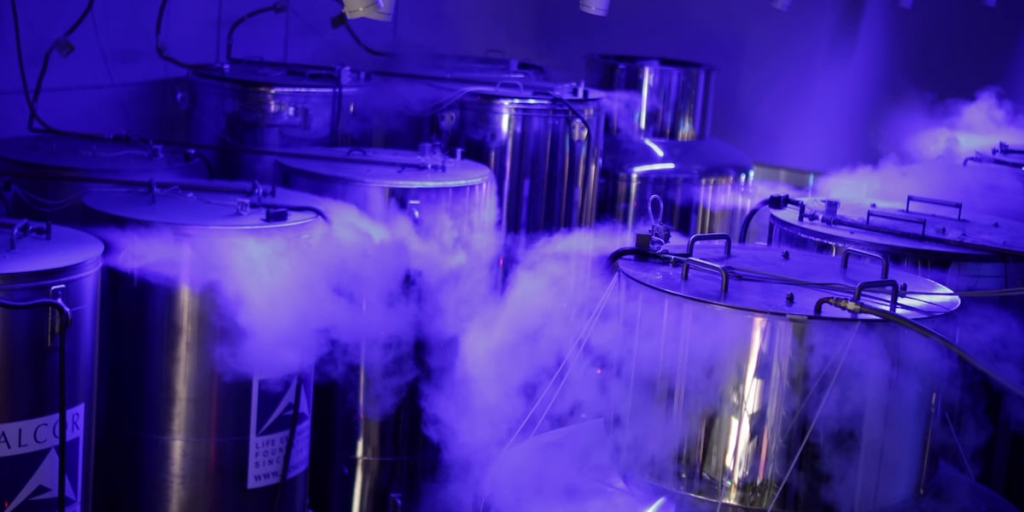
SCOTTSDALE, AZ (AZFamily) — In an unassuming building tucked inside an industrial section of Scottsdale, a small team at the Alcor Life Extension Foundation is working on something that can sound like science fiction: preserving people—and even pets—at ultra-low temperatures with the hope that future medicine may one day be able to repair and revive them.
For Alcor member and author Rick Lemler, the idea isn’t about certainty. It’s about possibility.
“It’s something I choose to believe,” Lemler said. “It’s something I believe in and am willing to gamble.”
Lemler said his fascination with sci-fi goes back to childhood, and now, he’s taken steps to make what once felt like a fantasy part of his real-life plan. He has signed up to be cryopreserved after legal death—joining hundreds of Alcor members whose bodies or heads are stored in large vacuum-insulated containers called dewars.
“Here I am almost becoming a real-life character of my own books,” Lemler said. “So that’s kind of cool.”
“We don’t bring anyone back from the dead”
The concept has long drawn skepticism—and controversy—because of the central question: Are they trying to bring people back to life?
Alcor CEO James Arrowood said that framing misses the point.
“I think the question really is, how does this make any sense,” Arrowood said. “Are we trying to bring people back from the dead? That’s actually a crude understanding of what this is.”
Alcor’s goal is to preserve cells and tissue as intact as possible through a process called vitrification—using chemicals and controlled cooling to prevent the ice crystals that typically form during freezing and can destroy cellular structures. Arrowood said one of the key solutions used, called M22, helps prevent ice from forming inside the tissue.
“In simplest terms, this is sort of a biological antifreeze,” he said. “Just like you put in your car engine, so it doesn’t crack—there’s literally ice outside of this. There is no ice inside of it.”
If vitrification can reliably preserve healthy cells without damage, Arrowood said it could have implications beyond cryonics, particularly in organ donation and transplantation, where time and tissue degradation are constant obstacles.
Rapid response after death
When an Alcor member dies, Arrowood said a specialized response team moves quickly. The team, often referred to as the “DART” team and made up of medically trained personnel, including former military members, begins cooling the body and preparing it for vitrification as soon as legally possible.
From there, Alcor’s internal medical staff continues a process that can take about a week, including replacing blood with preservation solutions and gradually lowering the temperature so the patient can be stored in liquid nitrogen.
Members can choose whole-body preservation or “neuro” preservation, which stores only the head, based on the belief that the structures associated with memory and identity are housed in the brain.
Once preparation is complete, patients are placed inside a dewar, a large container designed to hold liquid nitrogen at roughly -320 degrees Fahrenheit.
A wall of faces and unanswered questions
Inside Alcor, photos of members line the walls. Arrowood said that when Lemler’s time comes, his picture will be added—alongside people from around the world, including one of Alcor’s youngest members: a 2-year-old girl from Thailand who died from brain cancer.
The organization’s history includes high-profile disputes that still circulate online, including legal battles and calls for greater regulation decades ago. Arrowood acknowledges the past but said much of what people cite is old.
“Many of these things are 30 to 40 years old,” he said. “That’s not uncommon anytime you’re in the technology space.”
He said that in more recent years, the conflicts that arise are often tied to logistics and finances—particularly life insurance policies used to fund preservation.
Critics: “Preposterous” promises and major scientific hurdles
Not everyone believes cryonics can deliver what many consumers imagine.
Dr. Arthur Caplan, a bioethicist with NYU Grossman School of Medicine, called the idea of freezing a body, or a head, with the expectation of revival far-fetched.
“If you’re selling something and saying, ‘I can freeze your body. Someday doctors of the future will wake it up,’ or ‘I can freeze your head and someday doctors of the future will wake it up and stick it on another body or a robot’—what I say is preposterous,” Caplan said.
Caplan points to several barriers he believes science has not solved: the freezing process itself, achieving the correct chemical balance for preservation, and then, especially in neuro preservation, figuring out how a brain could function if it were ever removed from storage and placed elsewhere.
“If you were going to sort of take your brain and put it on another body,” Caplan said, “you are going to get signals coming in from the nerves of that body. That the old brain isn’t going to know how to process.”
Still, Caplan said one related goal could become realistic: using advanced preservation to improve organ banking and medical repair.
“Could we get someday to the point where we could freeze a kidney, freeze some cells that could be used to repair the heart? Yes,” he said. “I think that is possible.”
“I don’t know if this will ever work”
Arrowood is blunt about the uncertainty.
“I am the president and I am telling you that I don’t know if this will ever work,” he said. “And it may not work for me at all. In fact, I am perfectly OK with that.”
He compares the gamble to early medical breakthroughs with steps that initially seemed impossible but paved the way for modern medicine.
“The first heart transplant patient knew he would die a week or two later,” Arrowood said. “He did it because 30 years forward, his grandchildren—if they needed a heart—could get one and would live a full life.”
For Lemler, the choice is deeply personal, but rooted in the same idea: that the alternative is final.
Asked whether he fears it may never work, Lemler said he thinks of it differently.
“Concerned,” he said. “I know there is a good chance that it might not. But I don’t feel like I’m losing anything in the bargain here.”
What it costs
Cryonics isn’t cheap. Whole-body preservation typically costs about $220,000, while neuro preservation generally ranges from $80,000 to $90,000.
For those who sign up, it’s an investment in a future that may never arrive but one they hope science can someday reach.
See a spelling or grammatical error in our story? Please click here to report it.
Do you have a photo or video of a breaking news story? Send it to us here with a brief description.
Copyright 2026 KTVK/KPHO. All rights reserved.