
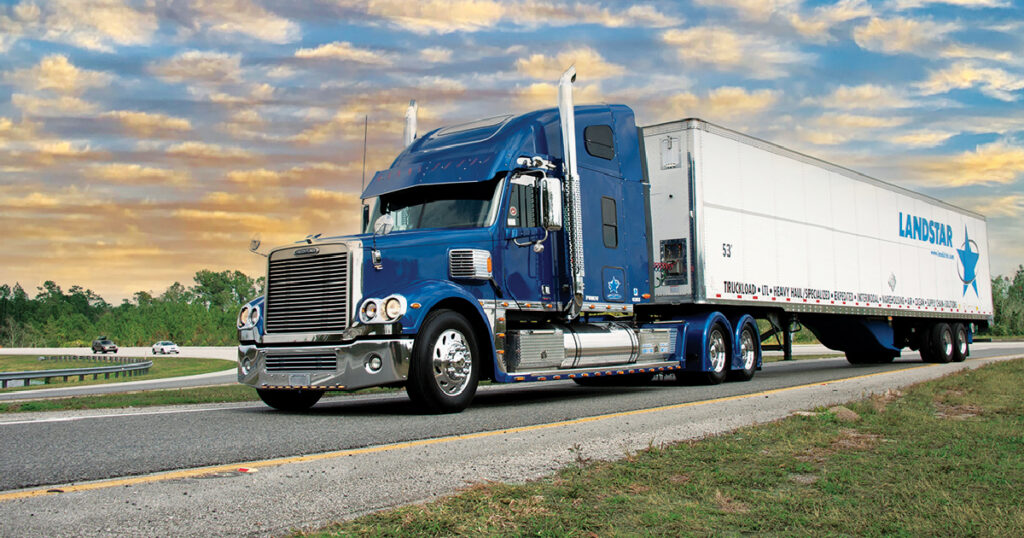
Total revenue increased 1.6% to $1.17 billion from $1.15 billion. (Landstar System via Facebook)
April 29, 2026 1:27 PM, EDT

- Landstar reported April 28 that first-quarter net income rose to $39.4 million, or $1.16 a share, on $1.17 billion revenue.
- CEO Frank Lonegro said AI pilots are producing time savings and throughput gains while tariffs, diesel volatility and cargo theft shape operations.
- Landstar said it is monitoring Middle East conflict, energy prices and trade policy while advancing AI tools with agents and BCOs.
Landstar System navigated artificial intelligence and geopolitical pressures to deliver a first-quarter revenue gain, the company reported April 28.
The Jacksonville, Fla.-based motor carrier posted net income of $39.4 million, or $1.16 a diluted share, for the three months ending March 31. That compared with $29.8 million, 85 cents, during the same time the previous year. Total revenue increased 1.6% to $1.17 billion from $1.15 billion.
“We are excited to discuss our results this quarter given the overall sense of optimism many in our network are sharing with us,” Landstar CEO Frank Lonegro said during a call with investors. “The 2026 first quarter was not without challenges that required our focus and attention. We are driving to incorporate AI into our business and do everything we can to mitigate any perceived industry-specific AI disintermediation risk.”
Federal Motor Carrier Safety Administrator Derek Barrs appeared at a convention for company agents in April. Lonegro noted during the investor call that many of the regulatory initiatives Barrs discussed are having a tangible impact on the trucking industry that has benefited his business. He also noted that AI is becoming a big topic among agents as the company pursues initiatives to implement it.
“We continue to be encouraged by the level of engagement we’re seeing among agents and [business capacity owners] participating in our [AI] beta programs,” Lonegro said. “That collaboration is already yielding tangible progress across a number of workflows.”
Lonegro stressed that the tools are being developed alongside agents and BCOs, with early pilots already in production or advanced testing. The initial feedback, he noted, has pointed to meaningful time savings, higher shipment life cycle throughput and improved visibility across the network, allowing them to spend more time on productive activities.
“We, like everyone else, are monitoring the news on the geopolitical conflict in the Middle East and the related volatility in the energy and diesel prices,” Lonegro said. “We also continue to monitor the potential effect of tariff and trade policy on our business, including the impact of the recent Supreme Court decision and tariff refunds from the federal government.”
Lonegro added that tariffs have already impacted freight loads, with a notable early influence being the front-loading of cargo ahead of expected tariffs during the prior-year quarter. He noted that this contributed to a relatively tough first-quarter volume comparison. He is also paying attention to how these trends impact trading relationships with North American partners.
“The 2026 first quarter also experienced lower insurance and claim cost expense compared to the 2025 first quarter, primarily due to the company’s ongoing efforts to address strategic cargo theft,” Lonegro said. “These efforts helped Landstar to achieve both the decrease in the frequency of cargo claims incidents during the 2026 period compared to the 2025 period as well as decreased severity of cargo claim incidents.”
The results were close to analyst expectations, who had been looking for $1.11 per share and quarterly revenue of $1.18 billion, according to Zacks Consensus Estimate.
Landstar noted in the earnings report that truck transportation revenue hauled by independent BCOs and truck brokerage carriers increased 3.1% to $1.08 billion from $1.05 billion. This represented 92% of revenue and included truckload operations such as van equipment as well as unsided/platform equipment. It also included less-than-truckload and other truck transportation operations.
- Truckload transportation revenue hauled via van equipment increased to $603 million from $595 million.
- Truckload transportation revenue hauled via unsided/platform equipment increased to $369 million from $340 million.
- Revenue from other truck transportation, which is largely related to power-only services, decreased to $87 million from $92 million.
- Less-than-truckload revenue increased to $23.8 million from $22.4 million.
Revenue hauled by rail, air and ocean cargo carriers decreased to $67 million from $83 million during the prior-year period. This represented 6% of total revenue.
Landstar ranks No. 11 on the Transport Topics Top 100 list of the largest for-hire carriers in North America and No. 25 on the TT Top 100 logistics companies list.