
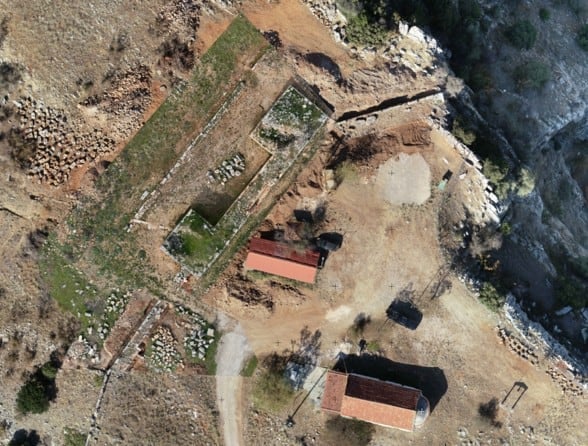
At the archaeological site, which holds a long historical continuity and played a significant role in antiquity, authorities carried out a series of works to stabilise and restore the western section of the fortification walls and the north-western towers, according to an official announcement.
Ancient Pelinna, one of the most important cities of ancient Hestiaiotis, lies approximately 16 kilometres east of Trikala. The city flourished during the late Classical and Hellenistic periods, when the original settlement transformed into an acropolis and the urban centre expanded into the surrounding plain, protected by strong fortifications. Macedonian rule in Thessaly ended after the defeat of Philip V of Macedon in 197 BC. In 191 BC, during the Antiochian War, the Athamanians captured the city, before Roman forces later seized it, leading to its decline. Despite this, the site retained strategic importance during the Byzantine era, when the settlement of Gardikion developed on the acropolis and remained inhabited until the early Ottoman period.
Culture Minister Lina Mendoni said the fortifications of Ancient Pelinna constituted one of the most significant ancient defensive works in Thessaly. She noted that the acropolis formed a monumental complex of exceptional historical and archaeological value, with architectural remains primarily dating to the Hellenistic period.
Mendoni said ongoing interventions by the Ephorate of Antiquities of Trikala ensured the monument’s protection and restoration, fully respecting its authenticity and historical continuity. She added that the works aimed not only to highlight the region’s cultural identity but also to support sustainable development for local communities.
The acropolis, built on a naturally fortified position, is enclosed by trapezoidal walls along its western, southern, and eastern sides. The northern end of the western wall features a strong bastion with two towers and an intermediate section. The central section of the western wall dates to antiquity but includes extensive medieval modifications, requiring specialised and multi-layered restoration.
The programme of works aims to restore the structural cohesion of the remains, address moisture-related damage, stabilise loads and foundations, and preserve all historical phases of the monument. Authorities carried out masonry consolidation, reinforced cracks, partially restored unstable sections, improved drainage, and upgraded the surrounding area.