
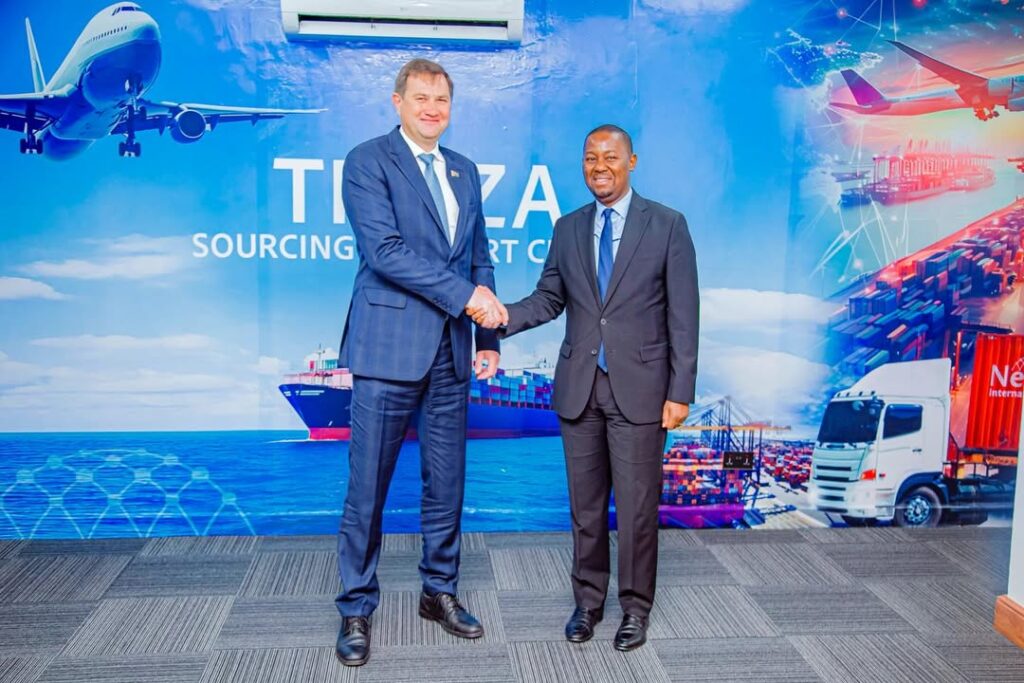
Tanzania’s investment authority has extended a formal invitation to Belarus to explore industrial investment opportunities in the East African nation, signaling growing economic ties between the two countries.
The Director General of the Tanzania Investment and Special Economic Zones Authority (TISEZA), Gilead Teri, met with Belarus Foreign Affairs Minister Maxim Ryzhenkov at the Benjamin Mkapa Special Economic Zone to showcase Tanzania’s industrial potential and investment climate.
During the high-level meeting, Teri highlighted Tanzania’s strategic efforts to create a business-friendly environment, emphasizing the country’s commitment to streamlining procedures for both domestic and foreign investors. He particularly noted the availability of industrial land ready for development projects.
“We have prioritized improving the business environment and simplifying procedures for investors looking to establish operations in Tanzania,” Teri explained during the talks. “The country offers abundant industrial land and favorable conditions that Belarusian businesses would find attractive.”
The meeting represents part of Tanzania’s broader strategy to diversify its investment partners and accelerate industrialization, a key pillar in its economic development plan. The East African nation has been working to position itself as a manufacturing hub in the region, leveraging its strategic location and relatively stable political environment.
Minister Ryzhenkov, who toured the special economic zone facilities, expressed satisfaction with Tanzania’s investment infrastructure. He commended the Tanzanian government’s ongoing efforts to strengthen both physical infrastructure and business systems necessary to support industrial growth.
“What we’ve observed today confirms Belarus’s interest in deepening our cooperation with Tanzania, particularly in industry, trade, and investment sectors,” Ryzhenkov stated after the facility tour. The minister indicated that Belarus sees significant potential in establishing mutually beneficial economic partnerships with Tanzania.
As part of his visit, Ryzhenkov also toured the Tooku Jeans factory, where he observed production processes for export markets. This visit provided practical insights into Tanzania’s manufacturing capabilities and export potential. The minister was accompanied by Tanzania’s Ambassador to Russia, Fredrick Kibuta, and Belarus Ambassador to Tanzania, Dzmitry Krasouski, underscoring the diplomatic significance of the economic discussions.
The timing of this engagement is noteworthy as both countries recently agreed to establish a Joint Trade and Economic Cooperation Commission, creating a formal framework for expanding bilateral economic relations. This commission is expected to identify specific sectors for collaboration and facilitate increased trade volumes between the two nations.
Tanzania’s pursuit of Belarusian investment aligns with its efforts to attract diverse international partners beyond its traditional investment sources. Belarus, known for its expertise in heavy machinery, agricultural equipment, and fertilizer production, could provide technological transfer in sectors where Tanzania seeks to build capacity.
Economic analysts suggest that successful partnerships with Belarus could help Tanzania reduce its technology import costs and develop local manufacturing expertise, particularly in agricultural machinery relevant to Tanzania’s large agricultural sector.
For Belarus, Tanzania represents an entry point into the East African Community (EAC) market of over 177 million people, as well as the broader African Continental Free Trade Area (AfCFTA), which is creating the world’s largest free trade area by connecting 1.3 billion people across 54 countries.
The developing Tanzania-Belarus economic relationship reflects a growing trend of non-traditional partnerships emerging across Africa as countries seek to diversify their economic ties beyond historical colonial and Western connections.